
From February to May 2018, the exhibition ‘Fate Unknown: The Search for the Missing After the Holocaust’ was displayed at London’s Wiener Holocaust Library. The exhibition was co-curated with Professor Dan Stone (Royal Holloway, University of London) and explored the history of the International Tracing Service (ITS). Since then, ‘Fate Unknown’ has been developed into both an online and travelling exhibition. In anticipation of its display at Northumbria University on 15 November 2023, the British and Irish Association of Holocaust Studies spoke to Elise Bath, the ITS Archive Team Manager at The Wiener Holocaust Library, to find out more about the Archive and its enduring legacy.
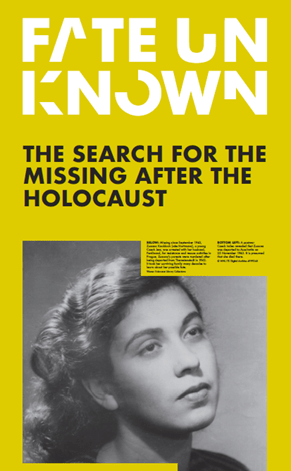
Exhibition poster for the ‘Fate Unknown’ exhibition. Photo courtesy of The Wiener Holocaust Library
Could you briefly describe your role at The Wiener Holocaust Library?
What began as a six-month work placement as part of a (since abandoned) PhD has turned into seven years of employment at the WHL. In the past I have worked here as Photo Archivist and ITS Archive researcher, and am currently the ITS Archive Team Manager. It’s a lovely team made up of three researchers and a community engagement co-ordinator. We use the ITS Archive to carry out research into individual victims of Nazi persecution, support academics wanting to use the archive in their own research, and also deliver events and outreach programmes designed to raise awareness of the archive and how it can be used to benefit Jewish communities and individuals.
What is the International Tracing Service Archive?
The ITS Archive is an incredible collection of over 30 million documents connected with the experience of 17.5 million people during and after the Nazi era. The material is made up of two main categories. Firstly, there are perpetrator records (concentration camp records, deportation lists, bureaucratic material from the Nazis and their collaborators etc.) now repurposed as tools of research, and secondly there is a great deal of post-war material, including records from Displaced Persons’ Camps, emigration documents, compensation claims, and correspondence from survivors trying to locate their missing relatives. The ITS Archive has sometimes been dismissed by academics as “an archive of lists”, which is a total misconception. The research potential of the collection is enormous, both for very granular research looking into what happened to individual victims, but also for investigating much broader thematic themes.
Over the last couple of years, the Library has hosted a pop-up version of the exhibition ‘Fate Unknown: The Search for the Missing After the Holocaust’, as well as workshops on how to use the ITS, in places such as Belfast, Leeds, Edinburgh and Manchester. What has been the public response to the exhibition and the workshop?
We have been delighted with the response to our outreach programme ‘Recovery & Repair; Supporting Jewish Family Histories of the Holocaust in Britain’ which includes display of the Fate Unknown exhibition, presentations from the co-curators, and family history workshops. We have worked with some fantastic institutions around the country, including Linen Hall Library, Holocaust Centre North, Manchester Jewish Museum, Scottish Jewish Archives Centre and many more. We’ve had such a warm welcome, and it has been great to raise awareness of the ITS Archive outwith London and how it can be used both in academic and genealogical work. Feedback has been great, and we have had a spike of enquiries and research requests after each event. We’ll be continuing this outreach work in 2024, in Cardiff, Sheffield and other locations too, so keep an eye out for us!
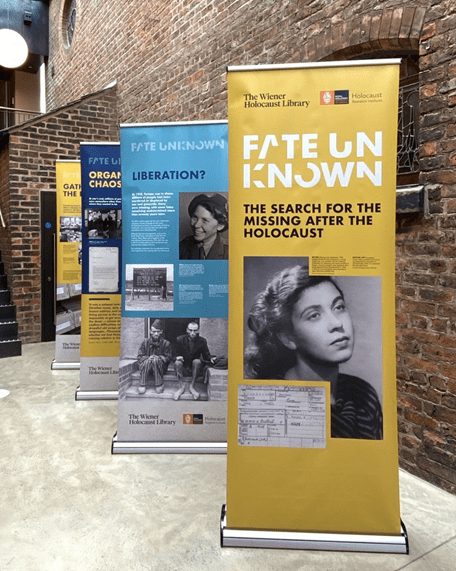
The ‘Fate Unknown’ exhibition on display at Manchester Jewish Museum, May 2022. Photo courtesy of The Wiener Holocaust Library
What have been some of the highlights of your work as the Library’s ITS Archive Team Manager thus far?
Without a doubt the most significant part of my work is working with families to uncover, often for the first time, what happened to their relatives during the Holocaust. Working with survivors in particular can be deeply meaningful. In the last few years, I have had a couple of cases of helping people who survived the Holocaust as children learn the identities of their parents and siblings, information which had previously been totally lost to them. Those were pretty powerful moments. Finding the names of people whose identities had been entirely lost is remarkable. The Nazis succeeded in destroying these people physically, but thanks to research carried out in the ITS Archive, at least their identities and names have not been similarly destroyed.
How do you think the extensive collection of the ITS – much of which is yet to be explored – will shape the field of Holocaust Studies in years to come?
I really hope that the research potential of the ITS Archive becomes more widely known in the coming years. It is a tricky archive to navigate, without a doubt, but the ITS Team at the Library is here to help people access the material it contains in the best way. Professor Dan Stone’s recent work on the ITS and its archive, particularly his recent publication Fate Unknown: Tracing the Missing after World War II and the Holocaust is a great example of the breadth of topics which can be explored using this archive.
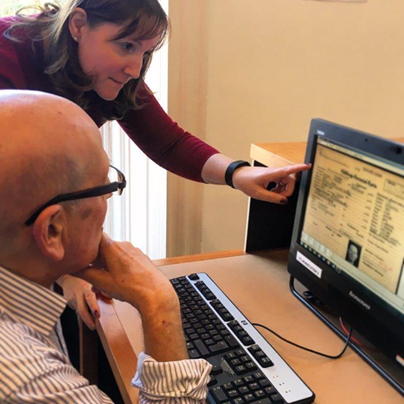
Conducting family history research using the International Tracing Service Archive at the Library. Photo courtesy of The Wiener Holocaust Library
For more information on future events in the ‘Recovery & Repair’ series, locations for the ‘Fate Unknown’ travelling exhibition and the Library’s other upcoming events and exhibitions, please visit the institution’s ‘What’s On’ page or sign up to the Library’s monthly newsletter.
Much of the International Tracing Service Archive is available online via the Arolsen Archives (where the physical collections are kept). If you need assistance with your research, however, or have any family research or academic enquiries relating to the Archive, please contact the Wiener Holocaust Library’s ITS Team.

