
Dr. Isabelle Mutton
Isabelle Mutton (former BIAHS postgraduate representative) completed her PhD at the University of Exeter in 2022. Her thesis examined the Canadian National Holocaust Monument (Ottawa) and the proposed UK Holocaust Memorial and Learning Centre (London) with regard to ideas of sacred space. She has also recently completed an AHRC postdoctoral fellowship at the University of Exeter and is working on publishing her PhD thesis as a monograph.
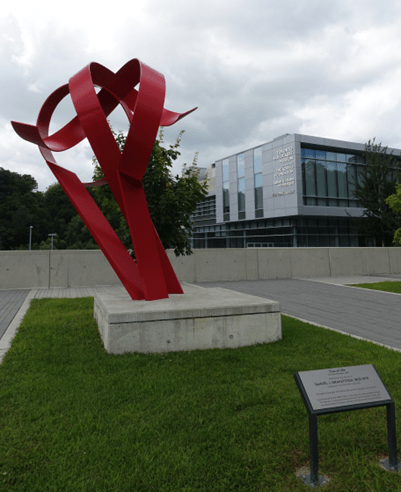
The exterior of the Toronto Holocaust Museum. Author’s own photograph.
Last month, I visited the new Toronto Holocaust Museum (THM). Opened in June 2023, this state-of-the-art, 9,500 square-foot facility replaces the dated Sarah and Chaim Neuberger Holocaust Education Centre which opened in 1985. Situated on a broader campus and within the Sheff Family Building, entering this new museum provided a rather different experience to that of visiting other Holocaust museums around the world. I passed children attending holiday camps, chattering excitedly, and people exercising in the gym facilities, a big glass window enabling me to see in as I ascended the staircase to reach the Azrieli Legacy Hall. Although unusual, this entrance sequence contextualises the museum in a way, particularly its fourth gallery entitled ‘Life in Canada’.
The Azrieli Legacy Hall (the Azrieli Foundation is the museum’s founding donor, contributing $12 million to its development) contains information about the museum, forthcoming events, and pre-war Jewish life. The content on pre-war Jewish life is primarily delivered through a Holocaust survivor testimony station, the first of 11 such stations dotted throughout the museum. These will be discussed in more detail below. I noticed that most visitors did not spend long in this space, keen to be punctual for their designated timeslot and enter the museum proper, set behind glass doors. Apart from one of the films in the theatre which focuses on pre-war Jewish life, there is no further content on this in the museum. Having it in the transitional space of the Azrieli Legacy Hall means that visitors will therefore likely miss out on core information. There could be further material on pre-war Jewish life within both the Hall and the galleries.
On arriving at the ticket desk, the staff were welcoming and friendly, explaining what awaited me and how I could get the most out of my visit. One slight critique would be that they directed me straight to the theatre. If I had followed their advice, as most visitors did, I would have missed some useful information boards. These gave a brief explanation of the Holocaust, why it matters, and what visitors will learn from the museum. There was also a ‘Message from the Curators’, outlining their approach to developing the museum and their hope that visitors will leave with ‘unanswered questions’ and a desire to ‘continue learning about the Holocaust and its ongoing relevance’.
In the theatre, which has seating for 40 visitors, there were two short films showing on the 180-degree screen. These were ‘A Tapestry of Moments: Jewish Life Before the Holocaust’ and ‘Setting the Stage for Genocide: Hitler and the Nazi Rise to Power’. The first film includes photos and video footage of pre-war Jewish life across Europe and North Africa, overlayed with music, for example, A Good Week sung in Yiddish by Adrienne Cooper, sounds of children playing and sounds of livestock. The second film, ‘Setting the Stage’, similarly features contemporaneous photos and video footage but has a narrator explaining the Nazi rise to power, antisemitism, Social Darwinism, and views at the time (including in Canada) on theories such as selective breeding.
Upon exiting the theatre, I entered the first of the four galleries. The galleries are entitled Persecution, Atrocity and Devastation, Liberation and Aftermath, and Life in Canada. All similar in design, they – like other Holocaust museums – feature photographs, text, and artefacts. Some of these materials are presented in horizontal and vertical drawers. Other interactive features include digital timelines and maps, which, the museum website explains, ‘encourage visitors to dive deeper into the history of the Holocaust by presenting opportunities to explore space, time and geography’.[1]

The Final Gallery: Life in Canada. Author’s own photograph.
The feature that stood out in particular was the ‘survivor testimony stations’ throughout the galleries. These hold videos of survivor testimony (220 minutes across the 11 stations), some from the archives and others recorded specifically for the museum using augmented reality. The testimonies are grouped thematically based on the content of that part of the museum (e.g. about liberation, Nazi propaganda etc.), and then into specific questions, such as ‘What were your first impressions of your liberators?’ and ‘Where did you go after liberation?’ For each question there are a number of testimonies to choose from. In addition to watching the testimonies (each clip between 30 seconds and 3 minutes), there is also an opportunity to read each survivor’s biography and learn more about three artefacts relating to them. These usually include photographs of pre-war Jewish life and post-war life in Canada. As I moved through the galleries, I found myself selecting the more recently recorded testimonies over the archival footage. The way in which they were filmed and presented making them more life-like and engaging.

One of the Survivor Testimony Stations in the Persecution Gallery. Author’s own photograph.
Another feature that I particularly liked was the ‘Meanwhile, in Canada’ information panels in the first three galleries. These give information about what was happening in Canada before, during and after the Holocaust. The text includes reflections on the Canadian Jewish community and some of the challenges facing them, such as antisemitism. They also address the treatment of other groups in Canada, notably Indigenous Peoples. On each panel is an image of a primary source, for instance a November 1942 article in Canadian newspaper The Globe and Mail which carried the headline ‘2,000,000 Jews in Nazi Europe Are Slain on Order of Hitler’. Although the space restrictions mean that this information cannot be comprehensive, it nevertheless offers a useful opportunity to consider Canada’s history in a fairly critical way.

The ‘Meanwhile, in Canada’ information panel in the Liberation and Aftermath Gallery. Author’s own photograph.
Nestled in between the final two galleries is ‘The Memorial’, a small room with floor-to-ceiling images of a forest landscape covering the walls. Superimposed on the images are the names of some of the individuals murdered and communities destroyed during the Holocaust. Gentle sounds of birdsong fill the space. There is a wooden bench in one corner and an information panel explaining the design of the memorial and its significance. The forest imagery is described as a way of referencing both the events of the Holocaust that took place within European woodlands and, simultaneously, Canada’s own natural landscape.

The Memorial. Author’s own photograph.
Unlike the National Holocaust Monument in the country’s capital city of Ottawa, opened in 2017, the THM does not function or indeed, I would suggest, attempt to function as a national site. Furthermore, although it did receive funding from both the federal and provincial governments, the museum is not a government project in the same way. As a result, it does not appear to have been weighed down by trying to articulate a national narrative of Holocaust commemoration. It has what feels like a greater freedom, including to have the local specificity that it does. The Montréal Holocaust Museum is also undergoing a relocation and redevelopment, due to be completed in 2025. It will be interesting to compare the two museums in this regard and analyse their relationship over time.
Turning away from Canada for a moment, one cannot help but wonder if those designing the learning centre component of the proposed UK Holocaust Memorial and Learning Centre (UKHMLC) should take note of what has been achieved in Toronto. It is no secret that the proponents of the London site want to focus on Britain’s Holocaust history. The THM offers, I think, an example of how to focus on national Holocaust history in a way that is celebratory where appropriate, but also honest and critical. In addition to the aforementioned ‘Meanwhile, in Canada’ panels, there is also information about the post-war struggles faced by survivors, rising antisemitism, Holocaust denial, and war criminals in Canada, for example. If following the THM in this regard, the UKHMLC could address similar themes. ‘Meanwhile, in the United Kingdom’ panels could include information about the treatment of minorities at the time and engender meaningful engagement with Britain’s colonial history.
Overall, the Toronto Holocaust Museum feels ambitious but not to its detriment. It is aware of its context, fulfilling that brief well. I cannot speak to how student groups (the museum’s primary audience) engage with this space and whether the educational programming is effective. However, for me as an average visitor on a Monday afternoon, albeit one with an above average knowledge of the Holocaust and interest in Holocaust memorials and museums, I thought that there was a lot that this museum did well. It has completely transformed and improved the previous provision and is welcome addition to the museum scene in Toronto.
For more information about the museum, see: https://torontoholocaustmuseum.org/
I am grateful for the South, West and Wales Doctoral Training Partnership for making my visit to the THM possible.
[1] Toronto Holocaust Museum, ‘Exhibition Highlights: Interactive Timelines’, https://torontoholocaustmuseum.org/exhibition/exhibit-highlights (accessed 13 September 2023).
 The British and Irish Association for Holocaust Studies