
By Phyllis Zimbler Miller
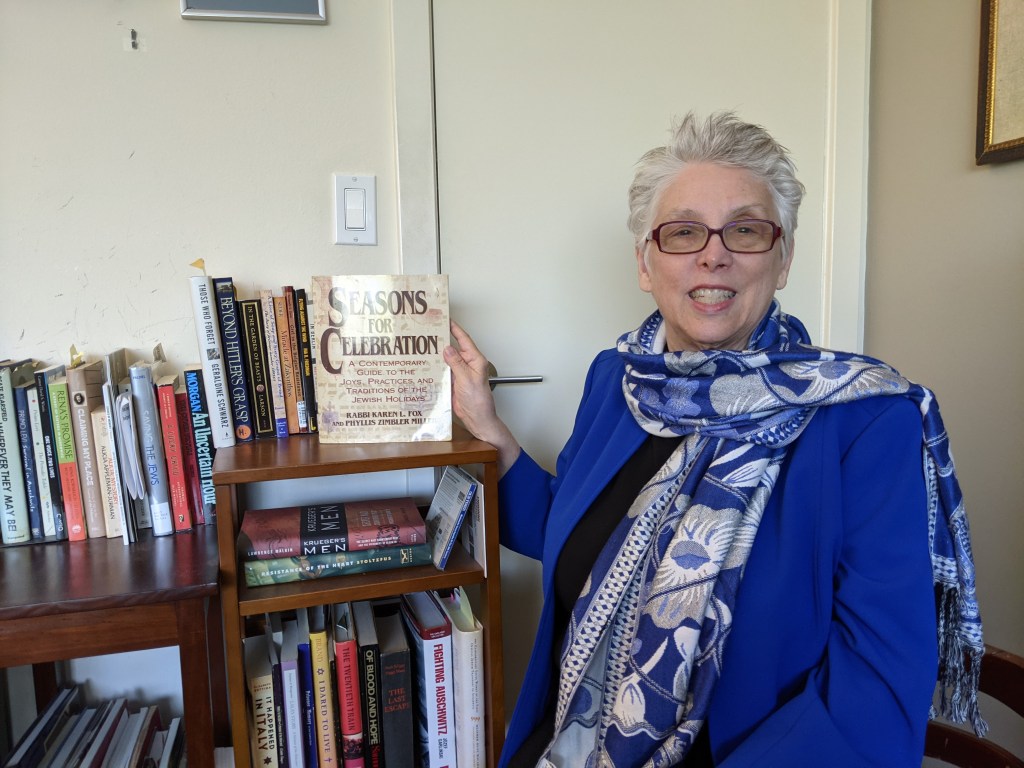
Phyllis Zimbler Miller is a screenwriter, playwright and published author in Los Angeles whose free nonfiction theater project www.ThinEdgeOfTheWedge.com has been developed to combat anti-Semitism and hate while encouraging critical thinking. She is also the co-author of the Jewish holiday book SEASONS FOR CELEBRATION.
Definition of “thin edge of the wedge”: A minor harmful change that starts a chain of more and more changes resulting in dangerous consequences.
How many times a day or a week can we read about acts of anti-Semitism or hate against individual Jews, Jewish schools, Jewish cemeteries – and the list goes on and on – without doing anything about these acts?
Saying how terrible these acts are and seeking the perpetrator isn’t enough. We must do something.
And that something I believe is educating people about how the Nazis’ systematic fanning of the flames of anti-Semitism led to the horrific murder of six million Jews and millions of others including Romani, political dissidents, disabled, Jehovah’s Witnesses, and homosexuals.
Yet how to educate in a way so compelling that especially both the hearts and minds of young people are engaged?
Theatre! Yes, theatre – whether it be viewing a theatre performance or taking part in a theatre performance – and then having accompanying discussions and additional learning opportunities.
This brings me to my free nonfiction theatre project: www.ThinEdgeOfTheWedge.com to combat anti-Semitism and hate.
The background of this current project starts in 1970:
In September 1970 my husband of one year, Mitchell R. Miller, Second Lieutenant, U.S. Army, and I were stationed in Munich, Germany. The first people to befriend us were the Orthodox Jewish chaplain and his wife.
A few months later when he and his wife were rotated back to the U.S. my husband became the lay leader of the miniscule U.S. Army community in Munich. (Because of the upcoming Munich Olympics in 1972 many of the U.S. Army’s units had already been moved out of Munich.)
To make a long story short:
We two American Jews of families directly untouched by the Holocaust spent our limited travel budget visiting sites of Jewish heritage in Western Europe. (We both had security clearances so we could not travel to Eastern Europe during the Cold War.) We decided that the only thing we personally could do regarding the tremendous loss of Jews from the Holocaust was to keep kosher upon our return to the U.S. and become more observant Jews.
Then upon our return I became an editor and reporter at the weekly newspaper the Jewish Exponent in Philadelphia in charge of the monthly literary supplement. Because of my living in Germany only 25 years after the end of WWII, I sought out firsthand accounts of Holocaust survivors and saviors to publish.
In addition, I had the privilege of personally interviewing important Holocaust-connected people on their book tours – such as rescuer Ruth Kluger (her book THE LAST ESCAPE written with Peggy Mann) and Nazi exposer Beate Klarsfeld (her book WHEREVER THEY MAY BE!).
Fast forward to approximately two years ago:
I mentioned to a writing friend of mine here in LA – children’s book author Susan Chodakiewitz – that I felt badly that the firsthand accounts I had published in the 1970s would be lost to history (I had given copies to the Holocaust archives at Chapman University in California) because these accounts were published before the internet.
She said, “Write a play.” I did, and then rewrote it, and rewrote it (with her dramaturg assistance). Then the project grew to being much more than simply the play. (In February before the lockdown in Los Angeles we held a pilot program at the Museum of Tolerance.)
As of this writing a long-time Los Angeles casting director/acting coach is casting a professional cast for a pro bono Zoom stage reading recording of the play. And most exciting to me – a German gymnasium history teacher in Heidelberg (whom I met on a Zoom sci fi meetup) – has generously paid to have a professional translation of the play into German. (See http://www.phylliszimblermiller.com/german-translation/)
THIN EDGE OF THE WEDGE:
The play THIN EDGE OF THE WEDGE is for both adults and students, and it is completely nonfiction and has 11 roles in which no role interacts with another role. The individual roles and their material – including the roles of Holocaust saviors and survivors – can be found at http://www.phylliszimblermiller.com/individual-roles/
While the play in its entirety may run up to 90 minutes, it might be easier to utilize the play in parts, especially depending on what aspect of WWII and Holocaust history is the focus.
The project’s goal is to learn from the past and then apply critical thinking skills to the present, including encouraging people of all ages to speak up against anti-Semitism and hate.
The Nov. 23, 2020, review in The London Magazine features the YA novel THE ASSIGNMENT by Liza Wiemer based on a true incident in Oswego, New York, in 2017 in which two non-Jewish high school seniors spoke up against a reprehensible assignment. It is this kind of “speaking up” that the THIN EDGE OF THE WEDGE project aims to encourage.
Here are two testimony excerpts from THIN EDGE OF THE WEDGE:
JUDITH (survivor)
I was eight years old, the youngest of three children, when the Russians occupied my hometown in Lithuania at the start of World War II. My father had died in 1938. He had not lived to see the Nazis invade Western Poland, followed by the Russians occupying Eastern Poland.
The Russians now occupying Lithuania sent a whole school class away for two weeks in the summer to help us learn to become good Communists. I was away at this camp when the Nazis marched into Lithuania in June of 1941. The non-Jewish children at camp were informed that no harm would come to them. We Jewish children were immediately separated from our non-Jewish friends.
One evening a counselor woke me to find a strange man standing above me and holding out a letter in Yiddish from my mother.
“Dearest Daughter: I have given this man my diamond ring in exchange for bringing you home. You must obey him completely.”
He put me into an empty sack and filled it with hay and potatoes. He warned me that making a sound could cost my life as well as his. Then he drove his horse and wagon all night. Every time the wagon stopped, I felt that this was the last breath I would ever take. When we arrived at his house, he tied me up in the basement to ensure I would not run away.
When we finally reached my home, my mother hugged me and broke out crying.
Later we heard that all the Jewish children who had been at Russian summer camp with me had been shot by the Nazis.
POLISH COUNTESS (savior)
During World War II my husband, Count Stefan Humnicki, and I were allowed to remain on our estate in Poland. The Nazis had taken over much of the private property in Poland, yet they allowed my husband to keep his land to provide for the Germans. When a request was made to grow vegetables and we did not have enough workers, a German officer agreed to assign Jews to do the work.
In late November of 1942 the Nazis came for the Jews working on our estate. In the early hours of a cold and frosty morning, some Nazis– aided by the Polish police from a nearby village — unexpectedly came with a number of farm carts. Shouting and cursing, the armed men broke down the door and dragged, pushed and herded the men, women and children on the waiting carts.
One of my trusted employees inspected the former quarters of the Jewish workers and found a young Jewish boy hiding in the bread oven. We persuaded the child of 10 or 12 years to come out from his hiding place. When he saw me with tears in my eyes, he said quite calmly, “Please don’t cry. I know I must die.”
PHYLLIS (POV role)
German Lutheran pastor Martin Niemoeller was imprisoned during the war in Sachsenhausen and Dachau concentration camps. He is credited with saying: “First they came for the Socialists, and I did not speak out — because I was not a Socialist. Then they came for the Trade Unionists, and I did not speak out — because I was not a Trade Unionist. Then they came for the Jews, and I did not speak out — because I was not a Jew. Then they came for me — and there was no one left to speak for me.”
Some people say that I am obsessed with the Holocaust. Am I? Or am I obsessed with the thought that these horrific crimes against humanity can happen again — anywhere — anytime — to any group of people?
All it takes is allowing the thin edge of the wedge to grow so wide until … there is no turning back.

In addition, country partners are being sought for this pro bono project:
While this is a completely pro bono project, I am looking for country partners who would consider sponsoring short play competitions in their own countries (and their own languages) to feature their country’s saviors and survivors. More information is at http://www.phylliszimblermiller.com/seeking-country-partners/
And I’d be happy to email a copy of the play in English or in German to anyone – contact me at pzmiller@gmail.com – or have a zoom conversation of how this project might be used to educate young people and adults.
 The British and Irish Association for Holocaust Studies