By Mie Astrup Jensen and Robert Thompson
Mie Astrup Jensen is an ESRC funded PhD researcher in Gender and sexuality studies and Hebrew and Jewish studies, University College London (UCL). She researches lesbian, bi, and queer Jewish women’s lived experiences in England and Israel. Robert Thompson is a Wolfson Foundation PhD Scholar in the Hebrew and Jewish Studies Department, UCL. He researches Christian encounters with Holocaust survivors in post-war Germany.
Elie Wiesel once remarked: ‘You hear me say occasionally that there must be light at the end of the tunnel. I believe that in those times there was light IN the tunnel.’[1] It is an apt starting point for Holocaust Memorial Day 2021, the theme of which was ‘be the light in the darkness’.
Aspects of the history of the Holocaust which are surely overwhelmed by stories of darkness concern our own research into LGBTQ+ Jewish people’s contemporary lived experiences, and into Christian-Jewish interaction after the Holocaust. The histories of the Nazi persecution of LGBTQ+ people and of Christian responses to Nazi antisemitism are histories that have not been given due scholarly or popular attention, and which challenge any wholly redemptive story of light in the darkness of the Holocaust. Whilst we note the liberation of homosexuals from the concentration camps, thousands were afterwards imprisoned under Paragraph 175 and many remained silent due to the ‘pink triangle stigma’. It is thus, only in the last couple of decades that we have started to learn about LGBTQ+ experiences. Similarly, whilst it is common in Holocaust commemoration to celebrate the Christian Righteous among the Nations, it is rarely mentioned that the Holocaust was nevertheless perpetrated by people who were mostly baptised Christians. Considering the complexity of these histories, how helpful is it to speak of light in the darkness?
Our respective research suggest that survivors’ and eyewitness’ continuing confrontation with the darkness of their experiences encourages an appreciation of the intertwined light and darkness in these histories. By remembering the complexities of lived experiences of the Holocaust, memory, history, and contemporary commemoration can all act to shine a light on the reality of Nazi persecution.
The Pink Triangle: bringing light to homosexual experiences
While recent scholarly research has brought some LGBTQ+ voices to light, there is generally less awareness of their lived experiences.[2] That is why it is important to remember LGBTQ+ Holocaust experiences. The LGBTQ+ scene in Berlin was thriving in Weimar Germany; things, however, changed when the Nazis came to power. The Nazi Party banned gay organisations and bars in 1933. They also burned down the Institut für Sexualwissenschaft (the institute for sex research) and books about non-heterosexual and gender non-conforming people.[3]
An important element to understanding the persecution of LGBTQ+ people is the gendered dimension since homosexual men were significantly more targeted than lesbians. More than one million German gay men were targeted, more than 100,000 were arrested, and between 5,000-15,000 died in the concentration camps. Paragraph 175 (the law that criminalised male homosexuality – it did not recognise female homosexuality), was not abolished following the liberation of the camps. In fact, West Germany used the Nazi’s ‘pink list’ to arrest gay men.[4]
Due to widespread homophobia, gay men experienced harsh conditions within the concentration camps. Homosexuals were treated as deviants and seen by many as the lowest group within the prisoner population. Some were beaten to death by fellow inmates. They often worked hard labour assignments – and usually longer than other prisoners. This was because many Nazis believed they could, via hard labour—such as work in cement plants—’re-educate’ them to become heterosexual. Accounts also suggest SS soldiers used the pink triangles on gay men’s uniforms as aims for target practice. Nazi scientists experimented on gay men in perverse attempts to find a cure, and many were castrated. It is estimated that 60 per cent of homosexual men died in the camps. Many survivors continued to be discriminated against after the war and many remained silent precisely because they had been pink triangle prisoners.[5]
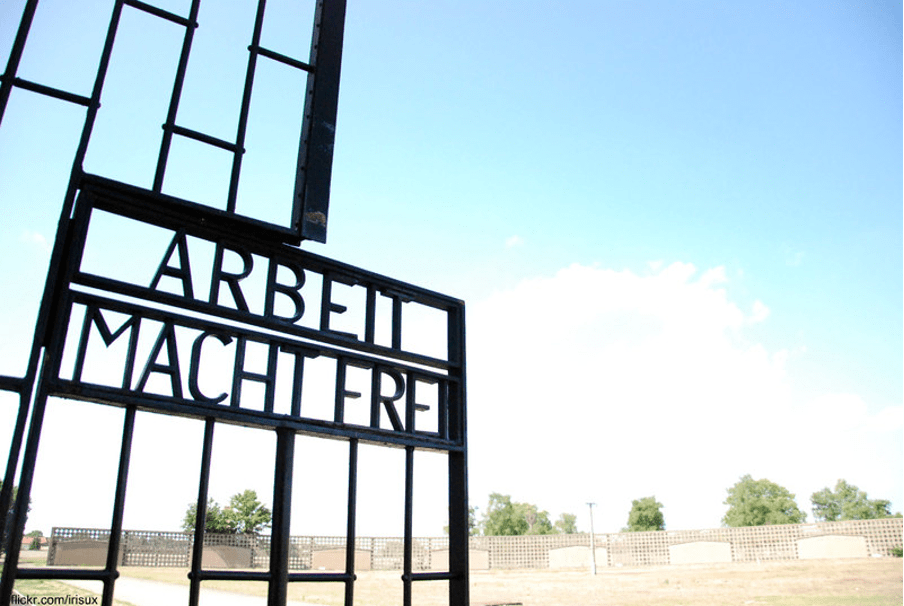
There are many testimonies about homosexuals’ experiences in the camps. One is Grune’s story. Richard Grune[6] (1903-1983), an artist residing in Berlin, was arrested under Paragraph 175 in 1934. He spent the majority of the next eleven years in camps in Lichtenburg, Sachsenhausen, and Flossenbürg. In Sachsenhausen, most gay men were imprisoned in the so-called ‘sissy block’ (Block 35) where they were not allowed to mix with other prisoners. In this block, they were subject to overt discrimination from the guards. Grune managed to escape Flossenbürg a month before the Nazis evacuated the camp. He fled to Kiel to live with his sister and then moved to Spain. He returned to Germany shortly before he died in 1983.
It can be hard to find any light in this story. And yet, Grune’s post-war response shone light into the darkness of his experience. Following a decade of imprisonment, Grune bravely decided to bring awareness to the horrors of the concentration camps. In 1947, he published Passion des XX. Jahrhunderets (Passion of the Twentieth Century). This portfolio, showing some of the darkest moments – the terror, torture, dehumanisation, and crimes – of the Nazi concentration camps became one of the first and most important visual recordings of the Holocaust. Art, such as visual representation, has the ability to humanise lives. We see glimpses of lived experiences rather than merely read a statistic. More importantly, art preserves memories beyond death. It is both a reminder of the experiences of homosexuals under Nazi persecution, and a continuing challenge to preserve the realities of these histories.
Similarly, interrogating the complexity of Christian-Jewish interaction following the liberation of the camps is another case where post-war memory is a defiant light shone into an otherwise overwhelmingly dark experience.
A Catholic Army Chaplain at Nordhausen
One example, neglected by historians thus far, is the story of the Christians who encountered Jewish survivors in the liberation of the camps and in the months of relief work which followed. They include Christian clergy who were chaplains to the military units which discovered the camps and the hospitals which cared for the victims.[7]
January 27th was selected as the date for Holocaust Memorial Day because it marks the anniversary of the liberation of Auschwitz-Birkenau in 1945. Many more camps would be liberated by Allied forces in the months which followed.
Fr Edward Doyle was a Roman Catholic Dominican priest from Providence, Rhode Island, who, with medical personnel of the 104th US Infantry Division, entered Nordhausen—or Mittelbau-Dora—concentration camp, a satellite of Buchenwald, on 12 April 1945. Though Fr Doyle helped with the care of the some 1,000 survivors, there is little that could be termed ‘light’ in the black-and-white and sepia photographs Fr Doyle captured of the corpses of the 5,000 unburied victims. When, in 1981, he gave his testimony at the International Liberators’ Conference in Washington D.C., organised by Elie Wiesel and the United States Holocaust Memorial Council, Fr Doyle shared the reason why he felt compelled to share his story of liberation: ‘I haven’t forgotten. And as a priest at the altar of God, I will not forget.’[8]
It is a Christian image, perhaps. But Doyle did not neglect awareness of the Jewish identities of the vast majority of the Nazis’ victims.[9] His testimony is evidence of a person whose faith was irrevocably changed by his encounter with survivors of the Holocaust. Fr Doyle spent the last fifteen years of his life telling audiences, both Christian and Jewish, about his experience at Nordhausen. He regularly attended the annual interfaith commemoration of the Holocaust at his local synagogue, Temple Emanu-El. In 1988 he was invited to light that ceremony’s seventh candle ‘in honour of the righteous of all nations’.[10]
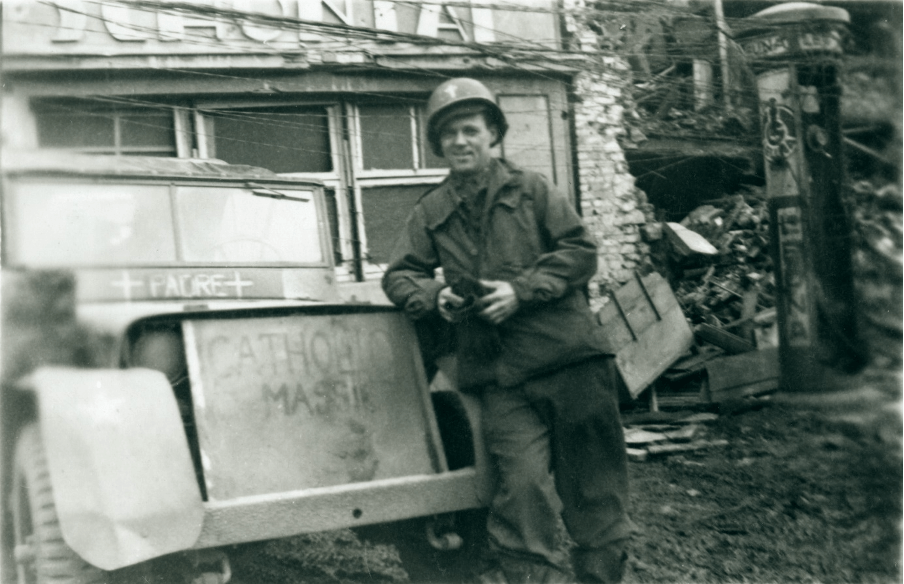
The light in the darkness of Fr Doyle’s experience at Nordhausen is certainly not a simple story of redemption. Fr Doyle never attempted to find an easy explanation for the horrors which remained in his memory. However, neither did he allow himself to forget their reality. Memory which persists despite all the mistruths which assault it, or which is challenged but which does not remain silent, a memory that is shared so that others might, too, remember: that can surely be called a light which Fr Doyle lit in the darkness of his recollections. His recorded testimony—like Richard Grune’s visual portfolio—is evidence which cannot be extinguished.
This is also, we believe, the very reason candles are lit on Holocaust Memorial Day: to remember intertwined light and darkness both in the tunnel, at its end, and in memories preserved for the future.
[1] United States Holocaust Memorial Museum, ‘Elie Wiesel: Days of Remembrance Excerpts’ <https://encyclopedia.ushmm.org/content/en/article/elie-wiesel-days-of-remembrance-excerpts> [accessed 25 January 2021]
[2] For resources on sexuality and the Holocaust please see: https://sexualityandholocaust.com/bibliography-sexuality/
[3] The National Holocaust Centre, ‘Homosexual Victims of Nazi Persecution’, [n.d.], <https://www.holocaust.org.uk/news/homosexual-victims-of-nazi-persecution> [accessed 25 January 2021]
[4] Biedroń, ‘Nazim’s Pink Hell’, [n.d.] Memorial and Museum: Auschwitz-Birkenau, <http://auschwitz.org/en/history/categories-of-prisoners/homosexuals-a-separate-category-of-prisoners/robert-biedron-nazisms-pink-hell/> [accessed 25 January 2021]
[5] Cuerda-Galindo, Esther et al. “Study of deaths by suicide of homosexual prisoners in Nazi Sachsenhausen concentration camp.” PloS one vol. 12,4 e0176007. 20 Apr. 2017, doi:10.1371/journal.pone.0176007
[6] National Education Union, ‘Richard Grune’, [n.d.] <https://neu.org.uk/media/2846/view> [accessed 25 January 2021]
[7] Robert Thompson, ‘“The true physicians here are the padres”: British Christian Army Chaplains and the Liberation of Bergen-Belsen’ (unpublished MA thesis, University of Southampton, 2019).
[8] United States Holocaust Memorial Museum, ‘Chaplains Panel’ [1981] <https://collections.ushmm.org/search/catalog/irn1002699> [accessed 25 January 2021]
[9] United States Holocaust Memorial Museum, ‘Oral history interview with Edward Doyle’ [1986] https://collections.ushmm.org/search/catalog/irn87396 [accessed 25 January 2021]
[10] Providence College Archives and Special Collections, Rhode Island. Father Edward Doyle O.P. Collection, ‘Service Honors Holocaust Victims’ [n.d.] < https://dpml.providence.edu/islandora/object/provc.pml%253Adoyle> [accessed 25 January 2021]
[11] Providence College Archives and Special Collections, Rhode Island. Father Edward Doyle O.P. Collection <https://dpml.providence.edu/islandora/object/provc.pml%3A485> [accessed 25 January 2021]

