Online Lecture Series 2025
Dr Eran Zohar, A Journey After Jewish Heroes: Reflecting on Eight Years of Research in Poland
Book Launch: Davies, Peter, Holtschneider, Hannah, Jelen, Sheila E., and Thonfeld, Christoph. 2025. Olga Lengyel, Auschwitz Survivor: Interdisciplinary Explorations. Palgrave Macmillan
Dr Aline Legeyda (Newcastle University/VN Karazin Kharkiv National University), Ethics. Aesthetics. Spectatorship. Authenticity: Exhibition and Creative Practice-As-Research
Dr Peter Morgan (Wiener Library), The Wiener Library Education Programme
Dr Robert Thomas (Cardiff University), Tourist and Tour Guide Acts of Moral Blindness: Sensemaking at Auschwitz-Birkenau and Nuremberg
Online Lecture Series 2024
Dr Hannah Wilson (University of Leicester), North East England and the Holocaust: Sites of Jewish Refuge and Recollection
Dr David Tollerton (University of Exeter), Navigating Holocaust Comparisons
Online Lecture Series Spring 2023
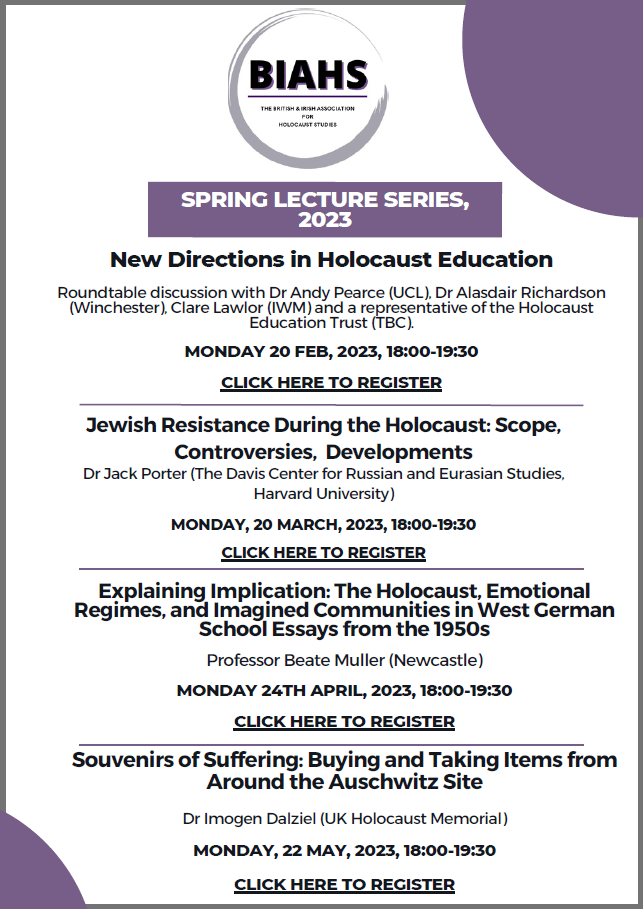
Dr Imogen Dalziel (UK Holocaust Memorial), Souvenirs of Suffering: Buying and Taking Items from around the Auschwitz Site
Professor Beate Müller (Newcastle University), Explaining Implication: The Holocaust, Emotional Regimes, and Imagined Communities in West German School Essays from the 1950s
Dr. Jack Porter (The Davis Center for Russian and Eurasian Studies, Harvard University), Jewish Resistance During the Holocaust: Scope, Controversies, Developments
New Directions in Holocaust Education: Roundtable discussion with Dr Andy Pearce (UCL), Dr Alasdair Richardson (Winchester), Clare Lawlor (Imperial War Museum), Clementine Smith (Holocaust Educational Trust) hosted by Dr Hannah Wilson (BIAHS)
Erin McGlothlin, Thinking About Perpetrator Trauma in Holocaust Studies
Online Lecture Series Autumn 2022
Dr Alasdair Richardson (Winchester), Christmas at Auschwitz: the Nazis and the Persecution of Catholic Clergy at Auschwitz and Dachau
New Directions in Holocaust Literature: Roundtable discussion with Professor Stephanie Bird (UCL), Professor Robert Eaglestone (Royal Holloway), and Professor Sue Vice (Sheffield)
Dr Dominic Williams (Northumbria University): Filming Auschwitz in Yugoslavia: The Heavenly Squad
‘A Hungarian Jewish Woman’s Story’ with Dr Agnes Grunwald-Spier MBE, Holocaust Survivor, JP, MA, HonDart, Hon.LittD
July 2022
Teaching Difficult Histories
Monday 25th April 2022
Diversity of Religious Responses to the Holocaust
Prof. David Tollerton (University of Exeter), Dr Isabel Wollaston (University of Birmingham) and Dr Barbara Krawcowicz (Jallegonian University, Krakow) with Lucinda Armstrong (University of Oxford) as chair.
Thursday 16th December 2021
For the third event in the British Association for Holocaust Studies postgraduate events series, we will hear from Dr Andy Pearce from the UCL Centre for Holocaust Education to discuss Holocaust Consciousness in Britain: A Response to the Claims Conference Survey.
Released in November 2021, the Claims Conference survey found that the majority (52%) of all respondents did not know that six million Jews were murdered and 22% thought that two million or fewer Jews were killed during the Holocaust. Further, a majority of U.K. respondents (57%) believe that fewer people seem to care about the Holocaust today than they used to, and 56% believe that something like the Holocaust could happen again today.
You can read the report here
Thursday 18th November – James Bulgin IWM Holocaust Galleries Talk
These galleries bring unseen objects, untold stories and unheard voices together. They use the most up-to-date research and technology to help visitors understand the most devastating conflict in human history and the genocide that became known as the Holocaust.
Alongside the new galleries, world-class learning and event suites enable visitors to explore this defining period of the 20th century beyond the galleries, making use of new learning resources and programmes to understand how the conflict shaped the world we all live in today.
The new galleries explore three core themes of persecution, looking at the global situation at the end of the First World War; escalation, identifying how violence towards Jewish people and communities developed through the 1930s; and annihilation, examining how Nazi policy crosses the threshold into wide-scale state-sponsored murder in the heart of twentieth century Europe.
By robustly interrogating the identity of the perpetrators, the galleries explain who was responsible for these crimes, what motivated them and how ordinary they often were in every other way.
Thursday 28th October – Dr. Alex Kay Book Talk
This book as been described as the first comparative, comprehensive history of Nazi mass killing – showing how genocidal policies were crucial to the regime’s strategy to win the war.
Nazi Germany killed approximately 13 million civilians and other non-combatants in deliberate policies of mass murder, mostly during the war years. Almost half the victims were Jewish, systematically destroyed in the Holocaust, the core of the Nazis’ pan-European racial purification programme.
Alex Kay argues that the genocide of European Jewry can be examined in the wider context of Nazi mass killing. For the first time, Empire of Destruction considers Europe’s Jews alongside all the other major victim groups: captive Red Army soldiers, the Soviet urban population, unarmed civilian victims of preventive terror and reprisals, the mentally and physically disabled, the European Roma and the Polish intelligentsia. Kay shows how each of these groups was regarded by the Nazi regime as a potential threat to Germany’s ability to successfully wage a war for hegemony in Europe.
17th December 2020
An Evening with Dorit Oliver-Wolff (BEM) – “Pop Star, Pin-up and Holocaust Survivor”
30th November 2020
“After the War: Auschwitz to Ambleside” : A Roundtable with children’s Author Tom Palmer, Trevor Avery of the Lake District Holocaust Project and Helen McCord of the UCL Centre for Holocaust Education
(Hosted by Hannah Wilson & Elizabeth Kendrick, 30th November 2020)
In this dynamic online event, our guest speakers shared their experiences of working on Holocaust education for primary and younger audiences. They reflect on the work of their own institutions, as well as their methods of research and interaction with testimonial sources and authentic stories of those who survived. The discussion centres around Tom Palmer’s recent children’s book “After the War: Auschwitz to Ambleside”, and concludes with a Q&A session (please note that the introduction is missing from this recording, so dives straight in with discussion from Tom Palmer).
26th September 2020
A Lecture Evening with Professor James E. Young – The Stages of Memory: Reflections on Memorialisation and Global Commemoration.
(Hosted by Hannah Wilson & Elizabeth Kendrick)
25th/26th June 2020
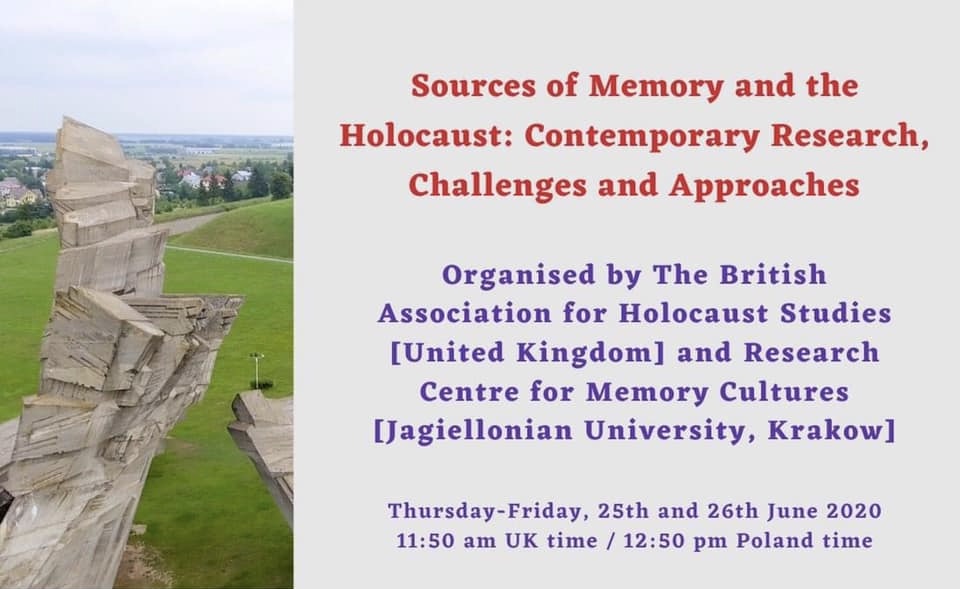
Sources of Memory and the Holocaust: Contemporary Research, Challenges and Approaches – A Workshop. Click on the picture to access the programme and videos of this event.
 The British and Irish Association for Holocaust Studies