
Dr Barnabas Balint, University of Oxford/UCL Institute of Advanced Studies
At the United States Holocaust Memorial Museum (USHMM), new discoveries about the history of the Holocaust are made each day. Families explore their past, researchers uncover new histories, and curators investigate the latest acquisitions and donations to the collections. It is a process of never-ending inquiry that pushes the limits of our understanding. As recounted in a new play, Here There Are Blueberries, this work ‘translates experience into knowledge’. Here There Are Blueberries – conceived and directed by Moisés Kaufman – tells the history of the discovery of the so-called Höcker Album of Auschwitz photographs and delves into the difficult questions around humanity and the Holocaust. Written by Moisés Kaufman and Amanda Gronich, Here There Are Blueberries premiered in 2022 at the Sheila and Hughes Potiker Theatre in San Diego. Since then, it has toured in Washington DC, Princeton, and Los Angeles. Its next stop is Miami in November and December 2025, followed by Seattle in the new year. The play was a 2024 Pulitzer Prize finalist; won the 2025 Lucille Lortel Award for Outstanding Play; and has been named one of the 10 Best Plays of 2024 by The Wall Street Journal.
Few historical discoveries have gained as much attention as did that of the Höcker Album. Incorporated into the Museum’s collections in 2007, the album of photographs presents both official visits and ceremonies at Auschwitz, as well as the social activities camp staff did during their leisure time. Karl Höcker was commandant of Auschwitz I from May to December 1944. The photographs in his album were arranged in the album with great care – on the first page of the album, a caption indicated the location (Auschwitz) and date (21 June 1944). Based on their analysis of the photographs, the Museum believes that several different photographers likely took the photographs that ended up in the album. The donor, an unnamed American counterintelligence officer, discovered the album in an abandoned apartment in Frankfurt after Germany’s surrender in 1945.
The play charts the history of the discovery of the Höcker Album. It is largely set in the USHMM, showing the discussions between the curators, researchers, and others as they seek to understand the album and its significance. Audiences are shown the uneasy relationship between the museum and the American former counterintelligence officer who donated the album, which provided more questions than answers. Viewers also see the museum’s response to the international attention brought by the album’s discovery. Throughout this story, the play presents the history of the camp and its staff, educating about the Holocaust as much as it does about the research journey. I viewed the play in February 2025 at the McCarter Theatre in Princeton, New Jersey, along with a group of other Research Fellows from the Jack, Joseph and Morton Mandel Center for Advanced Holocaust Studies at USHMM. As Holocaust researchers ourselves, watching this play was an odd experience. We looked on as the everyday process of our research was played out on stage: they acted out analysing the photographs, comparing them to documents, calling in and discussing with others who knew this history better. They outlined the questions that every researcher thinks of when they are confronted with a source for the first time: ‘Who created this album? Who put it together? And for what purpose?’
Throughout these scenes, they succeeded in conveying the urgency of this work, as well as its frustration – the struggle to identify and understand what is in front of us, and the challenges of deciding the ethical ways of treating it. The scenes are certainly dramatised – with a dynamism and enthusiasm that would bring a scolding from most reading room librarians – but the thrill of the investigation is by no means unwarranted. The staging of the play encourages the journey of discovery that the audience is taken on.
Photographs from the album are projected onto different surfaces across the stage and move from place to place to highlight certain parts of photographs to which the actors wish to draw attention, bringing the audience into the analysis and leading them through the discoveries as they are made on stage. This technique has another purpose, too, and starts from the very beginning of the play, where a Leica camera positioned in the middle of the stage takes our attention. By focusing on the pictures as photographs, the play challenges us to think about them not only as evidence of the Holocaust, but as ordinary objects, with very few technical differences to the photographs that we take of our own lives.
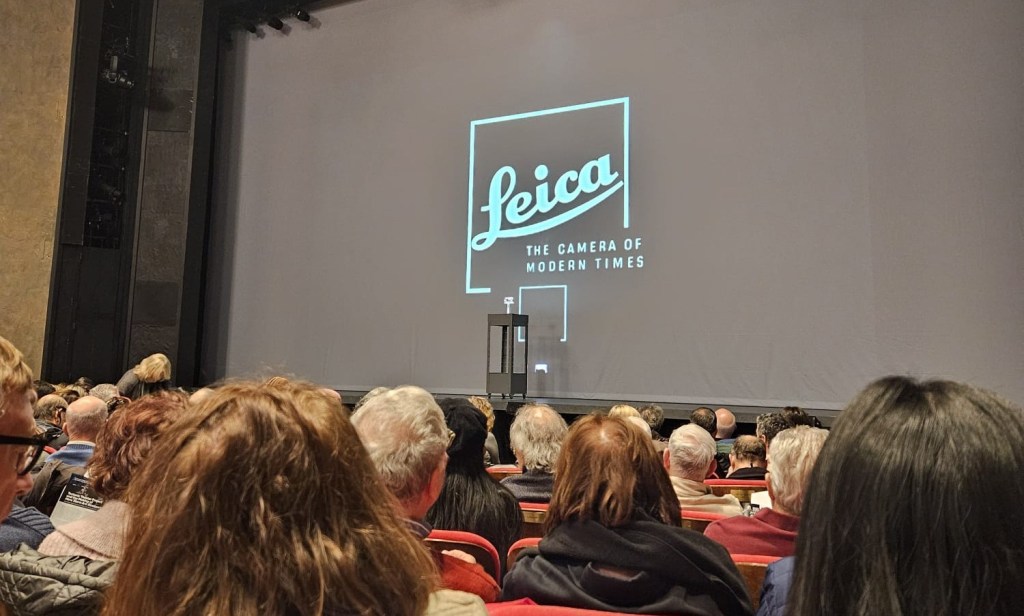
This cuts to the core of the play’s message, which seeks to make us reflect on the ordinariness of the perpetrators. In their own words, the play ‘confronts what these images reveal about the perpetrators and about us all’. The pictures of SS personnel enjoying themselves while taking time off from their work at Auschwitz naturally have a powerful impact on our understanding of the daily lives of perpetrators. Audiences are forced to acknowledge their uncomfortable humanity and to learn about a part of Holocaust history that jars with the horrific crimes that these people committed.
In a way, the play echoes the idea – long discussed in the field of Holocaust Studies and beyond, since Hannah Arendt’s famous work – of the banality of evil. The photographs show audiences exactly the people who made up the unthinking bureaucracy, the figures within the system of administration that oversaw the murderous machinery at Auschwitz. The research process that we witness in the play also underscores this element of the Holocaust, as researchers rush across the stage to consult Nazi administrative documents detailing the postings and reports of various perpetrators they want to identify in the images.
Perhaps one of the most striking images in the album that the play presents is that of Höcker and a group of women – the SS Helferinnen (female auxiliaries) – from the camp. It is from this picture that the play gets its name, as they are shown holding and eating bowls of blueberries. Figures on stage create a flurry of activity, trying to identify the women, research their roles in the camp, and speculate on the relationships between them. The play, therefore, presents a different history of perpetrators than many in the audience may expect – one that acknowledges the nameless in the picture as well as the named.
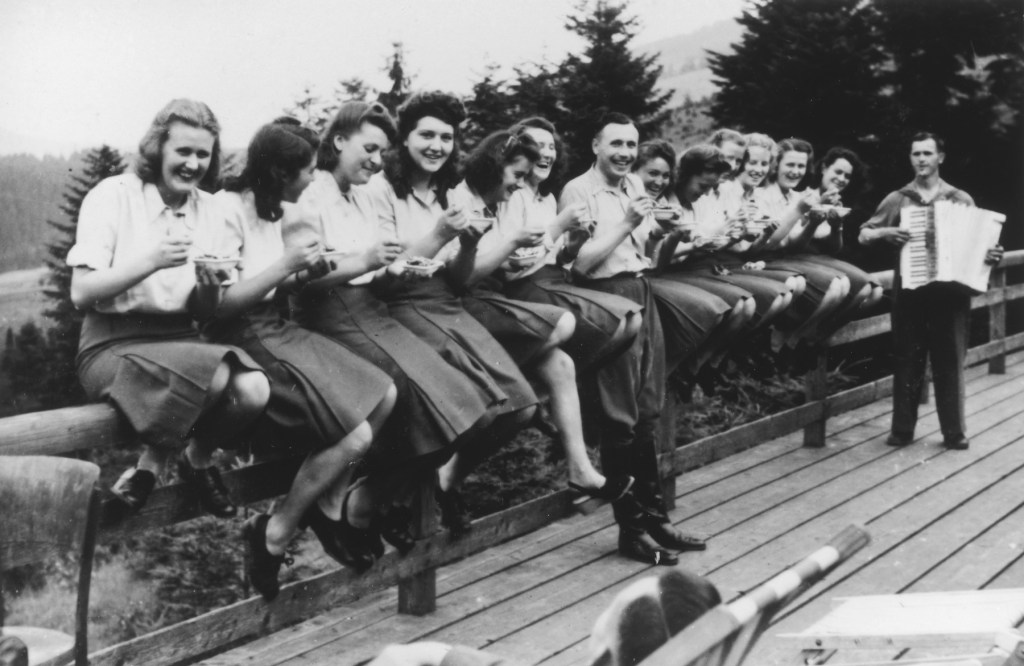
Instead of overwhelming audiences with the horrors of the Holocaust, Here There Are Blueberries tells us about the people who made it happen. As a result, it fits with a recent trend in Holocaust cinema, exemplified by films like The Zone of Interest, that seek to tell the uncomfortable history of the perpetrators. Unlike other representations, however, the play cleverly avoids embellishing or theatricizing the Holocaust. It never tries to recreate the camp; the play shows only the USHMM offices and other spaces contemporary to the investigation of the album. By showing us the process of historical investigation, the play makes clear what is historical fact and what is analysis, inference, or interpretation.
It is rare that archivists or historians can sit down and watch a theatrical rendition of our work. Here There Are Blueberries recreates one of the most important pieces of historical research this decade. It does so in a way that is provocative without being distasteful, focused without being niche, and which leaves audiences eager to learn more. I hope that it comes to the UK soon.
Here There Are Blueberries will be performed at the Theatre Royal Stratford East, London, from 31 January – 28 February 2026. Please click here for further information and tickets. You can watch a trailer of the play on YouTube and read more on its official website: https://www.heretherareblueberries.com.
Dr Barnabas Balint is an historian of the Holocaust, specialising in the history of Jewish responses to persecution in Hungary and France. He completed his doctorate in History at Magdalen College, University of Oxford under the supervision of Professor Zoë Waxman. He has held fellowships at the United States Holocaust Memorial Museum, Vienna Wiesenthal Institute for Holocaust Studies, University of Southern California, Institute of Historical Research at the University of London, and at Yad Vashem under the European Holocaust Research Infrastructure Conny Kristel Fellowship. He is currently a Visiting Research Fellow at University College London’s Institute of Advanced Studies.
 The British and Irish Association for Holocaust Studies