
by Sarah Cushman, Joanne Pettit and Dominic Williams
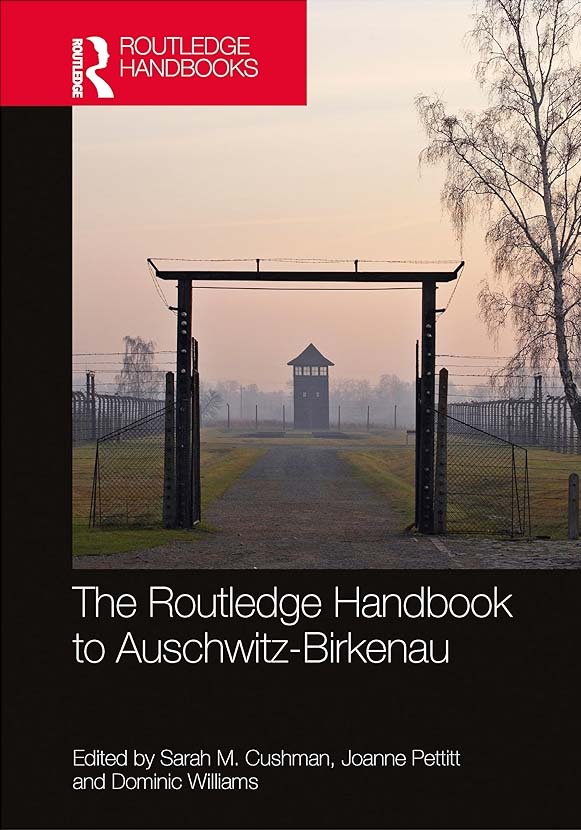
We were approached by Routledge to edit The Routledge Handbook to Auschwitz-Birkenau in 2020. At the time, Robert Langham, the commissioning editor, noted the growing ‘rich and varied’ literature on Auschwitz and suggested that it was ‘time to take stock with a volume summarizing the current state of research.’
It’s true that there has been a lot of research on Auschwitz, but much Holocaust scholarship has moved away from this one site, challenging its centrality to the Holocaust. Some historians (Wendy Lower and Ray Brandon (2010), and following them Dan Stone (2010)) have even lamented what they have called the ‘Auschwitz syndrome’. Given this context, we found ourselves asking: Why Auschwitz again? Why focus on a camp that has already been the subject of so much study, when there are other aspects of the Holocaust, such as the Aktion Reinhard camps or the Holocaust by Bullets, that have received far less attention? So, as far as was possible in a volume about Auschwitz, we wanted to challenge and interrogate this idea of Auschwitz as the centre.
Nonetheless, all three of us felt that it would be beneficial to take stock of the current state of research on Auschwitz. We also thought it crucial to try to address the public image of Auschwitz and its place in Holocaust memory. How do people see Auschwitz? How are they engaging with the camp? What does that tell us about people’s knowledge about the Holocaust more generally?
We attempted to do this in a number of ways. Firstly by attending to the fact that Auschwitz was not one place or one site, and that it involved a wide range of experiences. Secondly by paying as much attention as we could to overlooked experiences, such as Romanis or Soviet prisoners of war. And thirdly by placing Auschwitz in a set of wider contexts and processes.
Inevitably, not every idea that we had was realised, and no doubt there are many other possibilities that we did not think of. We engaged as best we could with people we knew and work that we were aware of. As members of the BIAHS will notice, this included several contributors who have played an important part in BIAHS over the years. But we also made an effort to include scholars who had been working in other languages than English, and scholars whose focus was outside the Anglosphere, and even Europe. In the end, we had to accept that there are necessarily limitations to any project, and that a volume like this can reveal gaps in research as well as offering a summary of what seemed to us to be key work in this area.
One of the most significant challenges we faced during the editorial process was engaging with the Romani genocide. We had hoped to include multiple chapters on this topic, as Romani experiences in Auschwitz are often relegated to the margins in Holocaust histories. However, when we reached out to scholars who specialise in Romani history, we encountered significant reluctance to participate. One scholar, who has dedicated their career to studying the genocide of the Romani people, expressed frustration, stating, ‘I am tired of being a footnote in someone else’s history.’
This sentiment highlighted an ongoing issue in Holocaust research – the underrepresentation of Romani people in discussions of the genocide. Despite our best efforts to integrate Romani perspectives, we recognise that this remains a major gap in the field, both within our volume and in the broader discipline. Although we made strides by encouraging contributors to include discussions of Romani experiences where relevant, it is clear that this is an issue requiring greater attention from future scholarship.
Our discussions extended to the appropriate preposition in the title, and whether it should be The Handbook of or The Handbook to Auschwitz-Birkenau. We felt, and got Routledge to agree, that ‘to’ was perhaps a little bit less strange, but calling a volume a ‘handbook’ in this context still feels a little odd. And it makes claims to comprehensiveness that were not quite the aims that we settled on.
We also considered the approaches that other books on Auschwitz have taken, thinking particularly about three texts: one from the 1970s and two from the turn of the twentieth to twenty-first centuries.
Hermann Langbein, the survivor of Auschwitz, and a prominent member of the International Auschwitz Committee, produced several volumes about the camp, but we thought about his People in Auschwitz (1972). That volume is an attempt to describe the different kinds of groups and the different kinds of experiences in the camp.
The United States Holocaust Memorial Museum’s volume, Anatomy of the Auschwitz Death Camp (1994) wasedited by Yisrael Goodman and Michael Berenbaum. The title gives a sense of breaking Auschwitz down into its constituent parts (suggesting a spatial metaphor), and analysing the different ways in which the different parts of it work together.
And finally, we considered the five-volume history produced by the Auschwitz Museum, whose subtitle is Auschwitz: Central Issues in the History of the Camp (2000). As the title indicates, its aim is to account for how the camp and sub-camps developed.
We tried to bring elements of all three approaches to this volume. The Handbook does not provide a comprehensive history by any means, but in the introduction and in some of the early chapters, we do cover the history, particularly the chapter contributed by Nik Wachsmann.
We took on board the thinking about the camp as a space, exploring questions that have been particularly fruitful areas of investigation for Holocaust studies in recent years. Tim Cole’s chapter on mapping in Auschwitz is one of a number in which a spatial approach is taken.
We also thought it important, despite the inevitable element of arbitrariness, to acknowledge individuals and their experiences, even though we are also aware that there is no individual record of the vast majority of people who were murdered in Auschwitz.
The major difference this volume and these three books is the massively greater importance in questions of representation and memory. In fact, when we sent the initial outline of what the volume could look like to Routledge, they noted with some surprise that there was still something to say about the history, as they had expected an almost exclusive focus on memory. Instead, we tried to strike a balance between history and memory, which we summarised by using the terms: site and symbol.
We divided the volume into 8 sections, with a total of 35 chapters. The aim was to group essays in a chronological kind of way, and then also in a thematic way, beginning with Auschwitz at the time that it was a camp, engaging with various memory practices, exploring Auschwitz in global representation, and then culminating in how people make meaning out of Auschwitz.
Section 1 ‘Placing Auschwitz’ attempts to set Auschwitz in its historical and spatial context as part of the broader Nazi camp system, as part of a then-formerly Polish space, its impact on the ecosystem in which it sits, and as a site that takes up space, but also that can be visualized and mapped.
The second section ‘Prisoner Groups’ comprises chapters that focus on prisoner groups that until recently have received scant attention, or less attention than we think is due them, in literature on Auschwitz. Here, the authors delve into existences of Romanis, Czech Jews in the Terezín family camp, POWs, children, and the Sonderkommando.
Section 3 ‘Experiences of community and suffering’ turns a few degrees from the above section to explore several themes: the impact of hunger on prisoners in Auschwitz, prisoner responses, including music making and religious activity, both of which attempted to bolster community among prisoners, and with a critical eye to the term ‘Muselmann’, a ubiquitous figure in representations of Auschwitz.
In Section 4, ‘Perpetrators and Collaborators’, the volume turns more sharply towards those groups in Auschwitz, with analyses of the SS uses of photography during genocide and its uncritical reproduction, or the uncritical reproduction of SS photography and representations of Auschwitz in the ensuing years, the participation of SS-affiliated women in the camp, the role and place of civilian workers, and a consideration of the first Frankfurt trial in the early 1960s.
Essays in the fifth section, titled ‘Representing Auschwitz’, take us to representations of Auschwitz in several genres: fiction, perpetrator fiction, Romani writing, graphic novels, and films. And what we see is that Auschwitz remains not only a cultural touchstone, but also a representational and ethical puzzle that people try to figure out through their writing.
Section 6, ‘Key Figures in Cultural Memory’, explores how survivors tried to solve the problem of representation and their impact on our perceptions of Auschwitz. Herman Langbein, Charlotte Delbo, Elie Wiesel, Yehiel Dinur, and Primo Levi all sought to help those who came after grasp what happened to them and others during their time in Auschwitz, and their influence has endured.
Contributions in Section 7, ‘Global Auschwitz’, show that the image of Auschwitz has animated global discussions on the Holocaust, and that the Holocaust is a touchstone well beyond the borders of Europe in places as disparate as Brazil, China, and Israel, but also locally in Poland. Many global locations grapple with the meaning of Auschwitz or point to Auschwitz as a way of making meaning.
The volume ends with Section 8 ‘Post-War Reflections and Engagements’, and these several essays take us back to the camp with reflections on Auschwitz as a political and philosophical problem, and the way that the museum at the site engages with visitors near and far, both when people visit that space, but also those who engage with it in a virtual space.
The Routledge Handbook to Auschwitz-Birkenau is not intended to be a definitive or comprehensive history of Auschwitz. Rather, it is an attempt to balance the study of Auschwitz as a historical site with the ongoing work of representing and remembering it. Our volume aims to expand the conversation around Auschwitz by introducing underexplored experiences, challenging established assumptions, and foregrounding the question of how this site is remembered and used today.
In editing this volume, we hope we have added to the growing body of research that not only seeks to understand Auschwitz but also to critically examine its role in the broader landscape of Holocaust memory. While there is still much work to be done, especially in terms of amplifying the voices of marginalised groups like the Romani, we believe this volume opens important avenues for future scholarship and reflection.
Gutman, Yisrael and Michael Berenbaum, eds. 1994. Anatomy of the Auschwitz Death Camp. Bloomington: Indiana University Press.
Langbein, Hermann. [1972] 2004. People in Auschwitz. Translated by Harry Zohn. Chapel Hill: University of North Carolina Press.
Lower, Wendy, and Ray Brandon, eds. 2010. The Shoah in Ukraine: History, Testimony, Memorialization. Bloomington: Indiana University Press.
Piper, Franciszek. 2000. Auschwitz 1940-1945: Central Issues in the History of the Camp. Translated by William Brand. 5 volumes.Oświęcim: Auschwitz-Birkenau State Museum.
Stone, Dan. 2010. “Beyond the ‘Auschwitz Syndrome’: Holocaust Historiography after the Cold War,” Patterns of Prejudice, 44(5), 454-468.
 The British and Irish Association for Holocaust Studies