By Nurit Grossman
Nurit Grossman pursued her MA in Holocaust Studies at the University of Haifa in 2016. She wrote her thesis on the topic of the Czech Kindertransport*, titled “The Emergence of the Kindertransport in Prague 1938-1939 – A Humanitarian Response to a Refugee Crisis”. In 2019 she presented her paper in the KT80 Symposium at University College London “The Emergence of the Kindertransport in Prague – a Unique Endeavor”, later published in the Jewish Historical Studies Journal (Grossman N., The emergence of the Kindertransport in Prague: the Barbican Mission to the Jews, a unique endeavour. JHS. 2019. Vol. 51(1):208-220). In 2023, she conducted research on her family’s history which resulted in a paper she presented at the International Conference in the POLIN Museum in Warsaw: “Amidst the Spheres of Ghettos and Camps Between Poland & Germany – One Woman’s Story of Survival”.
The luxurious Grand Hotel Evropa on Wenceslas Square was where, by the end of December 1938, efforts to get children out of Prague were set in motion. What started out as a single registration spot at the hotel’s café table, turned into a complex network of voluntary associates. A dedication plaque was displayed on the Evropa Café wall:
“Towards the end of 1938, and the beginning of 1939, an Englishman, Sir Nicholas Winton and his co-workers organized out from this Hotel, and often directly from this café a unique rescue mission of 669 Czech and Slovak children which has no parallel in modern history”.
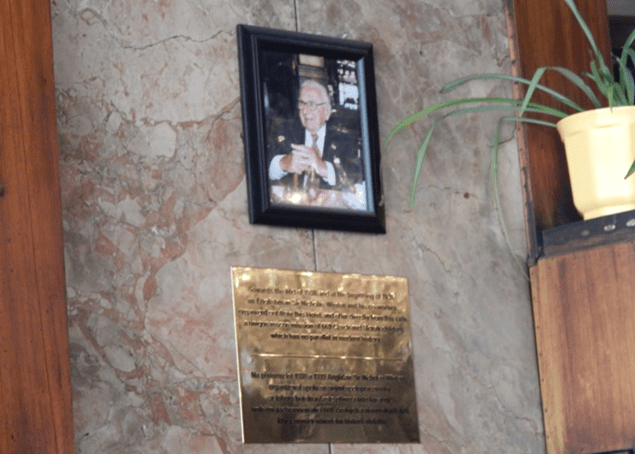
The dedication plaque to Winton in the Evropa Café, Author’s own Image
Besides Winton, and even before his arrival in Prague, several organizations, committees and humanitarian activists, some working independently and some as part of organizations or funds, were in Prague. The scheme of getting children out of Prague before the eruption of the Second World War, was publicly recognized only several decades after the actual events and has often been presented in literature and media as a one-man operation. The story of Nicholas Winton, who was operating under the umbrella of the British Refugee Committee of Czechoslovakia (BCRC), first came to light on the BBC TV Program “That’s Life” in 1988. An abandoned scrapbook compiled of clippings, letters and photographs, dating back fifty years, was discovered by Winton’s wife and displayed by the program’s host, Esther Rantzen. The Kindertransport set off from Prague to London during the pre-war period involved numerous activists, many of whom, besides the well-known Nicholas Winton, have been overlooked and under-researched. Their coverage in the published literature is negligible. They remained at the margins of this narrative.
One of the less documented and yet a significant player in the Czech Kindertransport were the Barbican Mission to the Jews (BMJ). The BMJ, a small organization seeking to promote the propagation of the gospel among the Jews, managed to get around a hundred children out of Prague. As 1938 was drawing to its end, some relief aid workers already in Prague were desperately trying to deal with the mounting refugee crisis. Some conscious activists have just appeared on the scene. It was around Christmas of 1938 that young British Nicholas Winton, joined his friend Martin Blake serving as a volunteer at the BCRC in Prague. Together with other members of the committee, such as Doreen Warriner, Trevor Chadwick, Beatrice Wellington and many others, they were providing aid to the refugees coming into Prague mainly from Nazi-occupied Sudetenland.
Just at about the same time, Reverend Isaac Emmanuel Davidson, Director of the Barbican Mission to the Jews (BMJ) in London, travelled to Prague and joined his fellow pastor, Reverend William Edward Wallner. Wallner, the BMJ representative in Prague, was conducting missionary services and arranging the baptism of Jewish children. The BMJ’s involvement in the Czech Kindertransport hardly received any public attention or credit. It was the collaboration between the BCRC with the BMJ that resulted in the first two flights that took children from Prague to London. The very first flight departing from Prague Ruzyně Airport, on January 12, 1939, consisted entirely of Jewish children under the supervision of Reverend Wallner, the BMJ representative in Prague. Nicholas Winton was on the scene at the time of the children’s departure, in his capacity as an activist associated with the BCRC. This is when Winton’s iconic photo holding little Hansi Beck was taken.
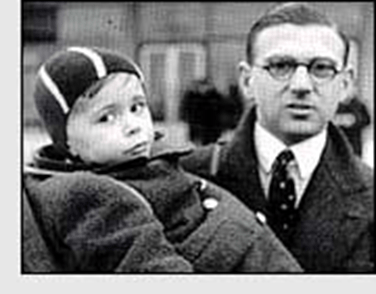
In his report of that day Winton wrote:
“The first party of children today left Prague. This was fixed up by the Barbican Mission to the Jews in London and transport was arranged by us. Being the first lot of kids to leave Czechoslovakia it aroused much attention and cinema men and journalists were very much in evidence”.
A second group left Prague two months later, on March 8, a week before Prague was taken over by the Nazis. This time the flight was arranged and accompanied by Reverend Davidson, director of the Barbican Mission. Both flights, the one in January and the second in March, have been planned much in advance by BCRC’s Doreen Warriner together with Rev. Davidson and Rev. Wallner of the BMJ. The BMJ openly declared that it was their intention to take the Jewish children to Britain on the condition that they would be brought up as Christians:
“It is our first and foremost intention to give these children a true Christian home and give them an opportunity to know the Lord Jesus as their Savior”.

Rev. Emmanuel Davidson and his wife Lucy provided homes for the Jewish children in suburban south-east London, mostly in Chislehurst. A memorial plaque is displayed on a wooden bench, just around the corner where Lubbock Road meets Old Hill in Chislehurst. A token of gratitude to Rev. and Mrs. Davidson, for their endeavor in bringing Jewish children from Europe to Britain in 1939. This memorial, in its very befitting location, is situated where the Jewish children brought from Prague were accommodated, raised and taken care of. The text inscribed on the plaque reads: “Rev. & Mrs. I. E. Davidson and Friends, gratefully remembered by all the BMJ children (68 of them rescued from Central Europe 1939)”.
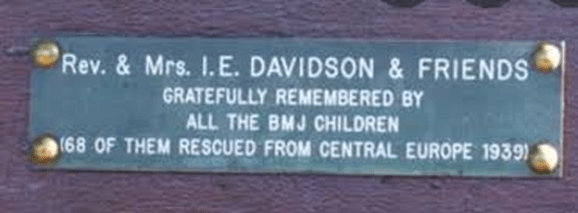
Driven by their missionary zeal, the BMJ’s conversionary activities were sparking strong criticism and resentment within the Jewish community in Britain. Furthermore, Many of Chislehurst’s residents have raised strong objections to the Davidsons’ conduct. And yet, the BMJ were providing homes for Czech Jewish children at the time when demand for foster families was very high, many of them already taken by the children who had arrived earlier from Germany and Austria.
Despite common knowledge, the Prague children’s transports were not included within the framework of the centrally organized scheme which brought thousands of Jewish children from Nazi Germany and Austria to Britain. Furthermore, in the absence of central organizations to administer the children’s departure from Prague, against the backdrop of the mounting refugee crisis, a network of voluntary individuals and committees from a wide range of affiliations emerged. It is beyond any doubt that the children’s departure from Prague was made possible thanks to the massive response generated by voluntary aid workers, whether religiously motivated or socially and politically concerned activists. Even more so, much beyond this response, these volunteers, cooperating among themselves, took the initiative and the responsibility to actually solve the problem of the endangered children in Prague. The BMJ, a religiously committed group, was beating the odds in the name of their faith.
* A note on terminology: The word ‘Kindertransport’ is used to describe the large scale transportation by train of ten thousand endangered, mostly Jewish, children from Austria and Germany to safety in the UK in 1938 and 1939. Though organised and sponsored independently, the same term became used for the Czech and Slovak rescue of endangered children which was organised in 1939 by Nicholas Winton with the help of Trevor Chadwick and other volunteers both in Prague and London: https://www.nicholaswinton.com/exhibition/kindertransport
 The British and Irish Association for Holocaust Studies