By Charlie Knight and Barnabas Balint
When we first applied to be the postgraduate representatives for the British Association for Holocaust Studies, we spoke about how important a supportive, vibrant, and collaborative academic community is for postgraduate students. Our application was driven by a desire to grow that community and to contribute to something that we had benefited from so much ourselves. Since August 2021, we have had the honour of being PG reps and of meeting and getting to know members of the BAHS PG community through our events, conferences, and newsletters. As we draw near to the end of our tenure and prepare to hand over to the new reps, we’d like to take this opportunity to reflect upon the past year and thank everyone for their support.
In the closing months of the COVID-19 pandemic we wanted to make the most of online events whilst they remained popular and useful. Our first event took place on 28th October 2021 and focussed on Dr Alex Kay’s new book Empire of Destruction. This book for the first time considers Europe’s Jews alongside the other major victim groups of wartime persecution: captive Red Army soldiers, the Soviet urban population, unarmed civilian victims of terror and reprisals, the mentally and physically disabled, the European Roma and the Polish intelligentsia. In the discussion, we talked about the context of the Second World War and how these groups were regarded by the Nazi regime as a potential threat to Germany’s ability to win the War. Keeping up with the latest scholarship is vital for Masters and PhD students and we hope that through this event we made it easier to understand some of the latest developments in the field.
Following on from discussions linking the course of the War and the Holocaust, our second event saw James Bulgin, Head of Content for the Imperial War Museum London’s Holocaust galleries, discuss the new exhibits. James presented an overview of the new space and told us some of the stories behind items in the galleries, alongside the decision to link the Holocaust and Second World War galleries both conceptually and physically. This gave attendees the chance to ask questions about some of the museological decisions, as well as find out some of the behind-the-scenes workings of constructing a Holocaust Museum. As PG reps, we believe it is vital to include spaces and opportunities for issues outside academia and were proud to highlight contributions on memorialisation, heritage, and contemporary issues throughout the year.
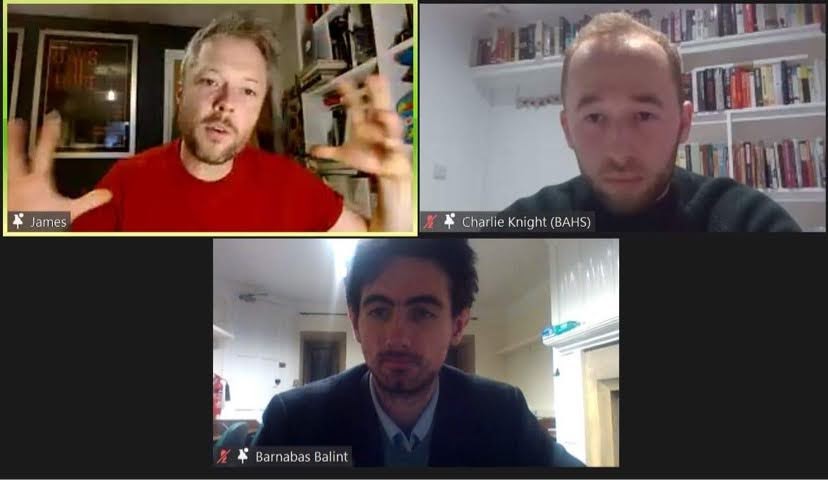
Our third event, held in December, focussed on the Claims Conference survey of Holocaust consciousness and education in the UK. As a response to this publication, Dr Andy Pearce of the UCL Centre for Holocaust Education and BAHS board member reflected on the findings, as well as those of the previous UCL survey to contextualise it. We discussed the place of the Holocaust both in the British education system and in wider society, and some of the potential opportunities moving forward which could make best use of the growing resources on the topic.
In January 2022 we brought together a panel of current and recently graduated PhD researchers from around the UK – Hannah Wilson (NTU), Dr Imogen Dalziel (HGRP), Roxy Moore (RHUL/Wiener Library), Kiera Fitzgerald (Roehampton/Wiener Library) and Dr Jaime Ashworth (Gen2Gen) to discuss how postgraduates can achieve public engagement from their work. The panel talked about their engagement with large organisations such as HET, HMDT, IWM, HGRP, The Wiener Library and others, as well as smaller scale projects and blogs that engage the public with historical research. Some particularly interesting projects were shared by BAHS Web, Social Media and Blog Editor Hannah Wilson, such as Sobibor on the Screen, Uncomfortable Histories, and her recent work for Music and the Holocaust.
The start of 2022 also saw us come together as a community to mark Holocaust Memorial Day. In association with the University of Oxford’s HMD 2022 Events Series (OxHMD22), we co-organised the last online event of their series, convening a panel of globally-respected academics to discuss their research surrounding Holocaust perpetrators. We were thrilled to be joined by Prof. Christopher Browning (University of North Carolina at Chapel Hill), Prof. Edward B. Westermann (Texas A&M University), Prof. Wendy Lower (Claremont McKenna College) and Prof. Stefan Kuehl (Bielefeld University). We explored issues such as the place of perpetrator research in wider Holocaust history, the different ways perpetrators conducted themselves, and how perpetrators are presented in museums. It was an honour to be able to bring together these scholars and to take their cutting-edge research to a public audience – this discussion is a must-watch for any student researching perpetrators of the Holocaust.

In March 2022, we were pleased to host a roundtable discussion on LGBTQ+ histories and the Holocaust, welcoming Dr Anna Hájková (University of Warwick), Dr Uta Rautenberg (University of Warwick) and Mie Astrup Jensen (UCL) to discuss avenues in their research and wider study. We explored the sources available to the historian, the complexities of researching gender identities and sexualities, as well as some of the most recent research into the area. Mie’s research provided a different lens to that of Dr Hájková and Dr Rautenberg’s, with her work at UCL looking at lesbian, bisexual and queer Jewish women’s sexual and religious identities in England and Israel in the post-war period to the present day.
The following month we tackled an understudied area in many academic circles, looking at the diversity of religious responses to the Holocaust, in association with the British and Irish Association for Jewish Studies. We brought together Prof. David Tollerton (University of Exeter) who detailed the place of Primo Levi in religious memorialisation contexts, Dr Isabel Wollaston (University of Birmingham) who discussed religion in present day memorials, and Dr Barbara Krawcowicz (Jagiellonian University), whose recent work History, Metahistory, and Evil: Jewish Theological Responses to the Holocaust employed a comparative reading of post-war North American and wartime Orthodox Jewish texts about the Holocaust.
In May, we hosted our first in-person event, welcoming three researchers from Western Galilee College in Israel to the University of Oxford, where they met with postgraduates in Holocaust Studies. With Dr Boaz Cohen, Dr Yaron Pasher, and Dr Daniela Ozacky Stern, we discussed new trajectories in Holocaust research, as well as the challenges involved in studying the Holocaust. We also heard about their latest projects on innovation and Holocaust memory and explored opportunities for public engagement with Holocaust research. It was an honour to convene this international seminar, in recognition of the importance of working together across borders to further research.
The pinnacle of the BAHS Postgraduate year is always the annual conference, this year held in the Taube Family Learning Centre at Imperial War Museum London. Attendees were treated to a host of papers on topics ranging from global narratives of the Kindertransport, to the use of Holocaust Imagery during the COVID-19 pandemic, to an analysis of Taika Waititi’s JoJo Rabbit. The day also included a thought-provoking keynote from Prof. Dan Stone (Royal Holloway, University of London) on Holocaust Historiography and Popular Memory, and a tour of the new galleries by James Bulgin (IWM). After the conference, we published a full report of the day which you can read here.

On 8th July, the BAHS Postgraduate Events series came to a close with a fascinating workshop for postgraduates to ask questions and discuss how to teach difficult histories in universities and wider education settings. The three panellists (with an accidental refugee histories theme) discussed their own experience as well as some advice on how postgraduates can make the most of their teaching opportunities and how best to deal with the practical and emotional difficulties of teaching the Holocaust. Thanks to Dr Rachel Pistol (King’s College London), Dr Amy Williams (NTU) and Nicola Woodhead (University of Southampton) for their time and expertise on this topic.
Throughout the year, the PG newsletter has highlighted both our own activities and events and CfPs of interest to other postgraduates. We’ve kept postgraduates up to date with the latest developments and opportunities, particularly those that don’t have mainstream national coverage. In this aim, we’ve highlighted little-known resources such as the ‘Mapping the Lives’ project from the German 1939 minority census and the Scottish Jewish Heritage Centre and Scottish Holocaust-era Study Centre. Each newsletter also contained a student spotlight, with contributions from Eliott Hull (Roehampton), Julie Fitzpatrick (RHUL), Nicolas Garraud (University of Oxford), Roxy Moore (RHUL), Archie Wolfman (QMUL), Nicola Woodhead (University of Southampton), Sophie Bayer (University of Edinburgh), Robert Thompson (UCL) and Emily Smith (RHUL). Thank you all for your time and giving us a little insight into your work. Spotlighting different research each month enriches our community and puts a face to the names of our members.
With our year as BAHS PG reps coming to a close, there are many people we must thank, without whom we could not have done as much as we have: from the speakers at our events, to those who wrote for us, to all of you who have attended our events and read our newsletter. We are also immensely grateful to the BAHS (now BIAHS) for giving us the opportunity to be the postgraduate reps this year. It has been a privilege to get to know so many postgraduates around the country and to interview so many academics from around the world. We now have over 100 members of the BAHS PG community, and we hope that after the disruption of the pandemic, our work has brought people back together in a common cause. It was our aim to provide a series of events and workshops to help postgraduates develop both practically and academically, and to be able to better orientate themselves in the ever-growing field of Holocaust studies. We wish the best of luck to our successors and hope that you too can grow the BAHS postgraduate network even further.
Barnabas and Charlie

 The British and Irish Association for Holocaust Studies