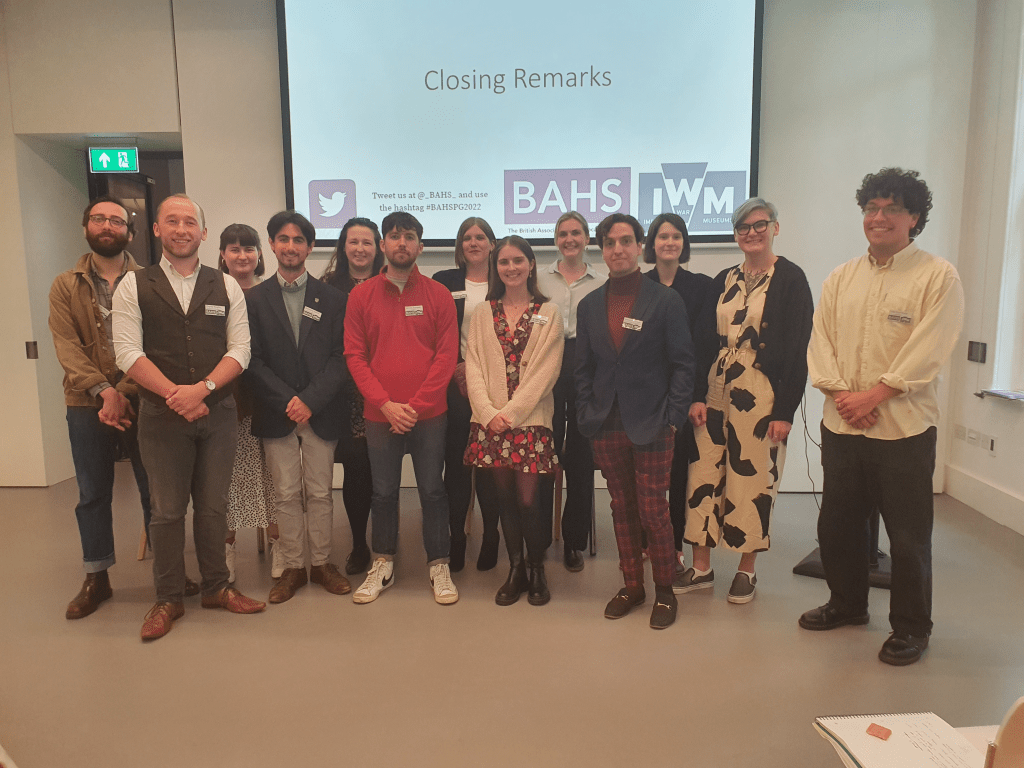
On Monday 30th May 2022, we welcomed 40 postgraduate researchers, educators, and academics to the Taube Family Learning Centre at the Imperial War Museum London for the BAHS Postgraduate conference 2022. Each year, the conference brings together a range of academics from across the UK and abroad with a wide range of expertise and interests. This year’s conference was no exception, providing an opportunity to expand the academic opportunities and resources available to postgraduates in our network. In the day-long conference, we heard a keynote from Professor Dan Stone, 11 papers featuring cutting-edge research from postgraduates from across the world, and took part in a tour of the new Holocaust galleries at the IWM.

The conference opened with the keynote lecture from Professor Dan Stone, which explored ‘Holocaust Historiography and Popular Holocaust Memory’. Based on one of his forthcoming publications, Professor Stone used his lecture to problematize the relationship between academic history and popular memory of the Holocaust. He outlined how the two often work in different directions, stating that ‘history is oriented towards “truth”, while memory is oriented towards identity’. Going further, he argued that those working on Holocaust memory needed to pay more attention to more general memory studies, to avoid becoming increasingly siloed. Speaking at the IWM to a room of researchers and educators, Professor Stone’s words held heightened significance and set the scene for a day of lively discussion and debate.

The first panel of the day explored Global Journeys of Fleeing the Holocaust and was chaired by Charlie Knight (University of Southampton). Its papers explored the varied way that Jews sought refuge from persecution abroad, highlighting little known histories and opening up new temporalities and geographies. First, we heard from Nicola Woodhead (University of Southampton) about the multiple migrations that Kindertransport children made beyond England, traveling to the USA, Israel, Canada, and many more countries. The second paper, presented by Niamh Hanrahan (University of Manchester) highlighted the complexity and chaotic nature of international travel during the Holocaust, dependent on multiple visas, means of transport, and countries, in a narrative that traversed Europe, America, and Asia.
Our second panel, chaired by Barnabas Balint (University of Oxford), focused on how ordinary people coped with persecution during the Holocaust. Papers in this panel went beyond traditional understandings of persecution, bringing into the discussion ideas about the persecution of the Roma and Sinti, decentralised perpetrator figures, and new readings of categories of analysis such as food, gender, and humour. Opening the panel, Catharine Aretakis (University of Amsterdam/NIOD) discussed native persecution of Roma and Sinti populations, revealing the engrained intolerance and prejudice in European communities and how it interacted with Nazi policies on persecution. The next paper, presented by Julie Fitzpatrick (Royal Holloway, University of London), explored the intersection between food, gender, and society for German-Jewish communities. By viewing people’s experiences through the lens of food, this paper used one of the most routine and ordinary features of daily life to shed light on identity politics, class distinctions, transnationalism, and the gendered experience of German Jews. Closing the panel, Nicolas Garraud (University of Oxford) introduced the category of humour to our understanding of Warsaw and the Warsaw Ghetto. Instead of perceiving humour as a form of resistance, this presentation revealed what humour can tell us about people’s mentalities and Polish-Jewish relations in the capital.

Over lunch, attendees had the opportunity to network and continue the discussions from panel Q&As in more detail. The learning rooms came alive with people comparing notes on their research and discussing connections. At this point, we also had the opportunity to join a tour of the IWM’s
new Holocaust Galleries, led by Head of Content for the galleries, James Bulgin. The new galleries form part of IWM’s wider regeneration project that began with the remodelling of the First World War Galleries on the ground floor, and have been equally as successful. In his review of the galleries for the BAHS, Charlie Knight wrote that ‘the gallery depicts scale but remains personal, horror without sensationalising, and complexity without alienating or overwhelming’. You can read the full review here. The tour at the conference explored these elements thoroughly, with James Bulgin explaining the immense attention to detail and thought that went into every aspect of the galleries, including the presentation of religious objects, the soundscape, and even the production of specific typeface.
After lunch, we continued with our third panel, on traces of the Holocaust in the post-war world, chaired by Lauren Cantillon (King’s College London). As a major event of the twentieth century, the Holocaust has had a significant impact on our global history since the end of the war. At the conference we heard about threads of the Holocaust in the lives of LGBT+ members who continued to face persecution, as well as how the Holocaust and its imagery has been used as a touchstone for other conflicts and contemporary protests. The first presentation came from Andrea Carlo Martinez (Ludwig Maximilian University of Munich), who outlined how persecution of LGBT+ people during the Second World War built on pre-existing legislation and continued after the war too. In the second presentation, Luke Summers (University of Oxford) spoke about how memory of the Holocaust influenced how the British Jewish community responded to the conflict and genocide in Bosnia. In the last presentation of the panel, Eliott Hull (University of Roehampton) discussed the ethics and impact of the use of Holocaust imagery in contemporary protest, raising difficult questions about who owns Holocaust imagery and the differences between acts of appropriation by Jewish and non-Jewish groups.
To close the conference, the last panel reflected on representations of the Holocaust in the modern era and was chaired by Niamh Hanrahan (University of Manchester). This is an often-contentious topic, with many disputed approaches. Our papers held no punches, exploring how the Holocaust has been represented in video games, cinema, and the theatre. Starting the panel, Archie Wolfman (Queen Mary, University of London) presented an overview of shifting narratives in contemporary Holocaust cinema. Using examples from different films over the years, this paper explored the use of image and sound to represent trauma and the ways this has changed in different cinematic pieces. Next, Cailee Davis (University of Oxford) gave a lively and engaging presentation on ‘New Holocaust Comedy’. Using the film Jojo Rabbit as a case study, she explored the intersecting genres of Holocaust film and comedy and raised questions about audience perceptions and narrative. For the final presentation of the day, Alexandra Jiménez Nimmo (Royal Holloway, University of London) spoke about video games and theatre which refer to the Holocaust and Holocaust perpetrators, including Wolfenstein and Die Kommandeuse. Providing an insight into the production of these though motion-capture technology, this presentation questioned how distance and intimacy impact people’s perceptions of the Holocaust.
Throughout these four panels and the tour of the galleries, the conference presented a thought-provoking and exciting insight into the cutting-edge research taking place in Holocaust studies. We are incredibly grateful to everyone who helped make the conference a success – to Professor Dan Stone for providing such an insightful keynote, to Clare Lawlor for providing us access to the superb learning programme rooms at the IWM, to James Bulgin for his tour and expertise throughout the day, and to all our postgraduate members who presented and attended the conference. Postgraduate members are at the heart of the BAHS community and are the scholars of tomorrow.
At this conference, we had the exciting opportunity to hear their research, in a true insight into the future of Holocaust studies.
 The British and Irish Association for Holocaust Studies
One thought on “BAHS Postgraduate Conference 2022 ”
Comments are closed.