by Jan Burzlaff
Jan Burzlaff is the William A. Ackman Fellow for Holocaust Studies at Harvard University and the 2021-2022 Dori Laub Fellow at the Fortunoff Video Archive, Yale University. Jan is completing his dissertation, the first transnational history of Jewish survival in eight cities under Nazi rule. Further areas of interest are interdisciplinary approaches with the social sciences, comparative genocide, and the history of violence. His latest articles on the death camp of Belzec and the Netherlands have appeared in Holocaust and Genocide Studies and Contemporary European History.
For Edith G., a forty-year-old Jewish woman from Hamburg, it happened in Zeist, a small Dutch town east of Utrecht, in February 1945. Until then, she had successfully escaped from the jaws of death. Her children had been in hiding since 1942, and she did not have to wear the star: a Dutch policeman lacked information about her parents, which was required to establish the ‘Jewishness’ of an individual under Nazi rule. Later, in the fall of 1944, a critical moment when the last deportation train headed eastward, she decided to go into hiding herself. In February 1945, with the Allies looming large, she stepped outside her hiding place. In a desperate gesture of arbitrary retaliation, Gestapo officers began to arrest a group in front of Edith: ‘they wanted bicycles — so they lined up people’, she remembers in her 1985 interview. Suddenly, an unknown man, who was witnessing the scene, approached her and said ‘that I should put a scarf over my head and run. I did, and the first house took me in. I waited two hours until it was over’.[1]
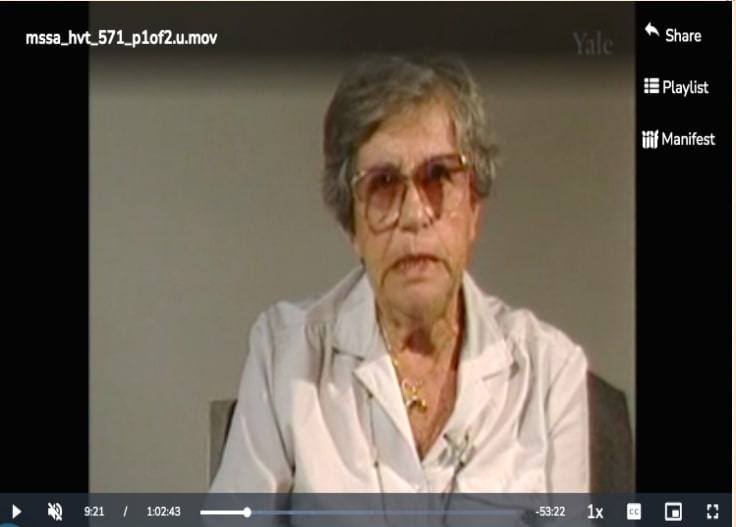
The unknown man, who will forever remain nameless, judged that Edith looked ‘Jewish’ due to her dark hair and, sensing her panic, decided to react. On her end, Edith decided to walk away fast; then, absolute strangers let her wait out the raid in their home. What this example points to is neither organized rescue nor betrayal, as in the infamous case of Anne Frank which is again unsettling the public.[2] In my research on the Holocaust in Western Europe, I often came across experiences like Edith’s: spontaneous acts of warning, support, and providing shelter at a critical moment. My article Silence and Small Gestures: Jews and non-Jews in the Netherlands (1940–1945), which was just published in Contemporary European History, proposes a fresh interpretation of the Holocaust in the Netherlands. The essay is an attempt to finally examine and incorporate Jewish perspectives into the history of the Nazi-occupied Netherlands. So far, one of the leading questions for scholars has been to explain the so-called ‘Dutch paradox’. The ‘paradox’ sought to explore why 75 per cent of the Jews in the Netherlands (104,000) perished in a country known for its liberal traditions. This abysmal mortality rate is particularly stark when compared with those in Belgium (44 per cent, 25,000 Jews) and Vichy France (25 per cent, 80,000 Jews). Historians tended to identify three factors that contributed to the highest number of Jewish victims in western Europe. First, the German police exerted an unlimited amount of control over the 103 deportation trains to the east, unlike those in Brussels and Vichy France. Second, the Jewish council was forced to execute German orders after February 1941, and therefore more closely resembled east European Jewish councils than those in Belgium and France. Third, the Jewish community falsely hoped for survival through compliance, which is also linked to the late emergence of resistance networks after 1943.[3]
A fourth reason that has often been put forward is Dutch non-Jews’ passivity in the face of Jewish deportation – a factor that scholars began emphasising in the 1990s after the black- and-white picture painted by the survivor-turned-historian Abel Herzberg (who was liberated from Bergen-Belsen) and Loe de Jong (who escaped to the UK in 1940). During the 2000s, public discourse reckoned with the national past, and the pendulum swung from ‘heroic resistance’ to ‘guilty onlookers’. The image of a nation comprising law-abiding, and thus guilty, ‘bystanders’ gained traction, and research on the ‘Dutch paradox’ came to an end.
My article goes beyond these top-down, German perspectives, but also overcomes a controversy that has unsettled the Dutch public in the last decade. In 2012, Bart van der Boom, a historian at the University of Leiden, published a book called ‘We know nothing about their fate. Ordinary Dutchmen and the Holocaust,’ in which he argues that Dutch non-Jews did not have any accurate idea of what happened to Jews in Eastern Europe. He infers that had they known, non-Jews would have helped more actively and pro-actively. Instead, van der Boom painted the picture of an empathetic public. Of 111 non-Jewish diarists, 92 rejected anti-Jewish policies, and van der Boom argued that the German occupation morphed into a crisis for Dutch non-Jews, rattling their centuries-old self-image of tolerant citizens.[4] There are excellent things in van der Boom’s book—such as the attempt to give voice to 30 or so Jewish survivors, and the study of the events on the ground that readers of this blog have helped undertake. But the book also has garnered much criticism, often unjustifiably so, like the narrow definition of ‘knowledge’ as the ‘subjective certainty’ about immediate death upon arrival, the extent of antisemitism in Dutch society, or the minimal role that Nazis played in his book.
In light of Edith’s experiences, one wonders why should ‘knowledge’ should be the primary yardstick against which a society’s dynamics are measured. Even if the unknown man did not know that most Jews were murdered after arrival in Eastern Europe, he still decided to act. Maybe he belonged to the at least 100,000 Dutch people out of nine million who saved Jews in the long run — we do not know. Indeed, the hiding of Jews heavily depended on clandestine networks after 1943. But as crucial as those networks proved for Jewish survival, they do not fully account for temporary, countless acts of support as Edith experienced them; even those ultimately deported often narrate such support that could take the form of both speaking up and deciding not to speak: warning a Jewish acquaintance of an impending round-up through a nod on the street or preventing someone from entering a building where a raid was underway were common actions, especially in towns with fewer than 20,000 inhabitants.
My article draws on more than 500 video testimonies, diaries and postwar memoirs by both deported and non-deported Dutch Jewish survivors to shed light on these experiences. They were given or written in Dutch, Hebrew, English, German and Yiddish as early as 1940 and as recently as the late 2000s. Taken together, these anecdotes and perceptions coalesce into a coherent picture of a large group of Gentiles who helped their Jewish peers, at times with life-saving consequences. They lay bare a social phenomenon that a French scholar, Jacques Sémelin, described for Vichy France as ‘social reactivity’, that is ‘the wide range of small gestures of aid and protection offered to Jews by individuals, whether or not they already knew each other’.[5] Sémelin uses this term to explain the survival of 220,000 non-deported Jews in France (75 per cent). The reasons for the low survival rate in the Netherlands are fairly well known— here, I want to shift our attention to the social dynamics before deportation. Social reactivity, which was at play in all parts of the Netherlands, overlaps with but does not exhaust the dominant notions with which we usually think about the Nazi-occupied Netherlands, including ‘rescue’, ‘pre-war networks’ and ‘social resources’. Rescue only becomes rescue when the danger is over.[6] Furthermore, there is a significant difference between rescue and Edith’s experience: the former involved, at one point or another, financial resources, either from non-Jewish rescuers or from the persecuted, paying for their often short-lived protection. These acts of solidarity are all the more remarkable when we consider the variety of Jewish groups in the Netherlands: the often indigent Jews who had immigrated from eastern Europe, wealthy German Jews or well-assimilated Dutch Jews whose lineage could be traced back centuries. How can we explain them?
I argue that various segments of Dutch society, at one time or another, preferred fleeting acts of solidarity to open protests and active resistance against the Nazis. Jewish accounts highlight how small, voluntary actions increasingly followed these expressions of sympathy with two notable peaks in 1940-1941 and the last six months of the war. Because non-Jews understood that anti-Jewish measures were not negotiable, these supportive interactions, however temporary or modest, became part of wider civil disobedience. As Dutch society split along the lines of approval or rejection of anti-Jewish policies, general observance of the Nazi laws could also allow for small acts of kindness toward Jews by entire villages, neighbours and their extended families, strangers on the street, and ambivalent officials. Many accounts of survivors and victims point to what one might call ‘silent groups’: not silenced in the sense of a muzzled population, but the ways these groups use silence as a weapon. A smile, silence, or a helping hand can all go a long way in countering, if not halting, violence, persecution, and betrayal. In 1942, the parents of Marguerite M., a then twenty-two-year-old Christian woman, were hiding fifteen Jews in their home in Haren, next to the northeastern city of Groningen. Once Marguerite travelled by train with a hidden child, but the little girl —maybe 5 or 6 years old —let slip that she was Jewish. Promising not to report them, all passengers kept quiet.[7]
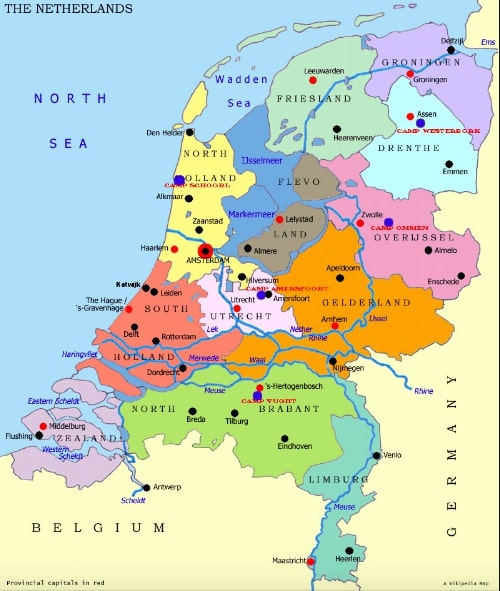
It is important to not romanticize social relations between Jews and non-Jews or assign a single cluster of motives for non-Jews’ participation in or refusal of the persecution. For the Netherlands, this black-and-white picture has been particularly stark until the late 2000s. Most infamously, Anne Frank and her family were denounced on 4 August 1944. The extent of such cases of betrayal is challenging to research, as most victims perished in camps in Nazi-occupied Poland. Additionally, post-war files capture only those 64,500 tried for collaboration.[8] Betrayal was never far away. But reading and listening to survivors’ testimonies, I realized that the two opposites — betrayal and rescue — suggest a much broader foundation of civilian acts of non-compliance and tacit obstruction, as a kind of middle ground. In fact, by offering these small acts of aid and support, non-Jews displayed, even most fleetingly, anti-German, and thus pro-Jewish, behaviour. We know that across Europe, the Nazi occupation reinforced, and in many cases, worsened existing social, religious and political divisions. Dutch Jewish accounts indicate that in the Netherlands, a steady process of polarisation unfolded, through which the Gentile population split into those who supported their Jewish compatriots and those who participated in the occupation system in some way – the latter partly influenced by subtle Nazi propaganda. Social reactivity was one aspect of that polarisation, involving a wide range of Dutch men and women from working-class families in Amsterdam, greengrocers, intellectuals and poor farmers in Friesland to a baron in Veghel, North Brabant. Shared enmity against the Nazis helped Dutch Gentiles to recognise and interact with each other.
By shifting the focus from the eventual outcome of the Holocaust—a prevailing theme in most studies – to wartime social processes, my article seeks to extend to Western Europe the vibrant research of victim perspectives and Jewish testimonies. The latter indicate that non-Jews, at one moment or another, chose fleeting acts of solidarity over open protests and active resistance in the Netherlands. In focusing on “a thousand and one ways of offering aid and protection,” my article offers a rare perspective of the Holocaust in Western Europe. Comparative studies of Jewish testimonies will be needed not only for the Netherlands, but also for Western Europe and Central Europe. I am thinking in particular of Denmark, Belgium, Italy and France, both on the regional and local level, which will help us better understand (and perhaps) reevaluate the role that the responses of non-Jews played over time. They will prove crucial to affirm or refine the case for widespread social reactivity that I have made in this article.
[1] Edith G., Fortunoff Video Archive (HVT), 0571, 1985.
[2] For the latest controversy, see https://www.niod.nl/en/news/research-report-book-about-betrayal-anne-frank-based-assumptions-and-lack-historical-knowledge.
[3] Ido de Haan, ‘The Holocaust in the Netherlands: National Differences in a Western European Context’, Ab Imperio, 2 (2019), 83–93; Ron Zeller and Pim Griffioen, Jodenvervolging in Nederland, Frankrijk en België, 1940–1945: Overeenkomsten, Verschillen, Oorzaken (Amsterdam: Boom, 2011).
[4] Bart van der Boom, Wij weten niets van hun lot. Gewone Neder-anders en de Holocaust (Amsterdam: Boom, 2012); Bart van der Boom, ‘“The Auschwitz Reservation”: Dutch Victims and Bystanders and Their Knowledge of the Holocaust’, Holocaust and Genocide Studies, 31, 3 (2017), 385–407.
[5] Jacques Sémelin, The Survival of the Jews in France, 1940–44 (Oxford: Holt, 2019), 193, and Jacques Sémelin, Unarmed against Hitler: Civilian Resistance in Europe, 1939–1943 (Westport, CT: Praeger, 1993), 84–8.
[6] For the substantial literature on hiding, see only Mark Roseman, Lives Reclaimed. A Story of Rescue and Resistance in Nazi Germany (London: MacMillan, 2019); Richard Lutjens, Submerged on the Surface: The Not-So-Hidden Jews of Nazi Berlin, 1941– 1945 (New York: Berghahn, 2019); Natalia Aleksiun, ‘Gender and the Daily Lives of Jews in Hiding in Eastern Galicia’, Nashim: A Journal of Jewish Women’s Studies & Gender Issues, 27 (2014), 38–61, and her forthcoming book.
[7] Marguerite M., HVT 2474, 1992.
[8] Pinchas Bar-Efrat, Denunciation and Rescue: Dutch Society and the Holocaust (Jerusalem: Yad Vashem, 2017).
This blog is a summary of the author’s following article: https://www.cambridge.org/core/journals/contemporary-european-history/article/silence-and-small-gestures-jews-and-nonjews-in-the-netherlands-19401945/88963FA8E94C6A0A68E619AAE0024854
 The British and Irish Association for Holocaust Studies