Harry Legg is a recent MRes graduate of Royal Holloway and its Holocaust Research Institute. His interests centre around shedding light on the understudied plight of the non-Jewish individuals falsely labelled as ‘full Jews’ by the Nazis. He has a forthcoming paper coming out this summer with the Journal of Holocaust Research on this topic. In line with this, he is hoping to begin a PhD in the academic year 2022/23, though this depends on acquiring funding.
How many Jews were murdered in the Holocaust? Most people would instinctively respond: ‘approximately 6,000,000’. This figure, however, is simply wrong.[1] Amongst the 6,000,000 were a considerable number of non-Jews. In this blog I explain why qualifying this infamous figure should not be a matter of preference.
In approaching this topic, it is useful to gain an understanding of exactly who was caught up in the Nazis’ extermination campaigns. Nazi Germany’s infamous 1935 Nuremberg Laws stipulated that an individual was to be considered a ‘Volljude’ (‘full Jew’) if three or more of their grandparents had been members of the Jewish community. In the intervening generations, many individuals left behind both their secular and religious Jewish identities. Here we are not referring to those who merely resigned from the specific local community but still identified as Jews.[2] Rather, we are referring to those that enacted a definitive separation from all things ‘Jewish’, as they saw it. The latter group, whose members had typically spent generations outside the Jewish community, was not excluded from Nazi anti-‘Jewish’ legislation. These individuals called themselves non-Jews, were usually members of the Christian religion, and moved predominantly in the social circles in which non-Jews typically moved. In other words, unless one holds to a notion of genetic ‘Jewishness’, they were not Jewish. Classified as ‘full Jews’, they experienced the full range of persecutory and exterminatory measures that the Nazis also inflicted on self-identifying Jews.[3]
Placing quotation marks around the word ‘Jew’, when referring to the 6,000,000 deaths, is a practical way to indicate the falsity of the Nazi label. At this stage, one could embark on a historiographical exegesis of the process by which these quotation marks were dropped (if indeed they were ever consistently adopted in the first place). One may also ask why we use quotation marks to ridicule the Nazi concept of ‘Aryan’, but rarely bother when it comes to ‘Jews’. This would be an interesting tangent. Such a discussion would inevitably involve considering how the category of non-Jewish ‘Jews’ ceased to exist after 1945. In comparison, self-identifying Jews formed a nation and sought to fit the Holocaust into what Philip Friedmann would call ‘the golden chain’[4]of Jewish history that stretched far beyond the 20th century. The Jewish memory of everyday life during the Holocaust was initially created by Jews, and, primarily, for Jews. After 1945, non-Jewish ‘Jews’ ceased to exist under that label. In other words, people were generally ignorant of, rather than maliciously disposed towards, memorializing the plight of non-Jewish ‘Jews’. References to the death of 6,000,000 Jews – without acknowledging that there were many non-Jews among that number – are usually well intentioned. Nonetheless, the road to obfuscation isn’t always paved with bad intentions. The claim that things have been forgotten or obscured in the process by which the Holocaust has been memorialized is certainly not a new one. This notion undergirded the recent flurry of articles that constituted the rather revealing so-called “Catechism Debate”.
Before we examine the differences between the experiences of non-Jewish ‘Jews’ and those of self-identifying Jews, it would be remiss to omit to mention some of the scholars who are aware of the plight of non-Jewish individuals. From the works of such powerhouse historians as the late Raul Hilberg and the much-underrated Bruno Blau, to more recent contributions by Katarzyna Person, Eberhard Röhm, Jörg Thierfelder, Sigrid Lekebusch, Martin Greschat and Ursula Büttner, non-Jewish ‘Jews’ have not been entirely ignored.[5] Yet, if one pulls out a microscope, readers may be shocked to learn that there is not a single publication in English entirely devoted to the everyday lives of non-Jewish ‘full Jews’ in Nazi Germany. The situation is barely any better in the German literature. The most common approach to covering non-Jewish ‘full Jews’ has been to evaluate organisations, inside and outside of Nazi Germany, that helped the group emigrate. Such research sheds invaluable light on everyday life but ultimately avoids its direct analysis. It is worth noting, too, that one cannot simply apply research findings about the lives of self-identifying Jews to non-Jewish ‘Jews’. Take as an example Abraham Ascher’s 2007 study of Jewish life in Breslau under Nazism. He rightly points out that, after 1933, Jews ‘relied more than ever for their socializing and entertainment on the facilities of the Jewish community’.[6] It should be immediately obvious that the very framing of this sentence rules out its applicability to non-Jewish ‘Jews’. They could not ‘rely more than ever’ on something they had never relied on in the first place.
Why, then, didn’t they just join the Jewish community? In the first place, they generally did not want to. One non-Jewish ‘Jew’, a father, despaired at the prospect of transferring his son from a non-Jewish school to the local Jewish school. His letter to the local authorities protested angrily at being forced to send his child to ‘a school that contradicts the Christian faith in its attitude to faith and stands in contrast to the parental home in its entire education’.[7] He went on to lambast the teachers being ‘of the Jewish faith’, the learning of Hebrew, and the fact that his son would stand out by not wearing the Kippah. Describing his child as ‘visibly alienated from the others’, he concludes the letter by taking issue with how his child ‘must suffer’ due to not receiving ‘the Protestant religious instruction to which he is entitled’. This is indicative of the oppositional attitude to joining the Jewish community one encounters in memoirs written by non-Jewish ‘Jews’. Furthermore, even if they had wanted to, non-Jewish ‘Jews’ were not necessarily welcome to join the Jewish community. In another example, a non-Jewish ‘Jew’ was imprisoned in Dachau alongside his brother, after the November pogrom of 1938.[8] Not only did he not recognise any of the so-called ‘fellow Jews’ who had lived in his own town – a revealing social indicator – but that very same group was actively hostile to him and several other non-Jewish ‘Jews’ inside the concentration camp.
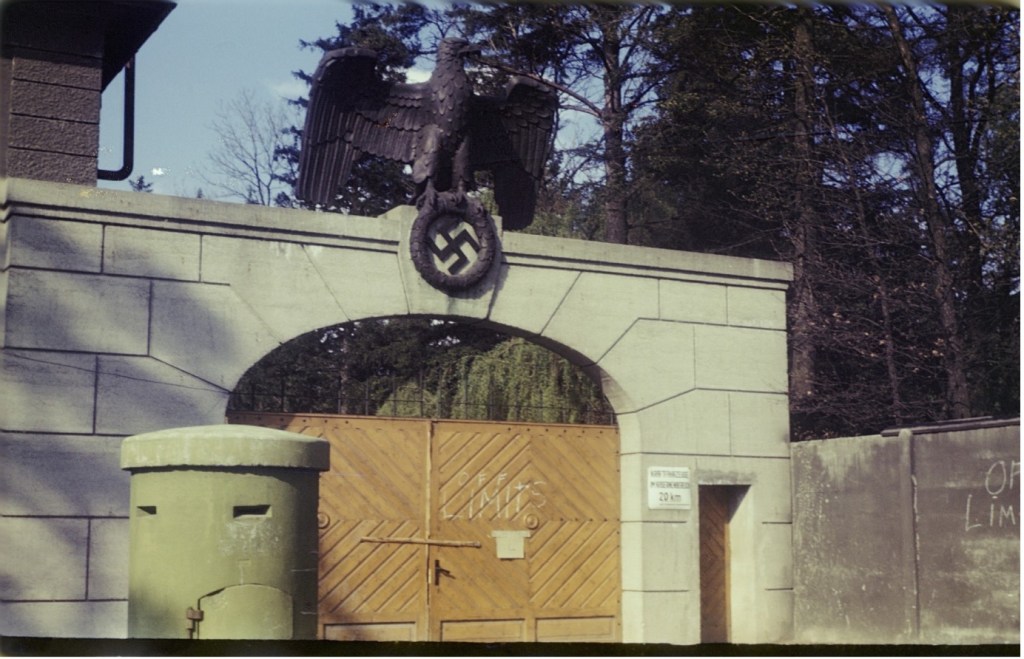
The entrance to Dachau Concentration Camp – the primary destination of ‘Jews’ after ‘Kristallnacht’ (Source: USHMM, courtesy of Colonel Alexander Zabin – https://collections.ushmm.org/search/catalog/pa1144526)
Of course, one must be careful not to draw decisive conclusions from anecdotes. Nonetheless, it is telling that the predictable divergence of the German non-Jewish ‘Jewish’ experience from that of the main self-identifying German Jewish cohort has only scantly been researched. I would go so far as to argue that the burden of proof is on anyone who would seek to argue that the experience of non-Jewish ‘Jews’ heavily resembles that of self-identifying Jews (except through the obvious though important application of Nazi measures). The few studies that have begun to research non-Jewish ‘Jews’ have supported this provocative statement.[9] That their experiences were measurably different can also be shown simply by referencing features that were necessarily experienced by the vast majority of the cohort of non-Jewish ‘full Jews’. Take, for example, the expulsion of ‘full Jewish’ children from ‘Aryan’ schools and clubs in 1938. Proportionally speaking, children of non-Jewish ‘full Jewish’ parents always experienced an uprooting which was only experienced by the children of self-identifying Jewish parents who had chosen to send their children to non-Jewish schools. Of course, because only 14% of Jewish children in 1932 had been in a Jewish school, the relative proportions seem insignificant.[10] Yet, the experience of the expulsion itself was also different. Non-Jewish ‘Jews’ were forced into schools that taught a religion with which they were unfamiliar. Self-identifying Jewish children who were expelled from their schools were able to attend Jewish social clubs to ameliorate the social rupture. In other words, all ‘full Jews’ were told that they were not German but, as a general though not universal rule, only non-Jewish ‘full Jews’ were forced to become Jewish.
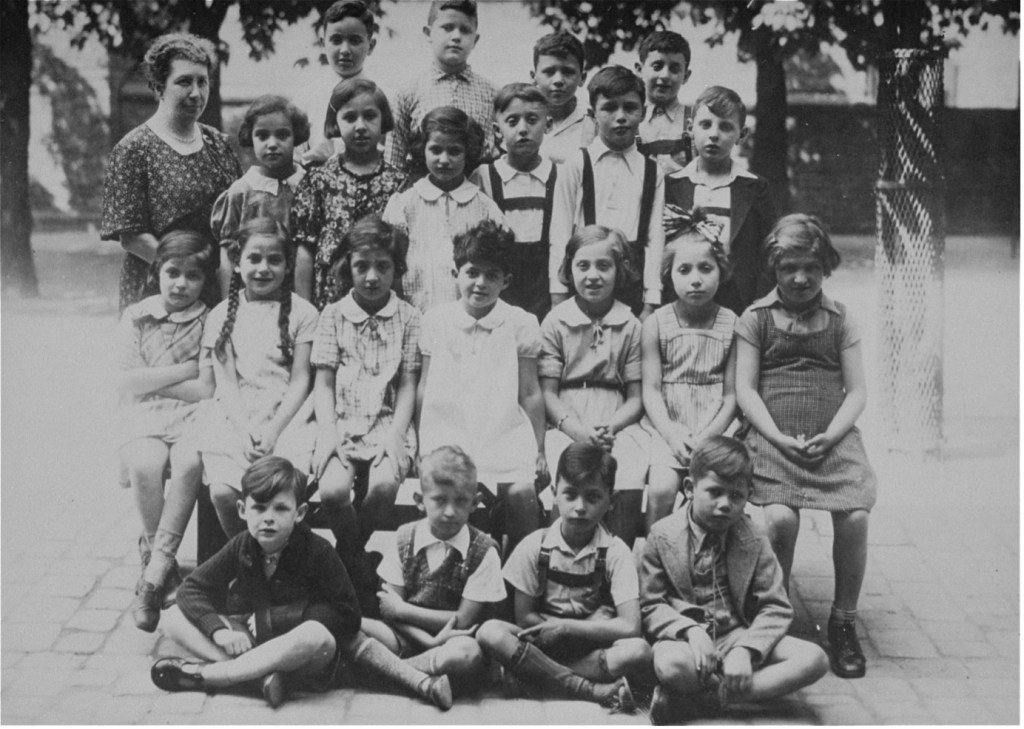
Pupils at a Jewish school in Karlsruhe, Baden state, July 1937 (Source: USHMM – https://collections.ushmm.org/search/catalog/pa27295, courtesy of Hanna Meyer-Moses)
To justify researching Germany’s non-Jewish ‘full Jews’, I set out, about a year ago, to work out precisely how many individuals fell into that category. At the outset, I admit that delineating the members of such a category is inherently an imprecise art. There is, of course, a great deal of fluidity between the two groups in question. I chose to define non-Jewish ‘Jews’ as those who did not self-identify as Jewish, a decision reflecting not just my upbringing in a pluralistic society but also the observable impact self-identity has on decision making. As I continued my research, it appeared increasingly likely that the approximately 20,000 people listed as ‘Nichtglaubensjuden’ (‘Non-Believing Jews’) in the 1939 census (in Germany, excluding Austria and the Sudetenland) perfectly matched my definition of this group. I began to suspect that one was unlikely to find self-identifying Jews (either secular or religious ones) inside the 20,000. Feeling compelled to do so, I began trying to prove this contention.
The full statistical calculations are provided in my forthcoming paper with the Journal of Holocaust Research, but some of the key facts are summarized below.[11]
The first fact I discovered is that the vast majority of ‘Nichtglaubensjuden’ were religious Christians. The second, and perhaps more indicative fact, is that the overwhelming majority of ‘Nichtglaubensjuden’ were married to other non-believing Jews or to so-called ‘Aryans’. I reasoned that self-identifying Jews would be unlikely to possess vehement objections to marrying other Jews. Even if one argues that secular atheistic Jews were amongst the ‘Nichtglaubensjuden’, one has to explain why they were so opposed to marrying religious Jews, but not religious Christians. Any argument that many of the ’Nichtglaubensjuden’ identified as Jewish but had converted for practical reasons is similarly flimsy. At the very least, such individuals, if they were to benefit from hiding their Jewishness, would have had to cut social links with the Jewish community. The only exception to this rule was within ‘mixed marriages’, where an individual may have converted to Christianity to facilitate marriage, whilst maintain a Jewish identity and Jewish social links. Importantly though, of the overall cohort of ‘Nichtglaubensjuden’, approximately 60% had never been in the Jewish community at all whilst only roughly a quarter of ‘Nichtglaubensjuden’ were in mixed marriages. Both of these statistics greatly lower the number of self-identifying secular Jews that we may expect to find amongst the ‘Nichtglaubensjuden’.
Extrapolating to 1933 is a far harder task. The unknown emigration rate of non-Jewish ‘Jews’ makes it likely that we will never know the true number of non-Jewish ‘full Jews’ in Germany in 1933. Regardless, it is undoubtedly the case that this group requires further research.
My forthcoming paper expands on this blog post and is expected to be published in July of this year. Any questions or criticisms would be happily received below or to this email address: harry.legg@gmail.com
[1] It is important to clarify, from the outset, that the Nazis certainly did murder 6,000,000 people they considered as ‘Jewish’.
[2] The best discussion of the two specific types of exit from the Jewish community is Peter Honigmann’s Die Austritte Aus Der Jüdischen Gemeinde Berlin 1873-1941: Statistische Auswertung Und Historische Interpretation (Peter Lang GmbH, Frankfurt, 1888),
[3] The exception to this rule is the minority of non-Jewish ‘full Jews’ that were married to ‘Aryans’. The Nazis judged that the damage to public morale, which measures against the ‘Jew’ in question would undoubtedly cause, justified delaying or even preventing the inclusion of these individuals in deportation actions.
[4] Mark L. Smith, The Yiddish Historians and the Struggle for a Jewish History of the Holocaust (Detroit, Wayne State University Press, 2019), 124.
[5] Raul Hilberg, Perpetrators Victims Bystanders: The Jewish Catastrophe 1933-1945 (London, Harper Collins, 1992); Bruno Blau, “The Jewish Population of Germany 1939-1945”, Jewish Social Studies 12, no. 2, (1950), 161-172; Katarzyna Person, Assimilated Jews in the Warsaw Ghetto, 1940-1943 (New York, Syracuse University Press, 2014); Eberhard Röhm and Jörg Thierfelder, Juden, Christen, Deutsche 1933-1945, 4 volumes in 7 sub-volumes (Stuttgart, Calwer Verlag, 1990-2007); Sigrid Lekebusch, Not und Verfolgung der Christen jüdischer Herkunft im Rheinland 1933-1945: Darstellung und Dokumentation (Pulheim, Rheinland-Verlag, 1995); Ursula Büttner and Martin Greschat., Die verlassenen Kinder der Kirche: Der Umgang mit Christen judischer Herkunft im Dritten Reich (Göttingen, Vandenhoeck & Ruprecht, 1998).
[6] Abraham Ascher, A Community under Siege: The Jews of Breslau under Nazism (Stanford, Stanford University Press, 2007), 124.
[7] Röhm and Thierfelder, Juden, Christen, Deutsche: Band 2/1: 1935-1938: Entrechtet (1991), 203-204.
[8] Gerald (Gerhard) Elsdon née Eisig, My Story, ed. by Phil Elsdon (unpublished manuscript, 1998-2000), 56.
[9] See especially, Lekebusch, Not und Verfolgung, & Mark Roseman and Jürgen Matthӓus’s repeated but brief mention of non-Jewish ‘Jews’ in Jürgen Matthaüs and Mark Roseman, Jewish Responses to Persecution Jewish Responses to Persecution: 1933-1938 – Documenting Life and Destruction: Holocaust Sources in Context (Lanham, Altamira Press, 2009), xxix, 34, 39, 89, 141-142 & 233.
[10] Marion Kaplan, “The School Lives of Jewish Children and Youth in the Third Reich”, Jewish History 11, no. 2 (1997), 41-52 (46).
[11] The vast majority of the statistics below come from either Honigmann, Die Austritte, or Blau, “The Jewish Population”, see references 2 & 5.
 The British and Irish Association for Holocaust Studies