
Dr. Daniela Ozacky Stern
Katarzyna Person, Warsaw Ghetto Police: The Jewish Order Service During the Nazi Occupation (Ithaca and London: Cornell University Press, 2021), 232 pages.
An early testimony in the Yad Vashem Archives tells of a Jewish policeman from the Białystok Ghetto, who performed his duty to the best of his abilities, as long as he was tasked with maintaining order in the Ghetto. But at the beginning of the first Aktion, when he was ordered to look for Jews in hiding and hand them over to the Germans, that policeman decided that he refused to carry out the order and stayed at home. He knew that this choice could endanger his life and the lives of his family, but nevertheless decided that he was not willing to dip his hands in this despicable job. Respect, conscience, and the feeling of humanity should remain above all – he thought. At the end of the Aktion, the policeman was fired from his job, was taken to work in forced labor, and was eventually murdered in Treblinka with his family.
I recalled this story as I read the new book by Dr. Katarzyna Person, one of the leading historians who currently works in Poland on the field of Holocaust Studies. Person has been working at the Jewish Historical Institute (Żydowski Instytut Historyczny; ŻIH) in Warsaw for many years. Her book deals with the Jewish police, a topic that is ostensibly written about and is well known, but it seems that there is much more to reveal and investigate. Person took on this important task and examined the experiences of the Jewish policemen in the Warsaw Ghetto during the war years and even after it from various and innovative angles. She analyzes the subject, using extensive skillful quotes, memoirs, and interviews. The book consists of ten chapters and is also based on testimonies from the policemen themselves and other Ghetto inmates.

On 16 November 1940, the walls of the Warsaw Ghetto were closed to its 380,000 inhabitants. The masses of refugees who flocked to Warsaw from elsewhere increased the number of inhabitants to about 450,000, and over time tens of thousands perished from poor conditions, famine, and disease. About two months earlier, Adam Czerniaków, a 59-year-old engineer, had been elected to head the Judenrat (Jewish Council) of the Jewish community in Warsaw, and his job was to mediate between the demands of the Germans and the needs of the Jews. On the day of his appointment, the Germans ordered him to establish a Jewish police force as a department of the Judenrat.
Establishment of the Jewish police
In her book, Person examines the place of the police in the Ghetto’s social network. She is trying to find out who joined the Ghetto police, and provides an unexpected answer: They were lawyers, engineers, yeshiva students, sons of businessmen, university graduates and more. The policemen came from Warsaw and its surroundings, but also from other cities like Łódź. They came from different backgrounds, from different ideologies. Many important questions are discussed in the book: What were their identities – Jewish or Polish? What happened to them after they enlisted in the police? What does this mean for a prisoner in the Ghetto to have an office, a desk, a job? Were they able to support their families? And what does it mean to belong to a defined group?
And perhaps one of the most interesting questions is whether the Jewish policemen themselves were victims, or murderers, sometimes even more dangerous than the Germans? Were they traitors to their people, or human beings who got into a horrible and inconceivable situation and did what they did to survive and save themselves and their families?
In retrospect we know that the policemen took part in the destruction of a large and prosperous community. Some assisted in the deportation of the Ghetto Jews to their deaths in Treblinka, there were police officers who acted with cruelty, corruption, humiliation, and contempt for their brothers and resorted to overt and covert violence.
The book presents the complexity of the situation. In the almost impossible life of the ghetto these young men were promised stable work, food rations, clothing, boots – for themselves and their families. No wonder they chose to engage in police work, but their choices had tragic consequences.
The Commander of the Jewish Police Szeryński
One of the most notorious Jewish policemen in the Warsaw Ghetto was Józef Szeryński, a talented and ambitious man with a strong, charismatic, and professional personality, who later became a controversial figure due to his role as commander of the Jewish Ghetto Police. He had a military and police background, and the author describes his glorious career before the war. Despite his suitable qualities, Szeryński was chosen to head the police only after two other candidates refused the position.
There are various testimonies as to how he, Szeryński, accepted the offer to command the police – did he initially hesitate or did he gladly accept the position, due to his difficult financial situation at the time and his professional ambition? We must remember that in October 1940, when Szeryński was appointed to the post, he could not know what actions the Jewish police would have to take in the coming years. Szeryński maintained good relations with Czerniaków, and they met regularly.
Person refers, among other things, to a body that was most identified with the Gestapo – the “The Office for the Prevention of Usury and Speculation”, which was known as The Thirteen (due to its office address on 13 Leszno Street). People who were members of the same ramified network of connections and organizations were exempt from forced labor and probably also from paying taxes to the Judenrat. In addition, they could leave the ghetto legally for short periods. The Thirteen was called a “Jewish Gestapo” in the Ghetto and was perceived as an organization made up of individuals who collaborated with the Nazis. There were also rumors about the organization’s commander, Abraham Gancwaich, a refugee from Łódź, that before the war he was a pimp and had his own office at the Gestapo headquarters. When the organization was disbanded in the summer of 1941, most of its members joined the ranks of the Jewish police.
Eradication of epidemics
Another interesting topic discussed in the book is the role of the Jewish police in the eradication of the typhus epidemic that spread in the Ghetto. In every act of disinfecting apartment, a police officer was present, in case he had to intervene and maintain order. In case they discovered a sick person with typhus, the police had to block the entire building where the patient lived and lead the other tenants to isolation or to the bathhouse. There have been cases of bribery of police officers to prevent the disinfection operation and transporting people outside their apartments. Many times, when the tenants were allowed to return to their homes, they found that these had been broken into and looted. The Jewish policemen were accused of failing to preserve the property of the residents and as a result, they were perceived by the Ghetto inmates as accomplices to the violence of the Germans and the Polish Blue Police.
Indeed, Person examines how the Jews of the Ghetto saw the police. The new authority the cops received excluded them from the community. Cops who got rich quick by accepting bribes were considered collaborators influenced by the Gestapo. They were perceived as part of the system of oppression that affected the “ordinary”, helpless Jews who tried to survive in the Ghetto. The behavior of the police symbolized the moral decline during the war, the disintegration of social ties and the loss of sensitivity to the suffering of other Jews. In the same context, Person quotes from the writings of the Jewish policeman Stanisław Adler: “Against a background of universal impoverishment and misery, this contemptible conduct made a macabre impression and created a wall not only of antipathy, but of vehement hatred between them and the rest of the population” (p. 82). The Ghetto inmates refused to believe that guys who until recently were acquaintances, neighbors and even relatives, were entitled under their new status to give them orders, humiliate them and abuse them. These hard feelings towards the policemen caused hatred and contempt towards them. There were cops who took advantage of the new power given to them and their authority for self-interest. Violence, corruption, and abuse of power were an integral part of the police. On the other hand, the policemen themselves tried to justify their behavior and claimed the enormous pressure they were under.
The Great Deportation to Treblinka
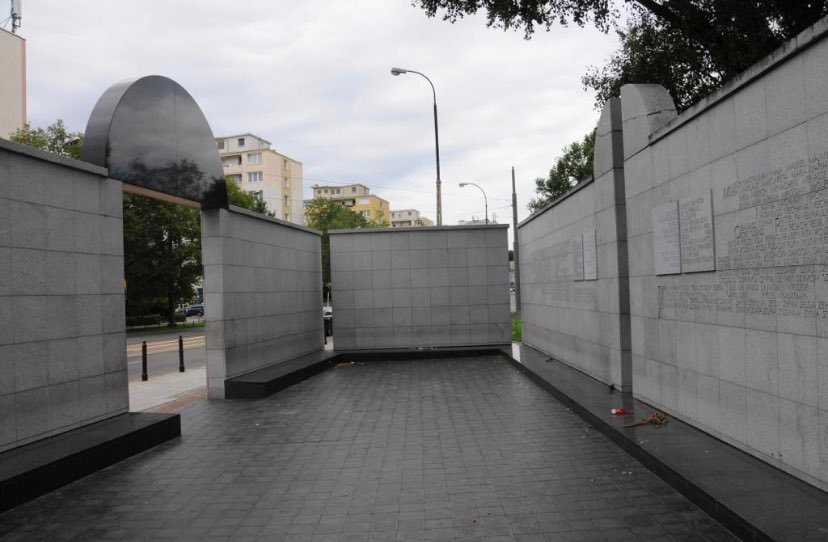
One of the infamous policemen was Mieczysław Szmerling, who managed the operations at the Umschlagplatz, where residents of the Warsaw Ghetto were taken before being transported to Treblinka. Apart from escorting deportees, members of the Jewish Police also took over the 24-hour watch at the spot. Police Chief Szeryński was arrested on 1 May 1942, on charges of handing over his wife’s fur coat to a Polish policeman. A few days after his imprisonment, which surprised the residents of the Ghetto, Jakub Lejkin, another figure known for his cruelty, replaced him as police chief.
On the morning of 22 July 1942, Lejkin was required to report to the Judenrat building where he was informed of the deportation plan. The Jewish police were instructed to carry out the operation. Person describes in detail the chain of events that day and in the following days in a chapter known as “Umschlagplatz”. The Jewish police were forced to bring 6,000 Jews to this place every day and they did carry out the mission using violence. Another cruel role they had to perform was to keep the Jews in the Umschlagplatz and prevent escapes. Szmerling supervised the Umschlagplatz during the day and was known for his aggressive and brutal behavior towards the deportees. The head of the Judenrat Czerniaków, on the other hand, took his own life the day after receiving the order to start the deportation.
The brutal deportation was an opportunity for the police to make money, as bribery was a means of freeing themselves from the obligation to report to the Umschlagplatz. Jews paid police officers in cash, jewelry, and other valuables so they would not be deported, and the author quotes diary writer Chaim Kaplan, who noted that the price of freedom is increasing daily.
As in other Ghettos, many of the policemen in Warsaw shared a fate similar to that of the other inmates. During the brutal Aktion called “The Cauldron” in September 1942, the police were given 500 “life permits” for themselves and their families. Anyone who did not receive this permit was forced to report with his family to the Umschlagplatz. The author tells of this difficult scene, and of the pleas of the policemen who asked for the permits, which were not enough for everyone. She quotes Abraham Lewin who wrote in his diary on 23 September that the Jews who saw this spectacle of the policemen being taken to the Umschlagplatz felt a definite satisfaction. This is the reward for their brutal acts against the Jews of Warsaw (p. 135).
Police Trials
A chapter in the book is devoted to trials held for Jewish policemen after the war. As early as 1946, legal action was taken against people who in one way or another collaborated with the Nazi authorities during the occupation, and attempts were made to expose the “traitors to their people”, on whose consciences lay tens, hundreds, and thousands of victims. It is interesting to note that the court did not impose liability on the Jewish police as a body, but each policeman was treated individually according to the acts he committed. A major goal was to find out to what extent the officers acted under duress and whether they could avoid police service. Indeed, there were voices who believed that in that time of chaos and disorder it was possible to evade the execution of German orders. Some of the policemen tried to justify their behavior and actions, claiming that overall, they were a small part of the Jewish police machine, and that they had no control over the actions, so they could not be held responsible for the acts attributed to them (p. 151).
In conclusion, despite the cruel descriptions of the actions of the Jewish police, Person asks in her book who was actually responsible for the role played by the Jewish police in the history of the Warsaw Ghetto? Is it possible to discuss the story of the policemen through the prism of the “Gray Zone”, the term coined by Primo Levi, which blurs the clear line between perpetrators and victims? Were the policemen themselves victims, or were they perpetrators who contributed to the extermination of their people? What role did the Jewish policemen play in the anti-Jewish policy of the Germans in Poland? We should not generalize all the policemen as one. The Jewish police should not be treated as a uniform and rigid body but should be dismantled and see the individuals who made it up. Each had a different background, different motives, and a different view of the situation. However, at the heart of it all is the question of choice: How did each of them choose to act in real time? What will a person do to protect himself and his family in extreme situations? How far will they go and what boundaries will they be willing to cross?
Perhaps the most interesting question is: did they have a choice? It seems that they did. Even in the most difficult situations, such as those that took place in the Umschlagplatz, the policemen had a choice. And as we learn, the level of sadism and cruelty varied from person to person.
Will Katarzyna Person’s book change the prevailing views of Jewish policemen as collaborators with the Nazis? There is no doubt that the book offers a broader, more complex, and multi-dimensional picture. In her choice to deal with the highly sensitive issue of Jewish collaboration during the Holocaust, the author adds new angles to our knowledge and makes a significant contribution to the discussion.

 The British and Irish Association for Holocaust Studies
One thought on “The Jewish Police in the Warsaw Ghetto: Between Duress and Violence”
Comments are closed.