
By Elisheva Joshua
Elisheva Joshua is a current law student at BPP Law School who also holds a BA in English from King’s College London. Elisheva writes widely on topics relating to untold narratives during the Holocaust, Holocaust denial, the Holocaust as evil and literature and anti-Semitism.
The millions of Jews killed by the Nazis performed Kiddush Hashem by falling, in the spiritual battle between Nazism and Judaism.
Esther Farbstein, Hidden in Thunder, Perspectives on Faith, Halachah and Leadership During the Holocaust[1]
Spiritual resistance as a phenomenon has been conceptualised in different ways. The connection between the different ways of understanding spiritual resistance all amalgamize to one fundamental foundation: the Jewish resistance against Nazism.
An unfortunate narrative that surfaced post-Holocaust was the wrongful belief that Jews were led to their deaths ‘like sheep to the slaughter house’, and did nothing to resist oppression.[2] While this claim is deeply flawed from evidence of physical defiance (for instance, the Warsaw Ghetto Uprising) spiritual resistance is an untold story of the battle Jewish victims fought during the Holocaust, resisting Nazi infiltration by preserving and maintaining their Jewish soul. This type of resistance is so important that Holocaust specialist and Historian Jacob Robinson notes, ‘passive resistance cannot be distinguished from active or physical resistance’ during the Holocaust.[3] This is because Germans punished for defiance of orders and observance of religious commandments, making no separation between the two.[4] During the genocide, the Nazis fought with satanic hatred ‘not only against “the Jews” but also against everything “Jewish”’.[5] While evidence of physical resistance is well-documented in Holocaust studies, the silent spiritual battle is still very much a lacuna in existing scholarship.[6]
My research involves breaking the institutional silences surrounding an already quiet discourse. I seek to bring a voice to spiritual resistance and illuminate moments where they surface.
Spiritual Resistance
Spiritual resistance has been mainly understood in three ways. Firstly, Rabbi Issac Nissenbaum coins the term Kiddush Hahayim to relate to spiritual resistance. [7] Nissenbaum explores Kiddush Hahayim as relating to instances where Jewish victims of the Holocaust sought to observe religious commandments and Jewish festivals in the face of brutal oppression. Nissenbaum’s understanding of what spiritual resistance is in the context of the Holocaust, is deeply unique, special to the specific genocide of the shoah.
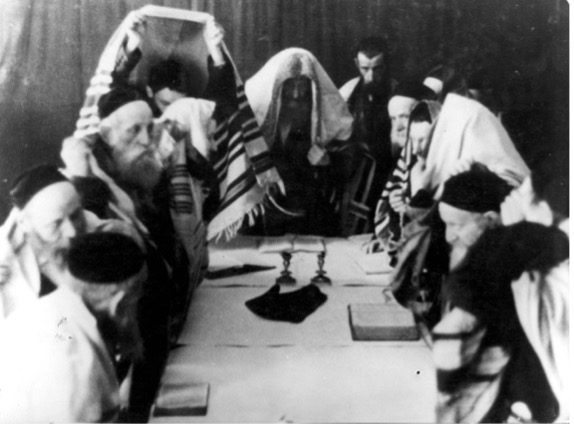
October 1940, Jews at prayer on Yom Kippur (Day of Atonement) in Krakow, Poland. Yad Vashem Photo Archives 1663/19
Secondly, spiritual resistance is conceptualised in its conventional understanding of Kiddush HaShem, that being the incomprehensible spiritual strength exercised by Jewish victims of the Holocaust before death, whereby there exists a ‘readiness to suffer martyrdom (in which) a man brings home to others an awareness of G-d’.[8] Kiddush HaShem involves reciting Shema or Vidui in preparation for death, glorifying G-d’s Name and resisting Nazi ideology.
Indeed, Jews murdered for their faith are kaddosh (holy), since the Holocaust was a time of Shemad (religious persecution), every Jewish victim died through Kiddush HaShem: ‘all six million Jews are kaddosh’.[9] Victor Frankl articulates how:
Man is the being who invented the gas chambers of Auschwitz; however, he is also that being who entered those gas chambers upright, with the Lord’s Prayer or the Shema Yisrael on his lips.[10]
Praying before death, especially the recitation of the Shema or Vidduy, was more commonplace throughout Holocaust testimony than conventionally understood.[11] A specific aspect of Kiddush Hashem was also related to ‘attempts to save the holy scrolls’.[12] After burning down a synagogue in September 1939, the Germans ordered Mottle Hochman to tear up a Scroll of Law or he would be shot:
“The officer gave the order to shoot the Jew. Two soldiers brought him over and stood him against the wall and prepared to shoot him. Hochman raised his voice and cried, “Shema Yisrael” [Hear 0 Israel, the Lord our God, the Lord is One]”.[13]
Under these conditions, what spiritual resistance provided, was ‘not how to avoid suffering…but how to suffer’, how to generate meaning in suffering.[14] It has been questioned, ‘where did the Jews derive the spiritual power to endure the sufferings?’.[15] This question exposes the existence of the inner spiritual battle; how Jews endured suffering and persecution through spirituality. Accessing inner spiritual strength, the martyrs, murdered for their faith, sought ways to make suffering meaningful, ascribing to a higher existence. These moments display the capabilities of man.

Lastly, spiritual resistance includes an internal preservation of the soul, evolving from instances where prayer especially, manifests as spiritual ammunition, self-defence against Nazi ideology and oppression. Preserving the Jewish soul reverberates a silent battle, since it gestures towards the construction of an inner existence, untouchable by the Nazis. Indeed, ‘at a time when human beings were stripped naked of everything, even of their names, the only resource available to them was their inner spiritual strength’.[16]
Salvations came about from harnessing spiritual self-defences:
“How did I avoid all the dangers? I can’t explain that myself. German patrols chased after me many times. Queer things happened to me. But I never gave a thought to my security. I said the Traveler’s Prayer (tefillas haderech) with great concentration, and I came out alive despite all the enemies and traps and wild beasts that infested the roads”.[17]
Spiritual resistance allowed for an altered set of circumstances for the Holocaust victim, affording a choice of how to approach reality, and even delivering from danger and death. Survivor from Chrznow, Moshe Rosenwasser, explains: ‘I was able to withstand that temptation and in a large measure my success was due to the spiritual ties’.[18] These spiritual ties, the inner sanctum inside the soul of the Jew, provided a spiritual experience of reality, uncontrollable by the Nazi. Articulated by survivor Vernon:
“I was not going to let the Germans steal my soul; I decided that from the first day (…) I knew that if I was going to survive, I had to hold onto only G-d because that was the only way I could hold only my soul”.[19]
Testimonies that relate to spiritual resistance counter false narratives regarding how Jewish victims fought back against Nazi oppression, demonstrating an absolute uncompromising hold onto the Jewish soul and observance of religious commandments and festivals. These testimonies gesture towards a paradigm of untold stories. The telling of one story in the Holocaust, gestures at the unknown six million stories, the telling of which is the telling of one single story: the persecution against the Jew and the Jew’s resistance.
References
[1] Esther Farbstein, Hidden in Thunder, Perspectives on Faith, Halachah and Leadership during the Holocaust, trans. Deborah Stern, (Vol I, II), (Jerusalem: Mosad Harav Kook, 2007), p.446.
[2] This phrase is derived from a similar phrase in the Hebrew Bible which depicts martyrdom, but has been wrongly misappropriated to refer to the Jewish condition during the Holocaust. See: Isaiah 53:7 ‘Like a sheep being led to the slaughter or a lamb that is silent before her shearers, he did not open his mouth’. Importantly, Abba Kovner fought against the use of this phrase, declaring ‘We will not be led like sheep to slaughter’, since its misappropriation is both insulting and untrue. See: Abba Kovner, ‘Let us not go like sheep to the slaughter’ in Richard Middleton-Kaplan, “The Myth of Jewish Passivity”, in Patrick Henry (ed.), Jewish Resistance Against the Nazis, (Washington D.C: Catholic University of American Press, 2014), pp. 3–26.
[3] James M Glass, Jewish Resistances During the Holocaust, (New York: Palgrave, 2004); Pesach Schindler, Hasidic Responses to the Holocaust in Light of Hasidic Thought, (New York: Ktav Publishing House, 1990), p. 45, p. 57.
[4] Glass, p.35.
[5] Moshe Yehoshua Aronson, Alei Merorot: Yomanim, Shut, Hagut ba-Shoah (Leaves in Bitterness: Diaries, Responsa, and theology in the Holocaust), (Bnei Berak, 1996). p.305. Elie Wiesel famously expounds ‘the Holocaust involved not man’s inhumanity to man, but man’s inhumanity towards Jews’, see: ‘Dedication of Yad Vashem Holocaust History Museum’, (Jerusalem: Israel, 2005):https://www.americanrhetoric.com/speeches/eliewieselyadvashemdedication.htm, (Accessed 24 May 2021).
[6] Many Holocaust researchers acknowledge this, see: Havi Dreifuss, ‘Holocaust and Post-Holocaust: Gerer Youths in the Holocaust, A Representative Blindspot in Holocaust Research’. See also: Havi Dreifuss ‘Orthodox Jews During the Holocaust: An Ongoing Lacuna of Research’, Historiography of the Holocaust, (Moreshet, 2020). Articles provided to me by the author.
[7] Rabbi Nissenbaum’s writings are collected and published by I. Shapira, Ha-Rav Yizhak Nissenbaum, (1951).
[8] Schindler, p.3.
[9] See: Gill Backenroth, “Six Million Kodoshim”, (Yated Ne’eman, 2019) https://yated.com/six-million-kedoshim/ (Accessed 24 May 2021); See also :Ahron Lopiansky, “The Six Million Kedoshim: Why We Refer To Those Who Perished in the Holocaust as Kedoshim”, (Aish Hatorah, 2003), https://www.aish.com/ho/i/48955481.html, (Accessed 24 May 2021).
[10] Viktor Frankl, Man’s Search for Meaning, (England: Ebury Publishing, 2004), p.136.
[11] Schindler, p.61. Rabbi Israel Shapira prepared for death, maintaining ‘we merited that our ashes will purify the whole of Am Yisrael (the Nation of Israel)’. ‘We are obligated not to hesitate and to not cry as we walk into the furnace; we must be happy, while singing Ani Ma’amin (I believe with perfect faith). And just as Rabbi Akiva did when he was murdered we will say the Shema Yisrael when the time comes’. See: Rabbi Kalonymus Kalman Shapira, Esh Kodesh (Holy Fire), (Maryland: Rowman & Littlefield Publishers, 2004), p.169. See also: Rabbi Shapira, Emunat Yisrael,https://hebrewbooks.org/pdfpager.aspx?req=3894&st=&pgnum=2&hilite (Accessed 24 May 2021), p.4. See also: Farbstein, p.462-3.
[12] Shimon Huberband, Kiddush Hashem: Jewish Religious And Cultural Life in Poland During the Holocaust, trans. David E. Fishman, ed. Jeffry S. Gurock, Robert S. Hirt, (New York: Yeshiva University Press, 1987, p.xii.
[13] Huberband, Yad Vashem Archives, 03/3077.
[14] Don Seeman, Ritual Efficacy, Hasidism and “Useless Suffering” in the Warsaw Ghetto, The Harvard Theological Review, 101.3/4, (Cambridge University Press, 2008), pp. 465-505, (p.466).
[15] Huberband, p.x.
[16] Yaffa Eliach, Hasidic Tales of the Holocaust, (New York: Vintage Books, 1982), p.xx.
[17] Moshe Prager, Eleh Shelo Nikhne’u (Those Who Never Yielded), (Israel Bookshop Publications, 2003), p.58.
[18] Prager, p.61.
[19] Glass, p.110.
Bibliography
Aronson, Moshe Yehoshua, Alei Merorot: Yomanim, Shut, Hagut ba-Shoah (Leaves in Bitterness: Diaries, Responsa, and theology in the Holocaust), (Bnei Berak, 1996)
Backenroth, Gill, “Six Million Kodoshim”, (Yated Ne’eman, 2019) https://yated.com/six-million-kedoshim/ (Accessed 24May 2021)
Seeman, Don, Ritual Efficacy, Hasidism and “Useless Suffering” in the Warsaw Ghetto, The Harvard Theological Review, 101.3/4, (Cambridge University Press, 2008)
Dreifuss, Havi, ‘Holocaust and Post-Holocaust: Gerer Youths in the Holocaust, A Representative Blindspot in Holocaust Research’
Dreifuss, Havi, ‘Orthodox Jews During the Holocaust: An Ongoing Lacuna of Research’, Historiography of the Holocaust, (Moreshet, 2020)
Eliach, Yaffa, Hasidic Tales of the Holocaust, (New York: Vintage Books, 1982)
Farbstein, Esther, Hidden in Thunder, Perspectives on Faith, Halachah and Leadership during the Holocaust, trans. Deborah Stern, (Vol I, II), (Jerusalem: Mosad Harav Kook, 2007)
Frankl, Viktor, Man’s Search for Meaning, (England: Ebury Publishing, 2004)
Glass, James M, Jewish Resistances During the Holocaust, (New York: Palgrave, 2004
Huberband, Shimon, Kiddush Hashem: Jewish Religious And Cultural Life in Poland During the Holocaust, trans. David E. Fishman, ed. Jeffry S. Gurock, Robert S. Hirt, (New York: Yeshiva University Press, 1987)
Huberband, Shimon, Yad Vashem Archives, 03/3077
Kovner, Abba, ‘Let us not go like sheep to the slaughter’ in Middleton-Kaplan, Richard, “The Myth of Jewish Passivity”, in Henry, Patrick (ed.), Jewish Resistance Against the Nazis, (Washington D.C: Catholic University of American Press, 2014)
Lopiansky, Ahron,“The Six Million Kedoshim: Why We Refer To Those Who Perished in the Holocaust as Kedoshim”, (Aish Hatorah, 2003), https://www.aish.com/ho/i/48955481.html, (Accessed 24 May 2021)
Prager, Moshe, Eleh Shelo Nikhne’u (Those Who Never Yielded), (Israel Bookshop Publications, 2003)
Schindler, Pesach, Hasidic Responses to the Holocaust in Light of Hasidic Thought, (New York: Ktav Publishing House, 1990)
Shapira, I. Ha-Rav Yizhak Nissenbaum, (1951)
Shapira, Rabbi Kalonymus Kalman, Esh Kodesh (Holy Fire), (Maryland: Rowman & Littlefield Publishers, 2004)
Shapira, Rabbi, Emunat Yisrael, https://hebrewbooks.org/pdfpager.aspx?req=3894&st=&pgnum=2&hilite (Accessed 24 May 2021)
Wiesel, Elie, ‘Dedication of Yad Vashem Holocaust History Museum’, (Jerusalem: Israel, 2005)
https://www.americanrhetoric.com/speeches/eliewieselyadvashemdedication.htm, (Accessed 24 May 2021)
 The British and Irish Association for Holocaust Studies
One thought on “A Silent Battle: Spiritual Resistance During the Holocaust”
Comments are closed.