By Daniel Adamson
Daniel Adamson is a PhD student in the History Department of Durham University. His research centres on educational portrayals of the relationship between Britain and the Holocaust.
“When I thought of the past, it often seemed to me that all this was merely a horrible dream. My only desire was to forget everything, to think of nothing”.
Miklós Nyiszli, Auschwitz: A Doctor’s Eyewitness Account (1946)
Introduction
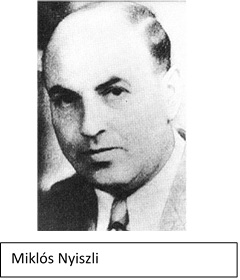
1946 saw the publication, in Romania, of an extraordinary memoir of life as a prisoner at Auschwitz. Its author was Miklós Nyiszli, a Hungarian medical doctor of Jewish descent, who had been arrested alongside his family in 1942, and transferred to Auschwitz in 1944. Originally titled I was Dr. Mengele’s Pathologist in Auschwitz, the memoir is now more commonly known as Auschwitz: A Doctor’s Eyewitness Account. Within, Nyiszli relates the atrocities he witnessed at Auschwitz, where he was compelled to assist the twisted medical experiments that were undertaken in the infamous number 12 barracks at the camp.
Reflection upon Nyiszli’s work reveals it to carry significant historical weight, even though it is a slim volume. It is somewhat surprising that Auschwitz: A Doctor’s Eyewitness Account has not occupied a more prominent position within the existing corpus of Holocaust testimonies. Reflection in the modern day upon Nyiszli’s words reveals a historical account that is striking in its incision, and which offers an important contribution to contemporary social and political landscapes. Nearly 75 years after its first iteration, perhaps it is time for Auschwitz: A Doctor’s Eyewitness Account to move towards the foreground of public Holocaust consciousness.
The story of Nyiszli
Nyiszli was born in 1901 in Transylvania, then part of the Kingdom of Hungary. Following qualification as a medical doctor in 1929, Nyiszli moved to Germany in order to specialise in forensic pathology. In 1937, Nyiszli and his family returned to Transylvania before moving to Hungary in 1940. After deportation to the Desze work camp in 1942, Nyiszli arrived at Auschwitz in 1944.
Nyiszli’s familiarity with pathology attracted the attention of the notorious Auschwitz camp physician Josef Mengele. Auschwitz: A Doctor’s Eyewitness Account relates how Nyiszli’s time at Auschwitz was spent performing autopsies and assisting with Mengele’s warped medical schemes. From this viewpoint, Nyiszli was able to observe the everyday functions of the Auschwitz camp, as well as notable flashpoints such as the prisoner revolt of October 1944. Nyiszli documented a litany of horrors: mass exterminations, appalling living conditions, and acts of extreme cruelty.
Shortly before the liberation of Auschwitz in January 1945, Nyiszli was evacuated from the camp along with over 60,000 other prisoners on a notorious ‘death march’. At the end of the Second World War, Nyiszli found himself in the Ebensee camp in Austria, before starting the long homeward journey to Transylvania.
Style and form
The literary features of Auschwitz: A Doctor’s Eyewitness Account are certainly striking. Nyiszli’s prose is characterised by a scalpel-like precision which mirrors the surgical tasks he was forced to carry out at Auschwitz. There is little room for flair or metaphor: Nyiszli himself noted that he related his story ‘not as a reporter but as a doctor’.[1] For some, Nyiszli’s tone could appear dry. However, this style itself provides a major contribution to the historical use of the memoir. Nyiszli writes with a clarity which enables the reader to accrue a clear sense of the structures and routines of life at Auschwitz. This is perhaps not coincidental. By most accounts, Nyiszli recorded his testimony with a direct view to its use in post-war legal action, and indeed he testified at the Nuremberg trials in October 1947. Nyiszli’s coldly-factual description of the Auschwitz extermination process is typical of this trait:
The bodies were cremated in twenty minutes. Each crematorium worked with fifteen ovens, and there were four crematoriums. This meant that several thousand people could be cremated in a single day. Thus for weeks and months—even years—several thousand people passed each day through the gas chambers and from there to the incineration ovens. Nothing but a pile of ashes remained in the crematory ovens. Trucks took the ashes to the Vistula, a mile away, and dumped them into the raging waters of the river.[2]
As such, Nyiszli’s work is set apart from more ruminative memoirs such as Viktor Frankl’s Man’s Search for Meaning (1946), or even If This Is a Man (1947) by Primo Levi. Nyiszli is less occupied with existential meditation than a concern to document in detail the horrors which he witnessed. Auschwitz: A Doctor’s Eyewitness Account has long provided a touchpoint for historians of the Holocaust. However, the composition of the memoir arguably lends itself less kindly to a mass commercial market that, in general, has tended to favour more contemplative works. Indeed, the recent success of the Holocaust fiction industry – the limitations of which have been debated at length elsewhere – provides further evidence of the mass market to gravitate towards more dynamic prose. Even so, Nyiszli’s memoir has proved itself to possess some cinematographic qualities. The haunting Hungarian film Son of Saul (2015) drew extensively on Nyiszli’s account as a narrative guide for its depiction of life in a concentration camp.
Rightly or wrongly, Holocaust consciousness has become increasingly preoccupied with forward-facing ‘lessons’ to be learned. The relative rigidity with which Nyiszli chronicled his experiences perhaps does not lend itself kindly to such a framework. Auschwitz: A Doctor’s Eyewitness Account provides an effective snapshot of the past, without necessarily offering a guide for the future of humanity.

Historiographical position
In a wider historiographical sense, Nyiszli’s memoir has occupied an uneasy position since its publication. The work has found itself caught in the crossfires of several different perspectives on the Holocaust. Auschwitz: A Doctor’s Eyewitness Account has attracted criticism from the Israeli historian Gideon Greif for the way in which the memoir presented ‘myths and other wrong and defamatory accounts’ of the actions of the Auschwitz Sonderkommando, especially in the relative absence of complementary testimonies from Sonderkammando members who survived the Holocaust.[3]
Equally, it is axiomatic that Nyiszli’s experiences cannot necessarily be described as typical of most prisoners at Auschwitz. As a quasi-member of staff, Nyiszli’s living conditions were different to those of most prisoners. Nyiszli’s skills allowed him to perform a specialised function within the camp that was somewhat removed from the wider prisoner community. Moreover, inmates who actually survived Auschwitz represented a mere fraction of the total number of the camp prisoners who perished. Compared to a survivor such as Primo Levi, Nyiszli’s viewpoint on the Auschwitz internment process was more esoteric, and perhaps explains why commentary on the work has at times hinted at the limited general utility of Auschwitz: A Doctor’s Eyewitness Account. In other words, Nyiszli’s account has been interpreted as unrepresentative of wider prisoner experiences.
Nyiszli’s camp experiences also feed into further debates surrounding the demarcation of agency and victimhood in the Holocaust. Few would claim that Nyiszli willingly performed his medical role in Auschwitz. However, Nyiszli’s story has naturally sparked discussion regarding the roles that existed in grey areas during the period: collaborators, bystanders, observers, and so forth. As early as 1960, the psychologist Bruno Bettelheim – in his foreword to the first English edition of Auschwitz: A Doctor’s Eyewitness Account – questioned whether Nyiszli had chosen the preservation of his own life over the preservation of his integrity by electing to assist Mengele. Indeed, Bettelheim chastised Nyiszli as becoming ‘a tool of the SS to stay alive’.[4] Such deliberations are not necessarily helpful for historians, given the risk of moralising the actions of people of the past. In the introduction to the 2012 edition of Nyiszli’s account, Sir Richard J. Evans himself notes that ‘readers have to judge for themselves’ whether the testimony represents ‘a man blind to the immorality of what he was doing…too weak to go to his own death by refusing to collaborate?’.[5]
The experiences of Nyiszli, a Hungarian, also have particular resonance in a modern political context. Hungarian Holocaust memory is troubled, and often finds itself caught between a reluctance to acknowledge Hungarian complicity and a contesting eagerness to commemorate the Holocaust in at least some form. The ambiguity of Nyiszli’s own experiences add further complications to the tangled contemporary narrative which is emergent in Hungarian public discourse.
Regardless of Nyiszli’s precise place within the dynamics of the Auschwitz camp, Auschwitz: A Doctor’s Eyewitness Account can provide a useful springboard from which to diversify black-and-white narratives of ‘victims’ and ‘perpetrators’. The Holocaust was a complex process, enacted by a diverse dramatis personae. Nyiszli’s account is testimony to this fact. Equally, by providing a microcosmic account of a unique experience within a camp, Nyiszli’s work can also offer balance to more sweeping histories of the Holocaust, within which individual human voices sometimes can be lost. Nyiszli’s testimony, therefore, has the potential to occupy a valuable future role in the field of Holocaust education.
Conclusion
Miklós Nyiszli’s testimony provides a haunting depiction of life at the heart of the Nazi killing machine. Beneath the detached exterior of Nyiszli’s prosaic writing style lie evocative questions which strike at the very heart of several debates which continue to rage in the field of Holocaust studies.
There are several possible ways to explain why Auschwitz: A Doctor’s Eyewitness Account has not truly occupied the foreground of Holocaust literature since its publication. Although clinical prose is, in many ways, the raison d’etre of Nyiszli’s testimony, its has perhaps proved itself less marketable on a mass level. It is possible that Nyiszli’s prose is simply too sterile for public tastes. It is also of note that Nyiszli eschewed public life after the Second World War, and died in 1956. As general interest in the Holocaust has gained momentum, Nyiszli has not been present to contribute to public discourse in the same way as other survivors such as Elie Wiesel.
The horrors described by Nyiszli suggest that readers might best hope to acknowledge, rather than understand, the events of the Holocaust. Nevertheless, the ‘documentary realism’ with which Nyiszli logged his experiences has provided for posterity an invaluable historical record of life at Auschwitz.[6] Clearly, there is ample scope for further exploration of both Nyiszli’s life and his memoir. In particular, one cannot feel that the merits of Auschwitz: A Doctor’s Eyewitness Account as an educational tool have, thus far, been overlooked.
Further reading
Posner, M. (2016). SON OF SAUL On the Human Imperative. Queens Quarterly, 123(1), 78-87.
Turda, Marius (2014). “The ambiguous victim: Miklós Nyiszli’s narrative of medical experimentation in Auschwitz-Birkenau”. Historein : A Review of the Past and Other Stories / An … Publication of the Cultural and Intellectual History Society. Europe PMC Funders Group. 14 (1): 43–58.
Miklós Nyiszli, Evans Richard J. In: Auschwitz: A Doctor’s Eyewitness Account. Tibère Kremer, Richard Seaver., translators. Penguin; London: 2012
Image credits
https://books.apple.com/gb/book/auschwitz-a-doctors-eyewitness-account/id556848565
https://www.goodreads.com/author/show/2939184.Mikl_s_Nyiszli
[1] Turda, Marius (2014). “The ambiguous victim: Miklós Nyiszli’s narrative of medical experimentation in Auschwitz-Birkenau”. Historein : A Review of the Past and Other Stories / An … Publication of the Cultural and Intellectual History Society. Europe PMC Funders Group. 14 (1): 43–58.
[2] Miklós Nyiszli, Evans Richard J. In: Auschwitz: A Doctor’s Eyewitness Account. Tibère Kremer, Richard Seaver., translators. Penguin; London: 2012. p. 56.
[3] Greif, Gideon and Andreas Kilian, “Significance, responsibility, challenge: Interviewing the Sonderkommando survivors”, Sonderkommando-Studien, 7 April 2004.
[4] Miklós Nyiszli, Evans Richard J. In: Auschwitz: A Doctor’s Eyewitness Account. Tibère Kremer, Richard Seaver., translators. Penguin; London: 2012. p. 171.
[5] Miklós Nyiszli, Evans Richard J. In: Auschwitz: A Doctor’s Eyewitness Account. Tibère Kremer, Richard Seaver., translators. Penguin; London: 2012. p. xxii.
[6] Turda, Marius (2014). “The ambiguous victim: Miklós Nyiszli’s narrative of medical experimentation in Auschwitz-Birkenau”. Historein : A Review of the Past and Other Stories / An … Publication of the Cultural and Intellectual History Society. Europe PMC Funders Group. 14 (1): 43–58.
 The British and Irish Association for Holocaust Studies