By Adina Dymczyk and Thorsten Fehlberg
Thorsten Fehlberg is a political scientist and social geographer. He works for the Neuengamme Concentration Camp Memorial. He worked for the non-governmental organisation Bundesverband Information & Beratung für NS-Verfolgte e.V. (https://www.nsberatung.de/index.php/de/) as project manager mainly for projects concerning the topic “Descendants of Nazi victims” from 2013 until 2019.
Adina Dymczyk is working on her doctorate at the Humboldt University of Berlin on the phenomenon of transgenerational transmission of trauma. Her PhD is funded by the Friedrich-Ebert- Stiftung. In 2018 she coordinated working groups concerning the topic “descendants of Nazi victims”. She still is a member of Bundesverband Information & Beratung für NS-Verfolgte e.V.
The after-effects of Nazi violence are clearly visible in the biographies of descendants of the persecuted. But many of them have organised themselves into self-help groups or are even politically active. The effects of persecution on descendants’ lives have been demonstrated in research on transgenerational transmission of trauma and research on the continuation of discrimination. “In conversation with descendants of different persecuted groups, similarities emerge, characterised by the individual’s experiences, or by familial and social narratives.” (Dymczyk and Fehlberg 2019: 14).
After-effects
One similarity in descendants ́ narrations is that many surviving victims did not talk about their experiences after the persecution. This was done in order to protect their children. Additionally, children did not dare to ask their parents and, for example, German survivors in particular, were afraid to talk due to the continuity of personnel in the judiciary and in politics. A number of studies have dealt with the effects of the Holocaust on subsequent generations (Barel et al. 2010; Sagi-Schwartz 2015; for an overview, see also Freyberger et al., 2015). Danieli (1998) considered it as proven that traumatic experiences can be passed on to future generations. Now, several years after the release of her article, even more studies exist. In more recent years, studies on epigenetic transmission have also been published (Yehuda, 2016; Kellermann, 2011).
Some descendants consider the research on ‘transgenerational transmission of trauma’ as helpful to understand their situation, whilst others reject it. At an individual level, there is the dilemma of how relatives and descendants can identify as members of the second generation, without having to represent themselves as victims (Spiegel, 2019). Although it should not be assumed that all descendants are necessarily affected by their family history, it is important to take the specific needs of those who are affected by the persecution of their ancestors seriously.
Descendants, whose parents were persecuted due to racist stereotyping, are often confronted with hostilities with references to Nazi Crime. In (autobiographical) books for example, Reinhardt (2014) or Laubinger (2018), the authors describe the connections between family persecution and group focused enmity. Diddens and Bernstein (2019) argue that Jewish people experience hostilities with both open and disguised references to National Socialism. Sometimes anti-Semitism hides behind the excuse that it is only a critique of Israel and neglects their use of traditional anti-Semitic or anti-Jewish prejudice. Although the continuity of discrimination is partly linguistically disguised, the constructs of rejection and disparagement remain similar. Descendants of the victims of Nazi persecution are very much aware of these continuities of discrimination and hostility. Only if we take the affected person’s perspective into
consideration, is it possible to overcome the shadows of the past.
Experiences of discrimination are often the reason for descendants becoming politically active. Fogelman (2001) describes how many descendants use their voices against forms of discrimination, not just in relation to their family history of persecution. However, no one should expect that descendants of survivors should talk about their experiences of discrimination or traumatisation, as both are often a reason for shame. Nevertheless, they should be given the opportunity to do so if they wish, in order to raise awareness about the discrimination.

Discrimination and Hostilities
Today, many descendants express the desire to talk about their commitment and motivation in fighting against past persecution. They are still helping their parents gain awareness of their suffering. They assist them to access compensation payments and are concerned with protecting the stories of their ancestors from being forgotten. The Second-Generation Network has published the magazine ‘Voices’ since 1996.Descendants of survivors and the murdered use it to report on the influence of persecution on their own histories, and on those of their relatives. There is also an increasing number of autobiographical books from the grandchildrens’ generation. The psychologist Dan Bar-On, along with his students, particularly Julia Chaitin at Beer-Sheva University, began to research why it may be easier for survivors to communicate with their grandchildren. One example is “Die Enkelin” [The Granddaughter] where Channah Trzebiner (2013) describes the effects of her grandfather’s persecution and how living with a survivor of Nazi persecution has influenced her own life.
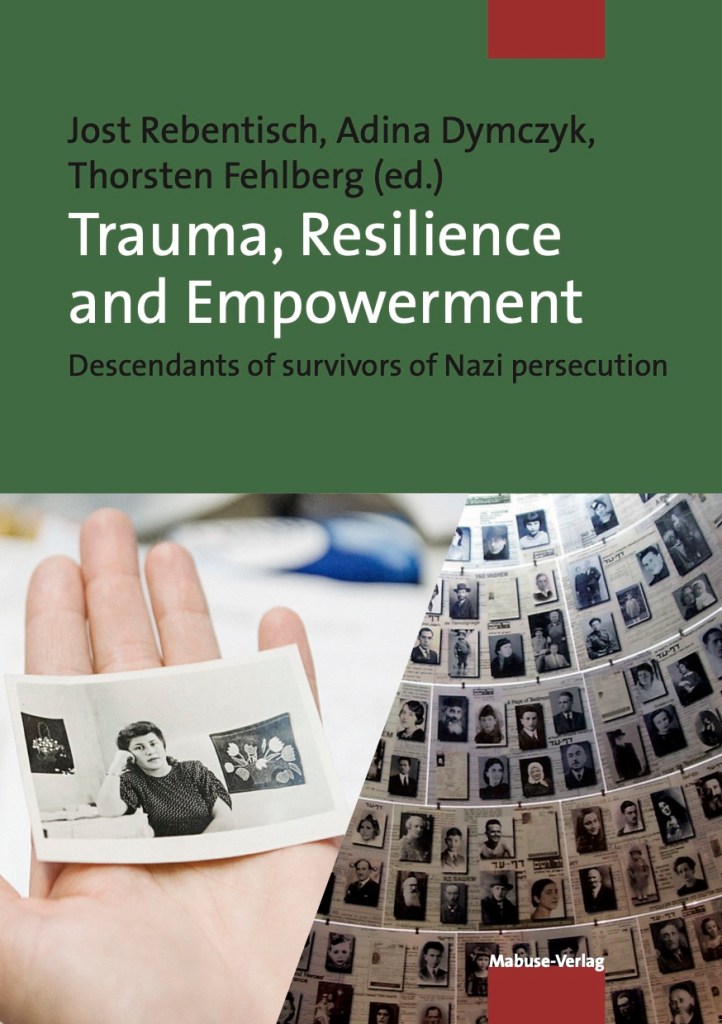
One cannot neglect the current work and political engagement of descendants. For example, as guides for visitors in concentration camp memorials and as members of non-governmental-organisations which contribute to a process of coming to terms with the past. The Federal Association Information and Advice for Survivors of Nazi Persecution initiated working groups of international experts to discuss political education and psychosocial issues, respectively, in relation to the work of, and for working with, descendants of survivors of Nazi persecution. In Neuengamme Concentration Camp Memorial Site, descendants have been involved in its commemoration work for years. The great interest that descendants have in learning more about their family history forms an important basis for the collaboration with them taking place at the memorial site. Furthermore, memorial sites can be a place for the individual and collective commemoration of relatives. For this reason, memorial sites must be open to the needs of descendants (von Wrochem 2019).
Descendants of former prisoners of the Langenstein-Zwieberge concentration camp work together in the
2nd Generation Group. The survivors of the descendants are from many countries and first came
together in 1998, with the support of the memorial site. After spending time researching their own family
history, the group decided to start a regular dialogue with young generations.
Summary
To summarise, we would like to highlight four key findings from our research. Firstly, descendants of
survivors are already actively involved in historico-political work in memorial sites, or work, for example,
in non-governmental-organisations to keep the memory of Nazi crimes alive. Secondly, they might suffer
due to the experiences of their ancestors or from discrimination. Thirdly, there are existing narratives and
research that proves the specific situation of descendants of survivors of Nazi persecution. Finally, one
can find a lack of public awareness for the situation of those affected.
References:
BAREL, E. et al. (2010) Surviving the holocaust: a meta-analysis of the long-term sequelae of a genocide. Psychological Bulletin. 136 (5), pp. 677– 698.
BERNSTEIN, J./ DIDDENS, F. 2019. Echoes of the Nazi Era: Jews in Germany amid routine Trivialisation of the Holocaust and anti-Semitic Attacks. In: Rebentisch, Jost, Adina Dymczyk und Thorsten Fehlberg (2019): Trauma, Resilience and Empowerment – Descendants of survivors of Nazi persecution. Frankfurt: Mabuse-Verlag, p. 40-58.
DANIELI, Y. (1998) International handbook of multigenerational legacies of trauma. New York: Plenum.
DRESNER, COLIN OLEK (2018) Bereavement and memorial candles. In: Second generation voices – for the children and families of survivors of and refugees from Nazi persecution. 67, p. 7-9.
DYMCZYK, A. FEHLBERG, T. (2019) Introduction and Initiation into the Subject Area. In: REBENTISCH, J./ DYMCZYK, A. AND FEHLBERG, TH. (2019): Trauma, Resilience and Empowerment – Descendants of survivors of Nazi persecution. Frankfurt: Mabuse-Verlag.
FOGELMAN, E. (2001): Adult Offspring of Holocaust Survivors as Moral Voices in the American-Jewish Community. In: BERGER, A./ BERGER: Second Generation Voices. Reflections by Children of Holocaust Survivors & Perpetrators. New York: Syrcause University Press.
FREYBERGER, H. et al. (2015) Transgenerationale Traumatransmission (am Beispiel der Überlebenden des Holocaust). In: SEIDLER, G.H., FREYBERGER, H.J., & MAERCKER, A., eds. Handbuch der Psychotraumatologie. Stuttgart: Klett-Cotta.
LAUBINGER, R. L. (2018) Und eisig weht der kalte Wind – Die spannende und ergreifende Geschichte der Sinti-Familie Weiss/Laubinger von 1925 bis 2017. Norderstedt: Books on Demand.
KELLERMANN, N. P.F. (2011) “Geerbte Albträume” – Wie werden erworbene seelische Eigenschaften vererbt? Cologne, 1st March, 2011. Cologne: Bundesverband Information & Beratung für NS-Verfolgte e.V.
REINHARDT, D. (2014) Everybody’s Gypsy. Popkultur zwischen Ausgrenzung und Respekt. Berlin: Metrolit.
SAGI-SCHWARTZ, A. (2015) Does extreme trauma transfer? The case of three generations of the holocaust. In: CHERRY, K.E., ed. Traumatic stress and long-term recovery: coping with disasters and other negative life events. London: Springer.
SPIEGEL. M. V. (2019) The Emotional Conflicts of the Second Generation. In: Rebentisch, Jost, Adina Dymczyk und Thorsten Fehlberg (2019): Trauma, Resilience and Empowerment – Descendants of survivors of Nazi persecution. Frankfurt: Mabuse-Verlag, p. 75-79.
TRZEBINER, C. (2013) Die Enkelin: oder Wie ich zu Pessach die vier Fragen nicht wusste. Frankfurt: Weissbooks.
VON WROCHEM, O. (2019): Memorial Sites working with Descendants of the Victims of National Socialism. In: REBENTISCH, J./ DYMCZYK, A. AND FEHLBERG, TH. (2019): Trauma, Resilience and Empowerment – Descendants of survivors of Nazi persecution. Frankfurt: Mabuse-Verlag., p. 197-209.
YEHUDA, R. et al. (2016) „Holocaust Exposure Induced Intergenerational Effects on FKBP5 Methylation“. Biological Psychiatry 80(5): 372–80.
 The British and Irish Association for Holocaust Studies