David Tollerton
David Tollerton is Senior Lecturer in Jewish Studies and Contemporary Religion at the University of Exeter. He currently holds a 12-month fellowship with the Leverhulme Trust and his next monograph, Holocaust Memory and Britain’s Religious-Secular Landscape: Politics, Sacrality, and Diversity,will be published with Routledge in 2020.
On 27 January 2014 David Cameron gave a speech at 10 Downing Street setting out the vision of his new Prime Minister’s Holocaust Commission (PMHC). Addressing the assembled survivors, politicians, and civic leaders, he reflected that ‘I’ve had some extraordinary gatherings of people in this room, but I don’t think there’s been a more extraordinary gathering or a gathering I’ve been prouder to have’. The work of the PMHC, he proposed, was no less than a ‘sacred task’.
Taking such stirring rhetoric at face value, we might ask what level of attention is given to the commission and public Holocaust memory in Cameron’s vast new memoir, published in September 2019. A subsection? A devoted chapter? In fact, amidst the forty-seven chapters of For the Record the topic gets half a page. The PMHC and its most high-profile outcome – the proposed memorial and learning centre next to Parliament – are mentioned in passing, but in a 732-page tome meant to stand as Cameron’s definitive statement on his tenure as Prime Minister, they are decidedly peripheral. No mention is made of the controversies that have dogged plans for the Victoria Tower Gardens site, and there is little sense that a core element of his legacy is at stake.
For those who suspect that his fervent words in 2014 (composed by speechwriter Tim Kiddell) were always somewhat superficial, and that the PMHC’s project started out as an under-theorised act of virtue-signalling, For the Record does little to dispel this impression. But there are nonetheless several interesting, even curious, aspects of the book’s short passage on Holocaust memory.
The first of these is its placement in a chapter on foreign policy, located specifically in-between discussions of Israel and the Middle East. Exactly how the PMHC and the Victoria Tower Gardens project contribute to this topic is not spelt out, and it is a surprising context given that the initiative, like so much government-supported Holocaust commemoration and education in Britain, has generally steered cautiously around direct reference to the Israel-Palestine conflict. (So much so that I have personally become increasingly conscious of a disconnect between assumptions that learning about the Holocaust confronts antisemitism and the extent to which debates around antisemitism are dominated by questions of what is – and is not – acceptable speech concerning the Jewish state).
But in For the Record Cameron maintains that it was a visit to Yad Vashem that in particular ‘made me determined to ensure Britain had its own national memorial and museum’. Leaving aside the irony that one of the (several) institutions he overlooks in such a comment – the National Holocaust Centre and Museum in Nottinghamshire – was itself inspired by a visit to Yad Vashem in the 1990s, Cameron’s statement sits awkwardly with other factors. One is that the visit to Yad Vashem he refers to occurred in March 2014, after both the launch of the PMHC in January of that year and a 2013 speech for the Holocaust Educational Trust during which he floated the idea of a new memorial. The second complication is that, in a May 2019 video produced by the United Kingdom Holocaust Memorial Foundation (UKHMF), Cameron stated that it was actually a visit to the Memorial to the Murdered Jews of Europe in Berlin that prompted his ideas for the PMHC.
How do these factors fit with the appearance of his reflections on Holocaust memory in For the Record? On one level, there is a suspicion that Cameron simply did not know where to locate his comments on the PMHC and Victoria Tower Gardens project, and so ended up lumping them into the middle of a discussion of foreign policy and the Middle East. The kind of joined-up thinking that might link public Holocaust memory to matters of immigration, cultural diversity, or social inequality are conspicuously lacking. There is also an impression that he is not consciously attuned to the very different meanings of constructing sites of remembrance in Jerusalem, Berlin, and London, but rather thinks of Holocaust memorials and museums as just generically good things.
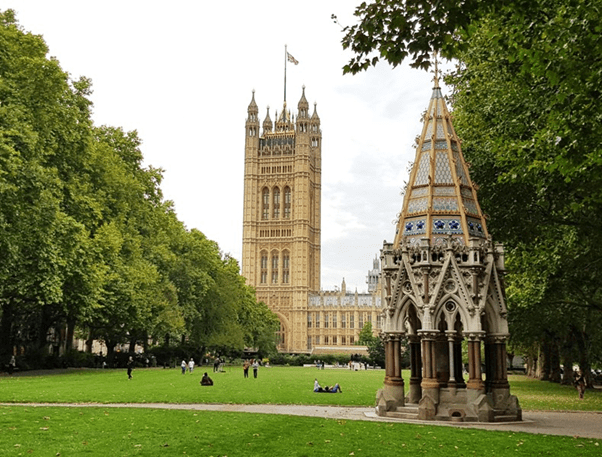
Yet this is not to say that Cameron avoids slipping into self-affirming British narration of the Holocaust’s significance. His reference to building the memorial and learning centre ‘at the heart of our democracy’ is familiar to anyone who has read PMHC and UKHMF literature, but particularly striking are his recollections of speaking to survivors and their descendants at the launch of the PMHC. He picks out two stories: one of dramatic escape from the Warsaw Ghetto, and another of ‘A woman [who] showed me her diary, in which her grandfather had written: “Wherever you go make sure you’re a good daughter to the country where they take you”’. Cited at the close of a paragraph, Cameron offers no commentary on these words, leaving the reader to mull over their exact meaning and why they struck such a chord for him. Presumably it was the appeal to national belonging in the aftermath of tragedy that he found especially inspirational, and the implication that this woman was indeed a ‘good daughter’ of Britain.
Of course if you are looking for a critical analysis of nationalism For the Record is not the place to look. This is a book the final paragraph of which begins ‘Whoever they are, I will tell them this. That Britain is the greatest country on Earth… [and so on]’. For all his laments over the failure to win the Brexit referendum, the closing pages also feature a sequence of complaints about an overbearing and integrationist European Union, reflecting the common suggestion that Cameron’s eurosceptic tendencies made him a particularly ineffectual standard-bearer for Remain. Amidst all this it is consequently unsurprising that his comments about public Holocaust memory are, like the Britain’s Promise to Remember report produced by the PMHC, a far-cry from turn of the century ideas of Holocaust remembrance promoting European integration that transcends nationalist sentiment.

Ultimately, although Cameron’s words on Holocaust memory in For the Record are fleeting and isolated there is no getting around that as Prime Minister his actions – even if under-theorised and subsumed into language of British (read English) nationalism – have had significant consequence. His vision of a new memorial site has become emblematic of the growing prominence of Holocaust memory in British public life since the 1990s, and there is a certain appropriateness to his memoir appearing right at the moment when the project’s fate hangs in the balance. Even as the Victoria Tower Gardens initiative has become mired in controversy and we wait for the outcome of the UKHMF’s planning application, For the Record reminds us of the person who set the wheels in motion but left the scene before the awkward realities of implementation came to the fore – a pattern of behaviour with which Cameron will for other reasons long be associated.
 The British and Irish Association for Holocaust Studies