Barnabas Balint
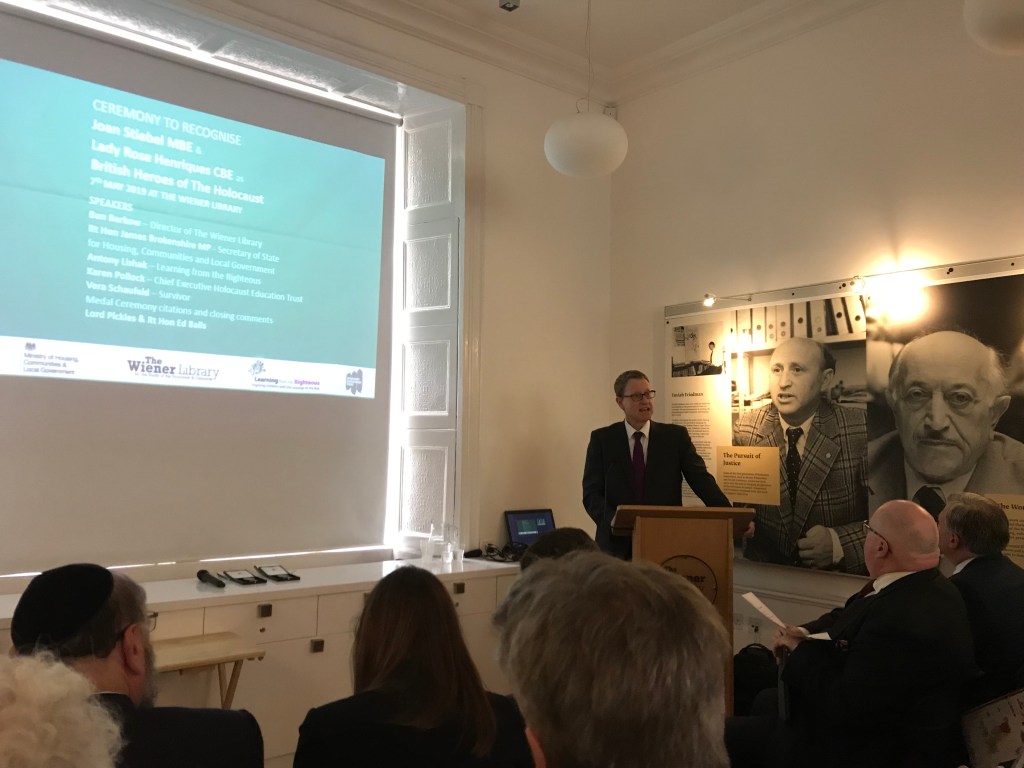
Barnabas Balint is a Master of Studies student in Modern European History at Magdalen College, Oxford, researching young Jewish resistance in Belgium and France. He completed his undergraduate degree in History at the University of Exeter in 2019. His research interests focus on the Holocaust and Jewish responses to persecution in Hungary, France and Belgium. Barnabas is also a Regional Ambassador for the Holocaust Educational Trust and Holocaust Memorial Day Trust. In May 2019 he attended the ceremony where the British Heroes of the Holocaust Medal was awarded posthumously to Ms Joan Stiebel MBE and Lady Rose Henriques CBE, the subjects of this blog post.
Public discourse on the Holocaust often puts great emphasis on the event of liberation as the culmination of survivors’ experiences. This framework leads to a division between before and after liberation, focusing on persecution and day-to-day survival. Whilst after liberation Jews were no longer facing existential threat, for the people themselves, the days, weeks, months and years after liberation also presented significant challenges on the road back to normality. They struggled to confront what had happened to them, their family and friends, and found it difficult to rebuild their lives. An integral part of this process was the support of relief workers, whose work intensified post-war. Individuals and groups provided much needed physical, logistical and emotional support and assistance to those who suffered horrendous conditions, easing their transition between camp inmate and free individual. Exploring this part of history through the experiences of two individuals, Ms Joan Stiebel MBE and Lady Rose Henriques CBE, this blog post highlights the role of relief workers and considers the relevance of such histories for today.
Recently, the UK Government recognized Ms Joan Stiebel MBE and Lady Rose Henriques CBE, two of the relief workers who supported Jews in the aftermath of the Holocaust, bestowing upon them the British Heroes of the Holocaust medal.[1] This national honour commends the British citizens who assisted in rescuing victims of the Holocaust; those who displayed extraordinary acts of courage and went above and beyond the call of duty in the most difficult circumstances. So far, 41 individuals have received the award, including well-known figures such as Sir Nicholas Winton and Major Frank Foley.[2] Unlike Sir Nicholas and Major Foley’s actions, however, Ms Stiebel and Lady Henriques both received the medal for actions they took after the conclusion of the war. Their contributions, taking place after the war, were no less important and no less meaningful than the traditional histories of rescue we are used to hearing about. Indeed, remembering the impact of their efforts highlights the significant amount of work that took place within this period of transition.
In the months following the end of the Second World War, Ms Stiebel was central to organizing the travel arrangements for hundreds of the 732 young people who were flown to the UK when the British government chose to admit one thousand young survivors of the Nazi concentration camps. This group has become known as ‘the boys’, although their number did also include a few girls, and their experiences have been well-documented in Sir Martin Gilbert’s book, The Boys: Triumph Over Adversity.[3] They experienced unimaginable horrors during the Holocaust, including death marches and the infamous camps of Auschwitz-Birkenau and Bergen-Belsen. For them, the transition to a new, free life was riddled with challenges, which people like Ms Stiebel helped them conquer. One survivor recalled how, on the flight to England, the pilot gave him a piece of chocolate, an act of ‘kindness I hadn’t felt for years’. Having arrived in Windemere, Ms Stiebel described how, at first, some of the young people smuggled bread from the dining room, fearing that they would not be fed later. Helped by relief workers who made them feel comfortable in their new lives, this bread soon ‘made a nice meal instead for the birds singing outside’.[4] The welcoming and supportive actions of Ms Stiebel and her colleagues brought hundreds of Holocaust survivors to the UK and helped them transition into a new chapter in their lives.
Similarly, in the aftermath of the Holocaust, Lady Rose Henriques CBE volunteered with the Jewish Committee for Relief Abroad (JCRA) agency, supporting former inmates in Bergen-Belsen and across displaced persons camps in Europe. Determined to help German and European Jews suffering persecution, she served as Head of the German department of the JCRA in 1943.[5] A key part of the JCRA was the Jewish Relief Unit, which carried out welfare work with survivors of persecution post-war, with Lady Henriques being one of an estimated 125 workers in the field. While some of these were trained doctors and nurses, others – like Lady Henriques – were ‘largely untrained, motivated by a desire to be of assistance’.[6] They provided much needed support and assistance to those who had suffered horrendous conditions, supplementing the material aid of the United Nations Relief and Rehabilitation Administration with their own efforts to boost morale. It was through this work that individuals like Lady Henriques contributed to the mental recovery of countless former concentration camp inmates.
Recognizing the support of relief workers in this pivotal time is crucial for understanding how survivors rebuilt their lives. It is easy to view the aftermath of the Holocaust in material terms – of food and medicine provided to people whose persecution had ended with the liberation of the camps. Yet the moral and emotional support is of equal importance, even more so when considering how survivors came to terms with loss and started to seek new purpose to their lives after genocide. The work of Ms Stiebel and Lady Herniques supporting this search for purpose forms a crucial part of the wider picture of relief activities. These people confronted the horror of the Holocaust and its profound impact on individuals in its immediate aftermath and made a significant personal contribution to the lives of survivors.

As recognized through their receipt of the British Heroes of the Holocaust medal, Ms Stiebel and Lady Henriques’s work in helping those who suffered persecution was immense. For them, there was never any question of what to do. In this way, Ms Stiebel and Lady Henriques provide us with powerful examples of the difference that standing together against hatred can make. Reflecting on the arrival of one survivor group in Windemere, Ms Stiebel wrote that ‘to all of us who had been preparing for the arrival of this transport… this was the fulfilment of our dreams’.[7] In carrying out this ‘dream’, their inspiring actions and dedication to helping others have rightly earned Ms Stiebel and Lady Henriques the title of British Heroes of the Holocaust.
[1] Mathilde Frot, ‘British heroes receive posthumous medals for rescuing victims of Shoah’, Jewish News, www.jewishnews.timesofisrael.com/british-heroes-receive-posthumous-medals-for-rescuing-victims-of-shoah, last accessed 6th June 2019.
[2] Tara Finn, ‘Bending the Rules to Save Souls’, Foreign Office Blogs, https://blogs.fco.gov.uk/tarafinn/2018/01/26/bending-the-rules-to-save-souls/, last accessed 6th June 2019.
[3] Martin Gilbert, The Boys: Triumph Over Adversity, (Vancouver: Douglas & McIntyre, 1996)
[4] ‘Description by Joan Stiebel of arrival in Windemere, 1945’, Wiener Library, London, 1127/1.
[5] Lady Rose Henriques Archive, Wiener Library, London, MF Doc 52.
[6] Joan Stiebel, ‘The Central British Fund for World Jewish Relief’, Transactions and Miscellanies (Jewish Historical Society of England) vol. 27, (1978-80), pp. 51-60, p. 55.
[7] ‘Description by Joan Stiebel of arrival in Windemere, 1945’, Wiener Library, London, 1127/1.
 The British and Irish Association for Holocaust Studies