Dr. Denisa Nešťáková
Dr. Denisa Nešťáková is a historian. Since May 2019 she has worked as a research associate at the Herder Institute for the project “‘Family Planning’ in East Central Europe from the 19th Century until the Authorization of ‘the Pill’”, focusing on Czechoslovakia. She studied History and Slovak language and literature at the Comenius University in Bratislava (Slovakia), and Jewish civilizations at the Hochschule für jüdische Studien in Heidelberg (Germany). In June 2018, she defended her dissertation thesis titled “Whoever is not with me is against me.” Arab-Jewish relations during British Mandate for Palestine through the perspective of the German Temple Society at the Comenius University in Bratislava. Her project Women and Men in the Labour Camp Sereď, Slovakia is carried thank to the Post-doctoral grant of the Foundation for the Memory of the Shoah, Paris, France.
While Swedish rescue efforts related to the Jewish communities in Norway, Denmark and Hungary during the Holocaust are well known, Swedish efforts were not limited to those known cases. In view of the abundance of studies of the Holocaust, the absence of knowledge of the Swedish attempts at rescuing Slovak Jews is somewhat surprising. Scholars of the Holocaust in Slovakia have also regarded the Swedish intervention in the case of the Jews of Slovakia as minor.[1] It is important to note that the lack of attention to Swedish interventions does not seem to stem from a lack of sources. Investigated sources, which consist of diplomatic and official correspondence between Slovakia and Sweden, are available in the Slovak National Archives, Yad Vashem, or National Archives in London. Why it is so?
The ‘final solution’ in Slovakia
The Munich Accords of 1938 represents an important change in the geopolitical situation in Europe and recognition of the dominance of Nazi Germany over Central Europe. The Hlinka Slovak People’s Party – a conservative right-wing political party with strong Christian and nationalist orientation with antisemitic, anti-Czech, anti-Hungarian elements led by the Catholic priest Jozef Tiso – exploited the weakening of the Republic of Czechoslovakia and declared the autonomy of Slovakia on 6 October 1938.
By March 14, 1939 the Slovak republic was established, and country with its approximately 89,000 Jews had introduced a political system built on authoritarian principles. Conditions for implementing the ‘final solution’ for the ‘Jewish question’ in Slovakia were a result of the international politics of Germany in combination with autochthonous anti-Jewish tendencies within Slovak society, and their implementation in antisemitic laws introduced by Slovak political institutions. The most extensive was the governmental decree from September 1941 – the so-called Jewish Codex, eliminating Jews from the political, social and economic life. These laws can be seen as a Slovak version of the Nuremberg laws from 1935.
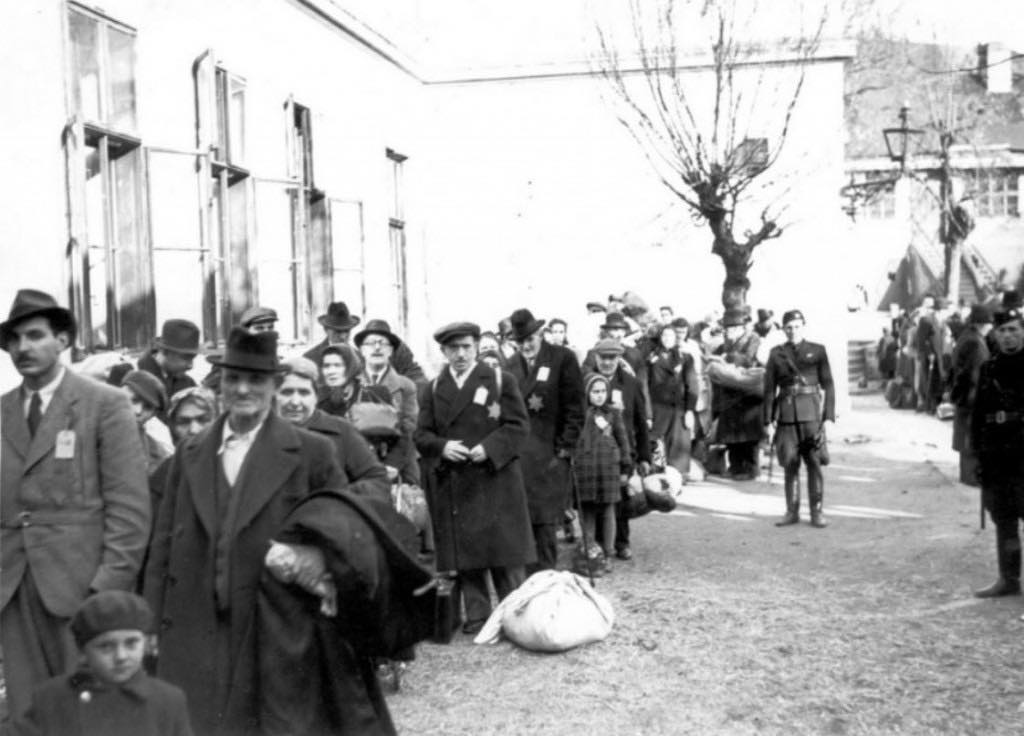
Soon after introduction of these laws, the deportations from Slovakia started from in March 1942. Until October 1942, 57 transports left Slovakia, 19 of them being sent to Auschwitz and 38 to the Lublin area. Together with the first pieces of information about the Jewish deportees from Slovakia to Poland the first attempts to act against deportations were initiated.[2] There were some attempts to interfere by the Slovak Catholic, Orthodox and Protestant Churches, and even the Vatican. Some international powers also tried to intervene. Among the international voices against the deportations from Slovakia was also Sweden.[3]
Slovak–Swedish diplomatic relations
Sweden had formally recognised the Slovak Republic in July 1939, which made Sweden the first northern European state to establish official relations with Slovakia. The interests of the Sweden in Slovakia were carried out by the Royal consulate, and the interests of Slovak Republic in Sweden were represented by the consul general Bohumil Pissko, who took office in October 1943. Pissko and his diplomatic relations with Swedish elites later became very important in the Swedish interventions in the Slovak Republic.
Rescuing individuals
The first Swedish attempt to intervene in the fate of Slovak Jewry did occur during the first phase of deportation in 1942. There were two known attempts by Sweden to protect Jews from the USSR who lived in Slovakia, via the Swedish Royal Consulate in Bratislava: couples Isaj and Berta Korscherschinski, and Rubin and Rachel Gutnik. Later on, Sweden intervened in individual cases of Slovak Jews. In all known cases the Swedish efforts failed due to a combination of various unfortunate circumstances.[4]
It made a considerable difference that the interventions were related to Jewish individuals originally from Slovakia and not from the USSR. But even though these Swedish requests were related to Slovakia’s own Jewish citizens, the Slovak official institutions followed these requests. These documents also prove that the Slovak authorities were willing to bypass the ‘legal’ directions which ordered them to transport these Jewish individuals. The readiness to satisfy these Swedish requests proves not only the importance of Swedish interventions but also that the Slovak authorities were willing to protect a few specific Jews from Slovakia. This may be seen as an act of subordination of Slovakia to the stronger partner, Sweden, and as an act of permission to save some Jews from deportation as long as they would leave Slovakia.
Saving the remaining Jewish community in Slovakia
The greatest of Swedish attempts to assist the Jewish community, which amounted now to approximately 18-20 000 individuals, started during the second phase of deportation of Jews from Slovakia. This attempt occurred between October 1944 and January 1945, during the so called second phase of the ‘solution of the Jewish question’ in Slovakia. Germany occupied Slovakia after the Slovak national uprising, which started in August 1944. This initiated a new phase of deportation under the German administration between September 1944 and March 1945. Approximately 13500 Jews deported, hundreds of Jews and non-Jews were also killed in Slovakia by the Einsatzgruppen together with the emergency division of the Hlinka Guard, and Freiwillige Schutzstaffeln.[5]
During these horrendous times a Swedish archbishop of Uppsala, Erling Eidem came with an initiative to save the whole remaining Jewish community in Slovakia. The archbishop turned to President Tiso via Pissko, the Slovak consul in Sweden. Pissko forwarded the letter to Tiso explaining the position of Sweden in the matter of the Jewish question. Pissko tried to engineer a suitable moment to accommodate the Swedish attempt to save the remaining Jewish community in Slovakia. Moreover, Pissko also expressed how his American colleagues considered the issue as highly important and willingness to make any financial sacrifice. This letter from Pissko to President Tiso was accompanied by the Eidem’s letter, dated November 11, 1944. Eidem asked the Slovak president to permit the relocation of Jews to a neutral area:
“Our poor Jewish brothers, here in Europe, have suffered tremendously in the last decade… Since there is still a remarkable number of Jews in Slovakia, located in various localities, I would like to address you with a keen demand – to kindly take charge of these endangered people. …. I must ask you to think if it is eligible to transfer Jews of your country to other areas in order to make their rescue possible.”
President Tiso responded to Archbishop Eidem in a letter from 8 January 1945. Tiso’s answer demonstrates his helplessness and unwillingness to help in this situation:
“It is a pity that the interest expressed was not shown before 28 August 1944. Until that date, Jews had been placed, in accordance with Slovak laws, in well-organised labour camps or had been left in their previous occupations according to the certificate awarded.”[6]

Tiso’s statement must be considered as a euphemism. It is true that some Jews could keep their previous occupations according to the certificate awarded. However, these certificates protected only about 5,000 Jews. Other Jews were placed in labour camps in Slovakia – in Nováky, Sereď and Vyhne, which also served as transit camps. Most importantly Tiso did not mention the deportations of 1942, when almost 58,000 Jews were removed from Slovakia to Nazi camps. Pissko’s reaction to the interaction between President Tiso and Eidem was sent to Eidem in the letter from 19 February 1945, saying:
“I feel very disappointed at the reaction of my president … seeing that my country has been swallowed up by the Nazis so that the president could not even give a promise.“[7]
Post-war silence
The common perception in academic circles has been that the Jewish community in Slovakia was never part of the diplomatic negotiation of Sweden. However, the new evidence of Swedish attempts to help the Jews of Slovakia is remarkable. So why there has been no knowledge about these efforts existed? I can only try to suggest several hypotheses that could explain the lack of research on Swedish attempts to assist Slovak Jewry:
1. The research of the Holocaust in Slovakia was limited or almost non- existent during the period 1948–89. Once the archives in Czechoslovakia were accessible, researchers focused on more dominant and important topics.
2. One of the main actors in these negotiations – the Slovak Consul in Stockholm, Bohumil Pissko – remained silent. He emigrated from Czechoslovakia shortly after the WWII, probably because he could be persecuted by his own state as a war-time diplomat.
3. Possibly there are no survivors who were saved thanks to these acts, or if there were any survivors, they have remained silent.
4. While the success of Swedish aid during the Holocaust has been well documented, the unfortunate story of Swedish attempts to help the Slovak Jewish community was not successful, which may explain why this story has remained untold for so long.
As Leni Yahil has noted, the case of Denmark is usually seen as ‘evidence of humanity’.[8] Seemingly, a rescue attempt needs to be a successful story to be able to stand as evidence of human goodness. What about those rescue plans which did not succeed? Are they not ‘good’ enough to show humanitarian effort?
[1] See one of the seminal works on the Holocaust in Slovakia Ivan Kamenec, On the Trail of Tragedy: The Holocaust in Slovakia, (Bratislava: Hajko & Hajkova, 2007)
[2] See Ján Hlavinka, ‘‘Dôjsť silou-mocou na Slovensko a informovať…‘: Dionýz Lénard a jeho útek z koncentračného tábora Majdanek, (Bratislava: VEDA, 2009), 119-125.
[3] The single work about Swedish involvement in the tragedy of Slovak Jewry was published in 2016 Denisa Nešťáková and Eduard Nižňanský, “Swedish interventions in the Tragedy of the Jews of Slovakia,” Nordisk judaisk. Scandinavian Jewish Studies 27, no. 2, (2016): pp. 22 – 39.
[4] SNA, Fund Ministerstvo zahraničných vecí, Box 142, Files 287/43 and 1366/1680/42.
[5] Eduard Nižňanský, “ Die Aktion Nisko, das Lager Sosnowiec (Oberschlesien) und die Anfänge des Judenlagers in Vyhne (Slowakei)“ Jahrbuch für Antisemitismusforschung 11(2002), 325 – 335.
[6] SNA, Fund Kancelária Prezidenta republiky 405, Box 8, File 43/1945
[7] Ibid.
[8] Leni Yahil, The Holocaust: The Fate of European Jewry, 1932-1945, (New York: Oxford University Press, 1990), 574.
 The British and Irish Association for Holocaust Studies