DANIEL ADAMSON
Daniel Adamson is currently a postgraduate student on the MA History Education course at UCL’s Institute of Education, having graduated from the University of Cambridge in 2017. In September, he will commence study for a PhD in History at Durham University. His research project will consider portrayals of the relationship between Britain and the Holocaust.
Since last year, Daniel has held the position of Book Reviewer for The Wiener Library, and he is also a past finalist in journalism competitions run by organisations such as The Daily Telegraph.
This article is based on research undertaken as part of his undergraduate dissertation at the University of Cambridge in 2017.
Introduction
Few areas of historical research have (separately) received as much attention as those of the Holocaust and the political career of Sir Winston Churchill (1874-1965). Journal articles, monographs, and popular histories of the destruction of European Jewry understandably dominate much of the historiography of twentieth-century Europe. In different ways, Winston Churchill has loomed large in histories of the Second World War and British politics more broadly. However, analysis – as opposed to an allusive narrative – of the interrelationship between the pair has remained relatively unexplored.
The story of Churchill and the Holocaust is primarily a history of high politics; yet it is also one which requires a certain amount of emotional guesswork. Conventional political narratives can be reframed in terms of emerging spheres of intellectual study. The topic of ‘Churchill and the Holocaust’ offers a rare chance to facilitate the interaction of political history with the sub-field of the history of the emotions, which has gained considerable momentum in recent years. Although an often-nebulous area, Peter N. Stearns astutely defines ‘emotionology’ as an aspect of social history which seeks to explore how ‘general cognitive processes act towards appraising the wider experience of individual and institutional actions’.1
It is not in doubt that the ultimate address of the Holocaust by both Churchill and his government was marked by a subservience to the overarching wartime objective, as expressed by Churchill himself in a private letter of 1944, of ‘the speedy victory of the Allied Nations’.2 However, there remains scope to explore the profound inconsistencies present within Churchill’s reaction to the Holocaust: words and actions, private and public. Intriguingly, Churchill was extremely reluctant – unlike in his treatment of other wartime issues – to acknowledge openly his placement of issues relating to the Holocaust as a secondary priority.
The Churchill Archives Centre, established in 1973, provides the key repository of Churchill’s personal and public papers. Alongside the governmental documents held in the National Archives, the Churchill Archives Centre allows for a comprehensive assessment of the words of, and the actions actually taken by, the Prime Minister.
Contradiction and emotional conflict
Largely thanks to the meticulously researched narrative histories of Martin Gilbert – characterised as ‘history as stenography’ by journalist Glenn Frankel – the extent of the information possessed by Churchill regarding the Holocaust at the time is well-known.3 More significantly, however, the speculative reasons why such profound discrepancies existed has also escaped sustained analysis. In reality, Churchill’s reactions to the extermination of Europe’s Jews were contradictory. The gulf between the Prime Minister’s words and actions in response to the genocide can be explained, in major part, by the contemporary organisational issues that riddled the structure of British government and bureaucracy. Accusations of antisemitism within the wartime civil service, for instance, have been explored by historians including Louise London (Whitehall and the Jews).
Churchill’s sympathetic private response towards the Holocaust consistently failed to translate itself into tangible political action. Private letters between Churchill and his wife Clementine offer the most intimate insight into Churchill’s personal opinions on a range of matters. One particularly vivid correspondence of April 1945 details the Prime Minister’s ‘intense horror’ at ‘German brutalities in the concentration camps’.4On a more personal level, several vignettes illustrate the highly emotional primary response of Winston Churchill to reports of the maltreatment of European Jews. For instance, Eve Gibson – wife of Wing-Commander Guy Gibson, of the famed 1943 ‘Dambusters’ raid – revealed in her memoirs of 1980 how she witnessed Churchill weep at a private screening at Chequers in July 1943 of a ‘film, captured from the Germans, depicting the atrocities inflicted on the Jews’.5
Famously, in an emotive personal minute to Eden on 11 July 1944, Churchill condemned the Holocaust as ‘the greatest and most horrible crime in the history of the world’ and deplored the ‘lack of feeding and sanitary conditions’ in concentration camps.6 However, Churchill’s confused attitude towards the relief of persecuted Jews is illustrated within the same document. The Prime Minister goes on to affirm his belief that ‘no negotiation’ with the Nazis should occur in the quest for Allied victory, even if such a process might aid the ‘escape of Jews’.7 Churchill’s personal humanitarian sentiment was ultimately subservient to his sense of political expediency, and was therefore rarely reflected in actual governmental policy.

Conversely, private actions taken by Churchill simultaneously countered any outward commitment he did afford to tackling the maltreatment of European Jewry. A confidential letter to the Jewish magnate Lord Melchett confirmed Churchill’s insistence that ‘earnest consideration’ could not be given to the extermination of Jews – described in the same correspondence as ‘one of the greatest and most horrible crimes ever committed’ – until the ‘speedy victory of the Allied Nations’ had been achieved, and not before.8
As a war leader, Churchill favoured the delegation of political responsibilities on a departmental basis. The orientation of Churchill’s political position was determined by that of those below him to a greater extent than he himself influenced the attitudes of his subordinates. Bernard Wasserstein’s evaluation of Churchill as ‘the most powerful Prime Minister in British history’ is only applicable in terms of the governmental resources available to Churchill; his actual deployment of such authority was far more limited.9
The assassination of Lord Moyne
Although infrequent in occurrence and generally less important than the aforementioned bureaucratic impediments, single events or episodes did have the power to change, in substantive terms, Churchill’s attitude to issues at hand. Events of political significance can be placed in a historical framework of ‘emotional’ analysis.
In particular, the assassination of the former Secretary of State for the Colonies, Walter Edward Guinness, 1st Baron Moyne, in Cairo on 6 November 1944 by two members of the militant Zionist group Lehi had a profound psychological impact on Churchill. Due to the Egyptian location where the murder occurred, the impact of Moyne’s assassination on Churchill has only ever been placed within the framework of Middle Eastern politics; in particular Zionism and the partition of Palestine. However, the historical interpretation of the killing of November 1944 from a different, psychological perspective can offer evidence that the episode also contributed to a decisive cooling of Churchill’s personal enthusiasm for positive involvement in the affair of European Jewry.
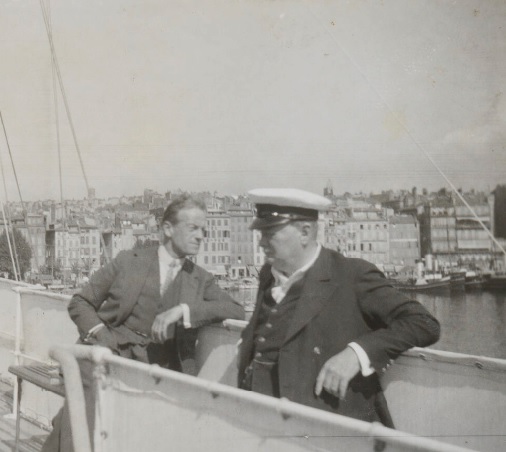
Lord Moyne was a close friend of Winston Churchill. During the summer of 1934, at the height of his ‘wilderness years’, Churchill had sought refuge in the company of Moyne on the latter’s yacht Rosaura in the Mediterranean Sea. Moyne and Churchill had earlier been political allies as minority opposition on issues including Hitler’s rise to power and German rearmament.10 Unsurprisingly, therefore, Churchill’s personal reaction to Moyne’s death was passionate. In private, Churchill denounced the killing as ‘an odious act of ingratitude’.11 A private letter to Moyne’s son, handwritten by Churchill on 17 November 1944, lamented the loss of ‘a great friend of mine in public and private’ and ‘a great and wise servant’ characterised by ‘ripe wisdom and vigorous intellect’.12 In public, Churchill’s comment on the matter was similarly emotional. In an address to the House of Commons on 17 November 1944, Churchill suggested that ‘the smoke of assassins’ pistols’ would force a reconsideration of the position towards Jewish affairs that he had ‘maintained so consistently and so long in the past’.13
Following Moyne’s death, Churchill’s language in relation to such matters became noticeably more abrupt and frosty. In late November 1944, Churchill simply scribbled ‘no message’ on an aide’s request for a 70th birthday message to Chaim Weizmann (President of the World Zionist Organisation).14 Even by January 1945, Churchill – in response to Eden’s appeal for a personal message to Weizmann expressing regret at the reports of genocide emerging from Eastern Europe – curtly instructed his Foreign Secretary to ‘do so yourself’.15
Again, although reliant on speculation, the conclusion that Churchill may have been aggrieved by the lack of personal messages from Jewish figures of sympathy regarding Moyne’s death – in contrast to the telegrams of condolence he received from both King Iman Yahya of Yemen and Prime Minister Hamdi al Pachachi of Iraq offering ‘heartful sympathy’ at the ‘sorrowful’ episode – is plausible.16
Crucially, the effect Churchill allowed his personal emotion towards Moyne’s demise to have on the largely unrelated issue of the Holocaust appears to have been interpreted contemporarily as irrational. Indeed, the conclusion of the Daily Telegraph on 8 November 1944 that Moyne’s murderers were ‘hardly less dangerous enemies of their race than Hitler’ offers a contemporary awareness of how Churchill allowed the episode to affect his treatment of Nazi war crimes. Churchill’s fear, expressed in a letter of 17 November 1944 to Secretary of State for the Colonies Oliver Stanley that Moyne’s slaughter could represent a potential anti-British conspiracy led by ‘Jewish terrorist bands…throughout the world’, proved both unfounded and illogical.
The Moyne episode depicts Churchill as an impulsive politician whose political outlook could easily be swayed by single events and passions. The fact remains that the response of Churchill to the Holocaust was primarily dictated by the advice of his government. The manner in which Moyne’s death affected the Prime Minister’s wider policy towards Jewish affairs offers an indication of his greater political character.
Conclusion
Naturally, the topic in question is one which has much scope for further exploration. The relationship between Winston Churchill and the Holocaust was one infused with ambiguity, ambivalence and contradiction. The sheer scale of the extermination of six million European Jews, and the moral response the Holocaust continues to provoke, makes it difficult to argue that the response to the genocide by Churchill and his government was anything other than unsatisfactory.
The record of the actions Churchill did take in reaction to the Holocaust has remained relatively defined for many years. Oscar Rabinowicz’s characterisation in 1956 of Churchill’s response to the persecution of European Jewry continues, essentially, to hold true. The Prime Minister’s approach to the Holocaust, as Rabinowicz elucidates, was dictated by a triad of factors: a concentration ‘solely on winning the war, an insistence on not committing himself on any definite future policy, and the inability to deal adequately with the [Jewish] problems while the fighting was still on’.17 As such, a profound gulf between Churchill’s words and actions in private and public emerged. This chasm, common to many politicians, has nonetheless thus far largely evaded historiographical and popular attention, despite Churchill’s personal papers revealing that he was well aware of such disingenuousness himself.

1 Stearns, P., “Emotionology: Clarifying the History of Emotions and Emotional Standards,” The American Historical Review90:4 (1985): 813.↩
2 Churchill Archives Centre (CAC): Papers of Winston Churchill CHAR 20/138A/16: private letter from Churchill to Lord Melchett, July 13, 1944.↩
3 Washington Post, December 16, 2007, 43.↩
4 Churchill Archives Centre (CAC): CHAR 20/214/29, letter from Churchill to Clementine Churchill, April 21, 1945.↩
5 Quoted in Gilbert, M., Auschwitz and the Allies (New York, NY: Holt, Rinehart, and Winston, 1981), 152.↩
6 CAC: CHAR 20/153/1, minute from Churchill to Eden, July 11, 1944.↩
7 Ibid.↩
8 CAC: CHAR 20/138A/16, letter from Churchill to Lord Melchett, July 13, 1944.↩
9 Wasserstein, B., Britain and the Jews of Europe 1939-1945 (New York, NY: Clarendon Press of Oxford University Press, for the Institute of Jewish Affairs, London, 1979), 350.↩
10 Wilson, D., Dark and Light: The Story of the Guinness Family (London: Weidenfeld & Nicolson, 1998), 296.↩
11 Quoted in Johnson, B., The Churchill Factor (London: Hodder & Stoughton, 2015), 330.↩
12 CAC: CHAR 20/138b/165, letter from Churchill to Lord Moyne, November 17, 1944.↩
13 Commons Debates, Volume 404, COL. 2242, November 17, 1944.↩
14 TNA: PRO PREM 4/52/3, internal correspondence in office of Churchill, November 27, 1944.↩
15 TNA: PRO PREM 4/52/3, private correspondence between Churchill and Eden, January 18, 1945.↩
16 CAC: CHAR 20/144B/176, telegrams between Churchill, King Yahya and al Pachachi, November 16, 1944.↩
17 Rabinowicz, O., Winston Churchill on Jewish Problems: A Half-Century Survey (London: Lincolns-Prager for the British Section of the World Jewish Congress, 1956), 159.↩
 The British and Irish Association for Holocaust Studies