KAREN TREBY-HOWARD
Karen Treby-Howard is a PhD student supervised by Thomas Weber at the University of Aberdeen. Her interests are in gender historiography, feminism and, more specifically, the hidden individual experiences of women in the Second World War. Her thesis involves comparative research on how Nazi reproductive policies impacted both Jewish women and women of Lebensborn. This progresses on from her MA thesis which was entitled “Abortion and Infanticide as Survival Strategies for Jewish Medics and Mothers in the Concentration Camps”. Karen also has a first-class Psychology degree and is a qualified secondary school teacher. She has taught for 15 years and currently works as the Sixth Form Co-ordinator at a large school.
Within 24 hours of actress Alyssa Milano tweeting two simple words in October 2016, half a million women joined her in revealing first-hand experiences of sexual assault and humiliation.1 #metoo unsilenced polyphonic voices which simply, but poignantly, revealed experiences long hidden due to oppression by dominant others, social stigma and an embedded fear of disclosure. Strong women were empowered by each other to speak out, their words promoting empathy and revealing a collective desire to remove the shackles of silence, “tired of making excuses, of letting politeness stop me from defending myself…”2
The magnitude of the candid responses exposes the liberating power of the written word. Self is separated physically from the audience and emotionally buffered by an illusion of distance. Frankness that is consequently exposed through the act of putting pen to paper or typing words onto a screen can thus provide insight into emotive experiences of individuals. For the social historian, the freedom of expression offered by writing divulges idiographic accounts of a certain place and time that are lost in more quantitatively-driven historical sources such as lists of prisoners in the concentration camps of the Third Reich or statistics of how many people were killed in the Holocaust.
It is here that a link emerges between women persecuted by the Nazis and those of the #metoo movement. Sexual abuse and humiliation are not contemporary issues, and as demonstrated in the recent activity on Twitter, women feel muted and unable to give voice to the assaults that they have suffered at the hands of powerful men. The same was seen in female prisoners of the concentration camps. For instance, Kitty Hart-Moxon wrote about being stifled by her uncle when she wanted to speak about experiences relating to sex in the camps as he wanted to prevent his children from hearing the unspeakable.3 What Hart-Moxon demonstrates in her guileless writing is that literature has a liberating effect, evidential in the memoirs of female survivors of the Holocaust.
The post-Second World War climate was grounded in rebuilding rather than reflection, and any narratives of life in the Nazi concentration camp spoken in a homogeneous and usually androcentric voice. Yet the interlinking of race and gender made life riskier for Jewish women, exemplified by the words of survivor Sara Nomberg-Przytyk: “Here in Auschwitz the German thugs murdered women and children first”.4Women were victimised due to their potential to reproduce and challenge the Nazi ideology of the destruction of Jewry. Consequently, pregnancy presented the most poignant problem, especially following compulsory abortion orders issued from July 1943.5 Women testify to witnessing and being subjected to forced abortions,6 and if gestation continued, mothers were shackled during labour,7 had their unborn baby cut from their uterus,8 or were killed.9
Some early survivor literature written and published in the immediate aftermath of liberation gave voice to the ‘choiceless choices’ women were forced to make when faced with the tyranny of the Nazis directly targeting their biological sex.10 Autobiographies of camp medics such as Gisella Perl, Lucie Adelsberger and Olga Lengyel revealed that female prisoners performed abortions or committed infanticide in the camps as protective strategies, reasoning that “for mothers, infants and children’s needs came first”, and death reduced long-term suffering for the child.11 But a lack of testimony about the death of a child at the hands of their mother for any reason rather than altruism prevailed, and Judith Tydor-Baumel noted how Holocaust commemoration continues to portray women as mothers, virgins and warriors, with the same principled semiotics attached to highly emotive issues such as abortion and infanticide.12 What dominates the female Holocaust narrative is what Charlotte Delbo labelled common memory: in this case, accounts of selfless, self-sacrificing mothers;13 the Holocaust was ‘bad enough’ without revealing non-normative stories and, as Hart-Moxon testified, active silencing occurred.
Yet, the 1961 Eichmann Trial was instrumental in shifting public consciousness. As one of the first televised trials, the trial raised awareness of the Holocaust through survivor testimony, making evident the double-edged sword of being ‘female’ and ‘Jewish’, such as exposing the reality that women and children were nearly always sent ‘left’ during selection.14 With an enhanced public awareness, a new readiness to listen to the unspoken horrors of the camps seemed to emerge and unintentionally may have acted to help give voice to the previously unspeakable.
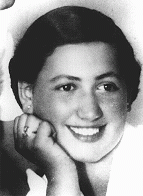
A case in point is Triumph of Hope
The memoirs of Ruth Elias, which was first published in English in 1998. Elias married and became pregnant by her husband in the Theresienstadt ghetto in 1942 before transportation to Auschwitz-Birkenau the following year. In the writing, she speaks of seeking an abortion on her arrival at the camp, a request which was refused, and she consequently carried to term and birthed in her barrack with the support of the Lagerschwestern. Elias acknowledges that she knew both her and her newborn were in mortal danger, yet in one statement she rebukes entrenched socially constructed notions of mothering and normative responses of altruism, revealing her own intrinsic desire to survive:
“Tomorrow we’ll go the gas chamber together. But, you know little one, I wanted so much to live a little longer. I’m still so young, only twenty-two and now I must die…I want to live, live, live!!”15
Consequently, she discloses that “I killed my own child”, choosing self-survival over self-sacrifice.16 This brave and brutally honest narrative that Elias shares, despite the risk of being vilified for such openness and divergence from the status quo, gives insight into aspects of life under Nazi rule that are hidden in more homogenous accounts of the Holocaust.
The academic temptation is to question the validity of such discursive sources, and rightly so, as they may not provide a wholly accurate depiction of historical events. Yet, the fact that they are subjective in nature is not a reason in itself to reject their importance. The written word of individuals is offering as insight into the experiences that are not central in common memory, and by using such sources in historical research we can continue to reject the homogeneous discourse of the Holocaust. The subjective nature of memoirs and autobiographies as source material does expose the need to consider the accuracy of recording retrospective memories. But this doesn’t make the account any less real or less important as an insight – what is provided is a personalised view of the Holocaust through the lens of a survivor.
Regardless of the separation of time and medium of disclosure, what both Elias and the women of the #metoo movement reveal is the power of words as a means to disclose personal experiences of life as a female that have not be healed by the passing of time and reveal a perpetual pattern of silence due to stigma and gendered expectations.17 When reality is reflected on paper, people are more liberating in being able to speak honestly and candidly about issues that skew the collective consciousness. It is this brutal honesty that make subjective linguistic sources invaluable to the historian in the quest to reject homogeneity in accounts of the Holocaust.
1 R. Seals, “What has #metoo actually changed?”, BBC News, accessed December 3, 2018, https://www.bbc.co.uk/news/world-44045291.↩
2 M. Reeve, “The Nastiness of Survival,” in Nasty Women: A Collection of Essays and Accounts on What it is to be a Woman in the Twenty-First Century, eds. H. McDaid and L. Jones (Edinburgh: 404 Ink, 2017), 51.↩
3 K. Hart-Moxon, Return to Auschwitz (Thirsk: House of Stratus, 1981), 17.↩
4 S. Nomberg-Przytyk, Auschwitz: True Tales from a Grotesque Land (Chapel Hill, NC: University of North Carolina Press, 1985), 79-80.↩
5 For a detailed overview of abortion laws in Nazi Germany see P. Henry, D. Jochen Fleischhacker and C. Hohn, “Abortion and Eugenics in Nazi Germany”, Population and Development Review 14:1 (1988), 81-112; O. Lengyel, Five Chimneys: A Woman Survivor’s True Story of Auschwitz (Chicago, IL: Academy Chicago Publishers, 2005), 113. ↩
6 KZ-Gedenkstätte Dachau, HN104328, Survivor testimony interview notes of Miriam Rosenthal, 11; L. Adelsberger, Auschwitz: A Doctor’s Story (Suffolk: North East University, 1997), 101; United Nations War Crimes Commission, Law Reports of Trials of War Criminals: Volume XIII (Washington: Library of Congress, 1949), 19.↩
7 S. Helm, If This is a Woman – Inside Ravensbrück: Hitler’s Concentration Camp for Women (St Ives: Abacus, 2015), 187-188.↩
8 E. Eger, The Choice (London: Rider, 2017), 87.↩
9 G. Perl, I Was a Doctor in Auschwitz (New York, NY: Arno Press, 1948), 84, 127; Ilya Ehrenburg and Vassily Grossman, The Complete Black Book of Russian Jewry (London: Transaction Publishers, 2001), 16; R. Elias, Triumph of Hope: From Theresienstadt and Auschwitz to Israel (New York, NY: John Wiley and Sons, 1998), 149-51; Helm, If This is a Woman, 457.↩
10 L. Langer, “Gendered Suffering? Women in Holocaust Testimonies,” in Women in the Holocaust, eds. D. Ofer and L. J Weitzman (London: Yale University Press, 1988), 351-363.↩
11 M. Goldenberg, “Female Voices in Holocaust Literary Memoirs,” Shofar: An Interdisciplinary Journal of Jewish Studies16:4 (1998): 87.↩
12 J. Tudor-Baumel, Double Jeopardy: Gender and the Holocaust (London: Routledge, 2017), 214; R. Lentin, “Expected to Live: Women Shoah Survivors Testimonials in Silence,” Women’s Studies International Forum 23:6 (2000): 691.↩
13 C. Delbo, La Memoire et les jours (New Haven, CT: Yale University Press, 1985), 11.↩
14 USHMM Eichmann Trial Session 66 and 67: Evidence of Auschwitz-Birkenau, Belsen and Chelmo: RG 60.2100.078, https://collections.ushmm.org/search/catalog/irn1001695, accessed December 2, 2018.↩
15 Elias, Triumph of Hope, 149-50.↩
16 Ibid, 151.↩
17 See, for example, L. Bates, Everyday Sexism (London: Simon and Schuster, 2014), 257.↩
 The British and Irish Association for Holocaust Studies