JOAN SALTER
Joan Salter was born in Belgium. Her parents were Polish Jews and she is a child survivor of the Holocaust. Following a career as a Youth and Community Officer in the Inner London Education Authority, she started a second career as a writer and researcher. In 2018, she was awarded an MBE for Services to Holocaust Education. Joan holds a BSc (Hons.) from the London School of Economics and an MA from Nottingham Trent University. At present, she is in the first year of a PhD thesis: ‘Vichy’s Jewish Children: The Dynamics of Survival’, also at Nottingham Trent University.
In this post, Joan reflects on an important anniversary which she commemorated in Poland in the summer of 2012.
Throughout mainland Europe, the summer of 1942 was scorching hot. The German army was fully stretched fighting a war on two fronts. In spite of this, in what has been termed “the fateful months of the summer of 1942”, the Nazis put into effect the plan for “The Final Solution”: the systematic extermination of every man, woman and child living under occupation who had one or more Jewish grandparent.
Having perfected a “practical, quickest and cheapest” method of mass murder – gas chambers – the Nazis created four new camps, specifically as extermination factories: Chełmno, Sobibór, Bełżec and Treblinka. In addition to the infamous Auschwitz-Birkenau, Europe already contained a web of concentration camps, very often run by local Nazi collaborators; Croatia alone housed six of these. As ghettos and villages were cleared, these camps effectively became holding places as inmates waited their turn for the train ride to eternity. In the heat with little water or food and poor hygiene facilities, the suffering was extreme. Death through starvation and disease was rampant, the treatment meted out to the victims by their jailors merciless.
In the Treblinka death camp, over 800,000 Jews, mainly from Warsaw and the Białystok region, were murdered in less than a year. Conditions in the Warsaw Ghetto were so desperate that medics euthanized infants to spare them a long drawn-out death from starvation.
For my paternal family in Tarnów, these months of 1942 witnessed the mass murder of almost all its Jews. In 1939, Tarnow had a population of 56,000, of which about 25,000 were Jews. Soon after the start of the German occupation they, together with approximately another 16,000 Jews herded together from surrounding villages, were forced into ghettos. Notices posted warned Poles of certain death for themselves and their families if they hid or in any way helped a Jew. On 11 June 1942, the mass murders started. Jews were murdered in the Town Square, 3,000 shot in the cemetery. In the nearby woods of Zbylitowska Góra, 7,000 people, mainly elderly and the young, were shot and buried in mass graves. A further 10,000 were sent by train to the death camp of Bełżec, the first to use stationary gas chambers. It is currently estimated that about 450,000 Jews from that region of Poland died in Bełżec.
By December 1942, Bełżec had served its purpose. There were no Jews in that part of German-occupied Poland left to gas. The camp was dismantled, every trace of its purpose eliminated, even grinding bones into dust creating “synthetic fertiliser”. Only one person survived this camp to give witness to the terrible events which happened there.

The restored Jewish cemetery in Brzostek, Poland. All photos in this article: Joan Salter
For two decades and more, local historian Adam Bartosz has worked tirelessly not only to commemorate the terrible fate of this region’s Jews but to bring alive the lives they lived, their involvement with and their contribution to their local communities. In June 2012 my husband and I joined the commemorations organised each year by Bartosz. As every year, they commenced in the woods. Here, surrounded by local cadets, school children and adults, as well as journalists and reporters, Bartosz spoke of the terrible events which took place here, exactly seventy years ago. Professor Jonathan Webber, an orthodox Jew living in Poland though originally from London, sang the traditional prayer for the soul of the departed, El Moleh Rachamim, and the priest from Tarnów cathedral (the Director of Diocesan Museum) recited prayers in Polish. Together with another survivor, I took part in laying flowers in honour of our families murdered there. A local elderly Pole gave witness to how, as a young boy playing with his friends in the woods, he had witnessed the event when 800 children had been marched from the local Jewish orphanage and shot in the woods. This area is now enclosed and a memorial stone dedicated to these unnamed children.
On the Sunday, we travelled with a group organised by Professor Webber to the village of Brzostek. Professor Webber, a social anthropologist, first travelled to Poland many years ago to this town from where his grandfather had emigrated at the turn of the last century. The only apparent evidence that Jews had once lived there was a strip of uncultivated land at the edge of a field which locals identified as the ancient Jewish cemetery. Except for the fact that the topography differed to the rest of the cultivated field, there was no evidence of it being a cemetery. It was not walled off; no tombstones remained. Determined to reclaim and rededicate this as Jewish sacred ground, Webber located an old map. He contacted another descendent of Brzostek and together they financed the work. Determined that the local community felt connected with this project, he hired a local contractor. The area was not to be walled in but enclosed with railings. When the contractor finished the work, he reported to Professor Webber that several grave stones had reappeared overnight. In all, 55 grave stones of the estimated 450 Jews buried in this cemetery were returned by the local villagers.

The restored Jewish cemetery in Brzostek, with its new railings
On this summer’s day in 2012, we said prayers for the Jews buried in the cemetery as well for the 500 Jews of Brzostek who are not buried there but who were murdered by the Nazis. On this occasion, we were accompanied by two elderly survivors of the massacre in Brzostek. Now in their 80s, they recounted their experiences on the terrible day in August 1942 when the Nazis rounded up the Jews in the square and humiliated them before shooting them. The few who survived were hidden by neighbours.
We then travelled to the Catholic cemetery where the son and daughter of Rivka Reiss dedicated a memorial stone to Maria Jalowiec, their mother’s neighbour who hid Rivka and another Jewish girl for two years, right under the noses of the Germans camped on their farm. When the Germans confiscated their house, Maria smuggled the girls out to a local priest who she knew was hiding Jews. He took them in, saying that he might as well be shot for 16 Jews as the 14 already hidden. These Poles deserve to be commemorated as Righteous among the Nations.
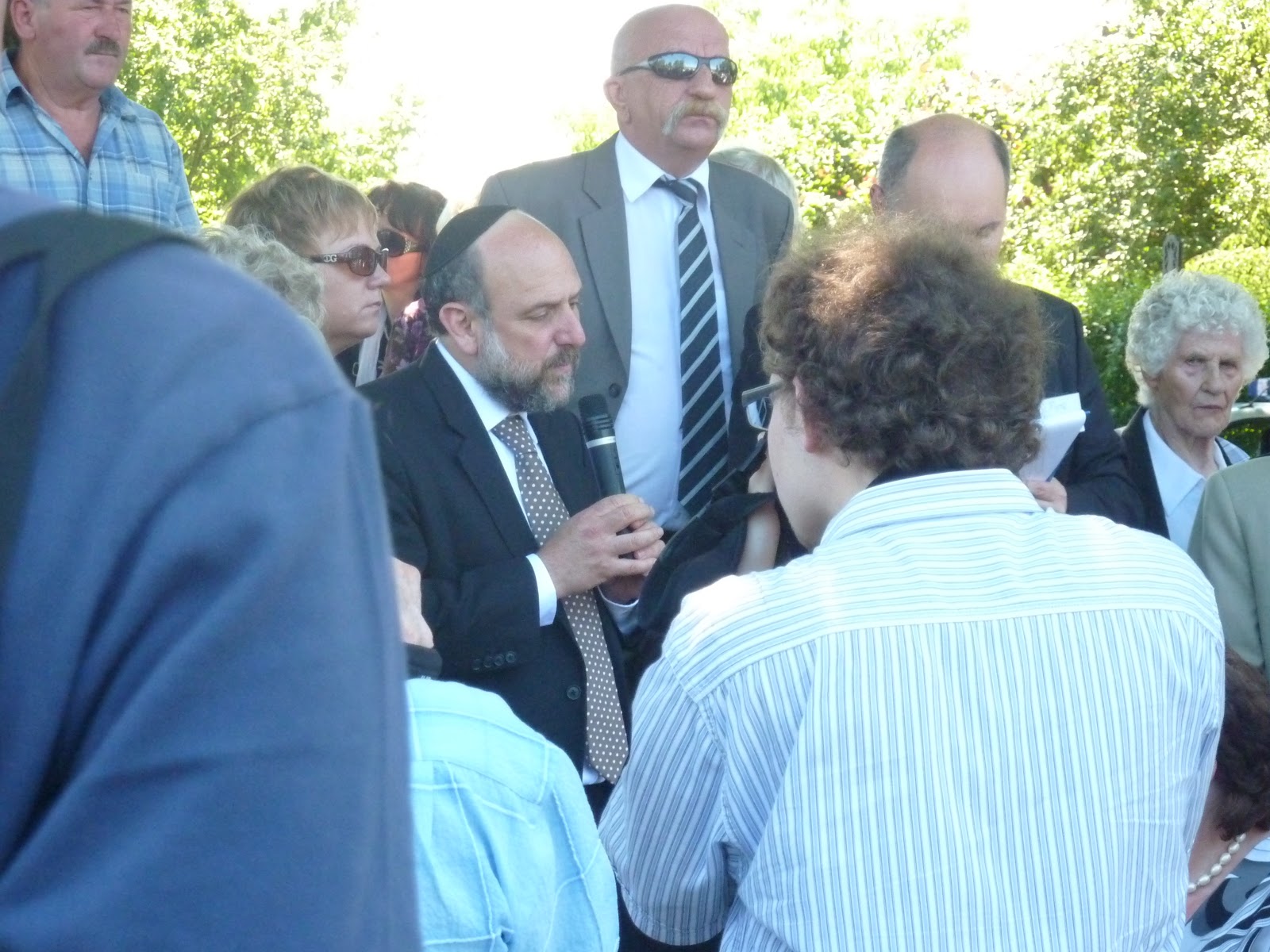
Chief Rabbi of Poland, Rabbi Michael Schudrich, taking part in the commemorations
After this we travelled to a local school where a magnificent lunch was put on for us and we were welcomed by local dignitaries. Students from the creative arts department put on entertainment based on their own work created in memory of the Jewish people who had lived and died in the area. We were greeted with Hebrew words and poems and songs about vanished neighbours and a need for tolerance. Professor Webber has initiated an annual prize for the work of the most creative student and last year’s winner put on a PowerPoint presentation of his travels to Greece, paid for by the prize. This year five students were awarded scholarships, financed by an elderly survivor who had been hidden by a local farmer.
Then, the most gruelling event of the day: in temperatures nearing 40 degrees, we climbed up into the Podzamcze forest outside the town of Kołaczyce. Here, on another sweltering day on 12 August 1942, 260 Jewish men, women and children were brought to this lonely place from Brzostek, Kołaczyce and the nearby villages to be brutally murdered and then buried here in a mass grave. Then, as in forests all over Poland, the evidence was covered over. An unknown person at an unknown time had placed a stone there marking the site of this mass grave. Now, in co-operation with the Gmina of Kołaczyce, a new memorial has been created by the Brzostek Jewish Heritage Project, funded by Professor Webber and other descendents of the Jews of this area. It retains the old memorial stone but now covers the full extent of the mass grave. Although a rough path into the forest had been prepared, in the heat of the afternoon, the climb into the forest almost defeated many of us. It was the need to pay homage to those so cruelly murdered there that drove us on.
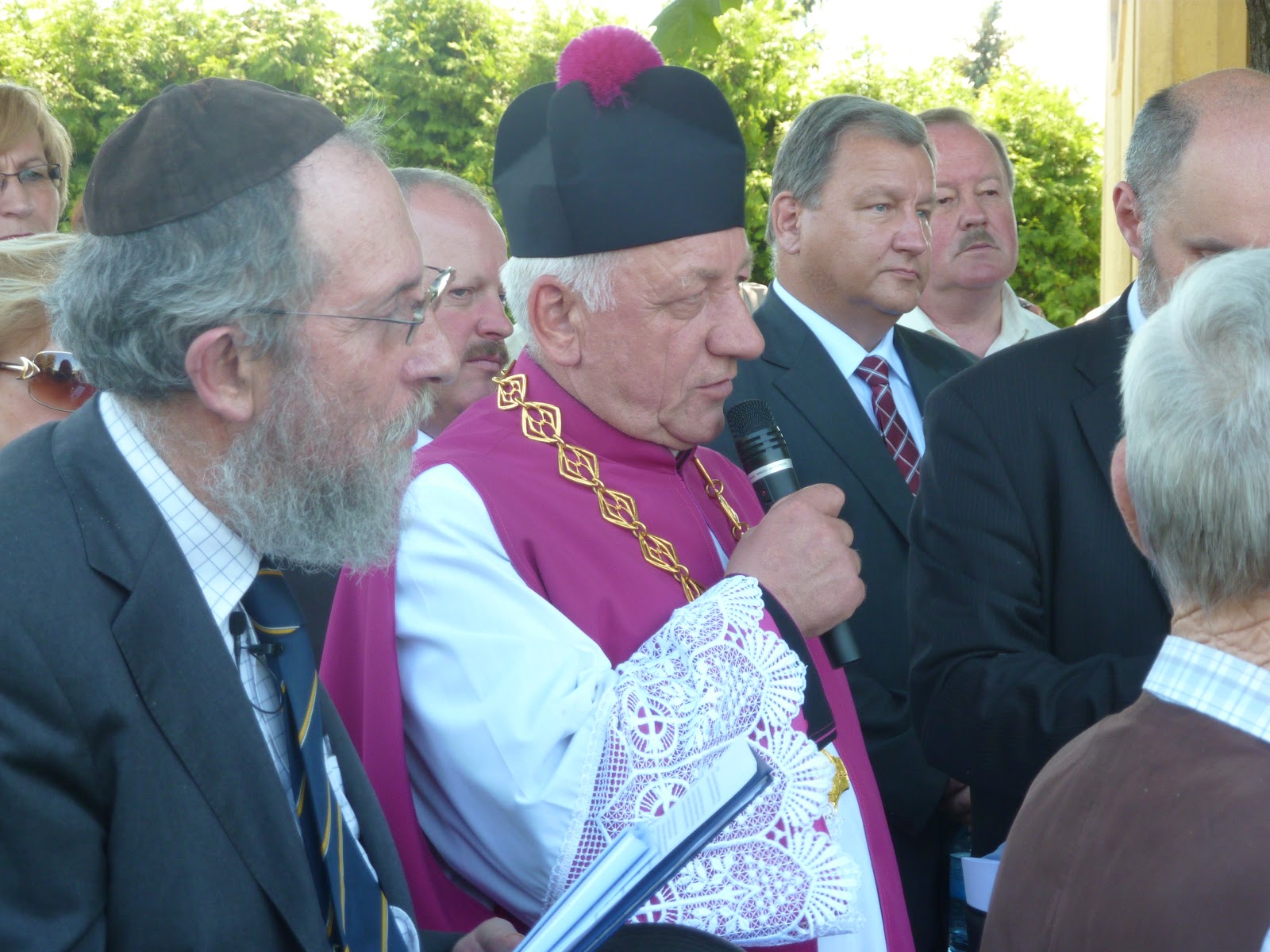
Prayers at the Catholic cemetery
Throughout these commemorations, we walked openly as a group of Jews. Nowhere did we encounter any evidence of hostility. In every place we were welcomed by the local mayor and local people walked with us. In Tarnów, with only a handful of Jewish visitors, it was local people who filled the seats at a play based on the testimony of the last commander of the Jewish uprising in Warsaw. At a concert in front of the Bimah, the only relic remaining in the town of its many synagogues, again there was a full house of locals who clapped hands enthusiastically in time with the Yiddish music. I sat next to a tiny lady beautifully dressed in Roma costume – another part of Tarnów’s population decimated by the Nazis. In the woods of Zbylitowska Góra, a Bishop stood alongside an orthodox Jew. In the Jewish and Catholic cemeteries of Brzostek and the forest of Podzamcze the Dean of the Parish, Father Dr Jan Cebulak, and the Chief Rabbi of Poland, Rabbi Michael Schudrich, stood side by side. Jews recited their prayers, Catholics theirs. In our tradition we placed stones in remembrance of the dead; Catholics placed flowers. Two communities united in remembrance of the horrific fate of the Jews of that area.
 The British and Irish Association for Holocaust Studies