
ISSY SAWKINS
Issy Sawkins is a first-Year PhD student based at the University of Exeter, investigating the instrumentalisation of Holocaust memory in the Russian Federation. Through examination of cultural artefacts, both domestic and international, she examines how the Russian state pushes a particularly nationalist rhetoric in order to secure domestic legitimacy and international prestige.
The issue of how one should culturally represent the Third Reich, and particularly the Holocaust, has long been contentious for those in the world of visual arts. Some critics argue that the topic needs to be approached with caution, out of consideration for the suffering of the victims and in order to prevent younger generations from becoming accustomed to shocking events that now represent our European moral benchmark. This is exactly the argument propagated by those who call for the banning of Nazi symbols in the arts, an attempt to eradicate one of the most recognisable signifiers of the totalitarian regime.
But what is really to be gained from banning such symbols? It doesn’t change the fact that the events of the Holocaust, and some of the individuals who perpetrated them, were indeed affiliated with the Nazi Party. Are we just being too sensitive and refusing to openly confront our past? Surely in this era, in which far right-wing activism is on the rise in Europe, we should encourage ourselves and others to critically engage with far-right activism from our past, including symbols from the era, both literal and figurative. George Santayana’s quote indeed rings true here: ‘Those who do not remember the past are condemned to repeat it’.1
The attempt to airbrush Nazi symbols out of history has most recently been noted in the advertising material for the Netflix film Operation Finale. Starring Oscar Isaac and Ben Kingsley, the film explores the Mossad agency’s 1960 mission to extract Adolf Eichmann, the man who had ‘organised the planned extermination and destruction of the Jewish race’, from Argentina.2 Having been tipped off that Eichmann had not in fact died in the collapse of Nazi Germany but was living in Latin America under a false identity, Mossad felt morally obliged to locate the Nazi criminal and transport him to Israel, where he would stand trial for ‘crimes against the Jewish people’ and ‘crimes against humanity’ under the Nazis and Nazi Collaborators (Punishment) Law.3 Eichmann, the ‘one man who had been concerned almost entirely with the Jews, whose business had been their destruction’, would finally be held accountable for his crimes.4Despite issues regarding the legality surrounding his abduction and Israel’s right to try Eichmann, the Nazi criminal was ultimately sentenced to death by hanging, which was carried out on June 1, 1962.
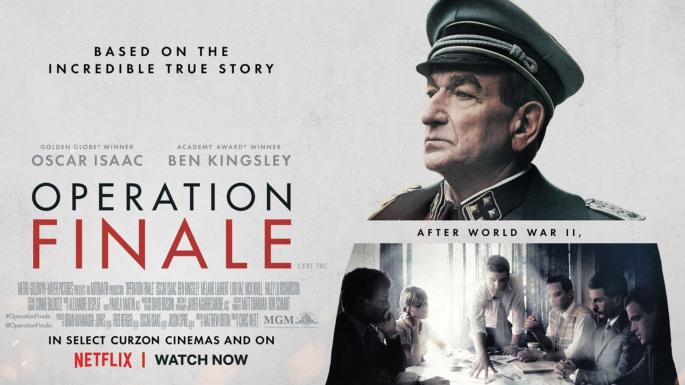
Netflix advertising without the Nazi symbols. Source: The Times
In the lead-up to the film’s release, it was noted that Nazi insignia, such as the eagle clutching a swastika and a skull and crossbones on the Obersturmbannfürher’s cap, had been removed from billboards advertising the production, so as to comply with laws in several European countries banning the showing of such symbols. For example, under German law it is illegal for swastikas and Nazi symbols to be publicly displayed, unless displayed as part of an artistic performance covered by the constitutional guarantee of free speech. Nazi symbols can therefore only be displayed in the film itself, not in any advertising materials.5
The ban also used to be applied to video games, both in the advertising and the games themselves. Swastikas were replaced with the game’s logo, and Hitler was referred to as a ‘chancellor’, without his infamous moustache.6 The law regarding video games has recently softened, however, and provided that swastikas are deemed to be used in a historically-accurate manner, the Entertainment Software Self-Regulation Body has now argued that they may be used in computer and video games.
This ban can be traced back to the end of World War II when, through the process of ‘denazification’, all public symbols of Nazism were removed from West Germany, from the removal of figures of the Nazi power through the Nuremberg trials to the more superficial eradication of Nazi symbols from German buildings. West Germany was ashamed of its past, and the Allies were keen to have this era of abominable acts wiped from the face of history. During the 1950s, the denazification process was furthered through the rendering of dissemination or production of symbols if they were deemed to have originated from unconstitutional parties, such as the Nazis, illegal. The only exception to this law was the world of art, in which such symbols may be reproduced only for the purpose of scientific research, historical purposes or historical accuracy. At the beginning of the 1960s, Holocaust denial was criminalised, yet again a valiant effort to demonstrate German confrontation of the horrors of its past.7
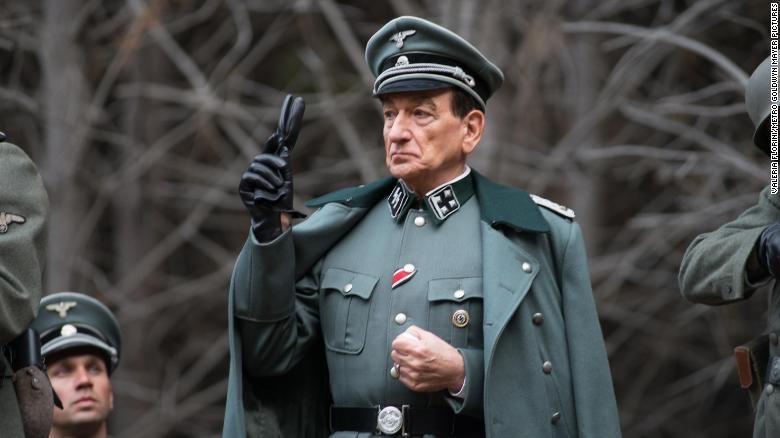
A screenshot from the film, in which the Nazi insignia is visible. Source: Valeria Florin/Metro Goldwyn Mayer Pictures
So, what is to be made of the situation today, in which laws have been laxed for video games, yet continue to be strongly enforced for films? It is understandable that the laws were introduced in the aftermath of the war, a means of distancing the successor state of West Germany from the horrors of its past, but does 21st century Germany need these laws anymore? Some may argue that this development represents a German attempt to show that it is now willing to more openly confront its past – exclusively, seemingly, in video games. Yet others, such as Jeremy Black, will argue that it is actually just a sign of Germany moving with the times; we currently live in a world in which Europe, and therefore the atrocities committed on European soil, are losing their significance and therefore, the symbols of the era may need less regulation.8 I like to think that it is not the case that such a tragic event is already losing its significance less than 100 years after its occurrence…
NOTES
1 George Santayana, The Life of Reason: Introduction and Reason in Common Sense (Cambridge, MA: MIT Press, 2011), p. 172.↩
2 Lawrence Douglas, The Memory of Judgment: Making Law and History in the Trials of the Holocaust (New Haven, CT: Yale University Press, 2005), p. 98.↩
3 H. W. Baade, ‘The Eichmann Trial: Some Legal Aspects’, Duke Law Journal, 61:3 (1961), p. 400.↩
4 Douglas, The Memory of Judgement, p. 97.↩
5 ‘Netflix nixes Nazi symbols from billboards for new Eichmann movie’, The Times of Israel, October 7 2018, https://www.timesofisrael.com/netflix-nixes-nazi-symbols-from-billboards-for-new-eichmann-movie/ [accessed November 23 2018].↩
6 ‘Germany lifts total ban on Nazi symbols in video games’, BBC News, August 10 2018, https://www.bbc.co.uk/news/world-europe-45142651 [accessed November 23 2018].↩
7 Gabby Raymond, ‘Germany Will Now Allow Some Nazi Symbols in Video Games. Here’s What to Know About the History of That Ban’, Time, August 10 2018, http://time.com/5364254/germany-nazi-symbols-video-games-history/ [accessed November 23 2018].↩
8 Jeremy Black, The Holocaust: History and Memory (Bloomington, ID: Indiana University Press, 2016).↩
 The British and Irish Association for Holocaust Studies