MICHAEL HOLDEN
Michael Holden completed a BA (Hons) in English Language and Literature and an MA in English Literature at the University of Sheffield, where he wrote his Master’s thesis on the depiction of Médecins Sans Frontières in the graphic novel form, alongside essays on Holocaust representation. He is currently undertaking his PhD research as a member of the Future of Holocaust Memory Network, which is funded by the White Rose College of the Arts and Humanities, and through which he works closely with colleagues from the Universities of Leeds and Sheffield.
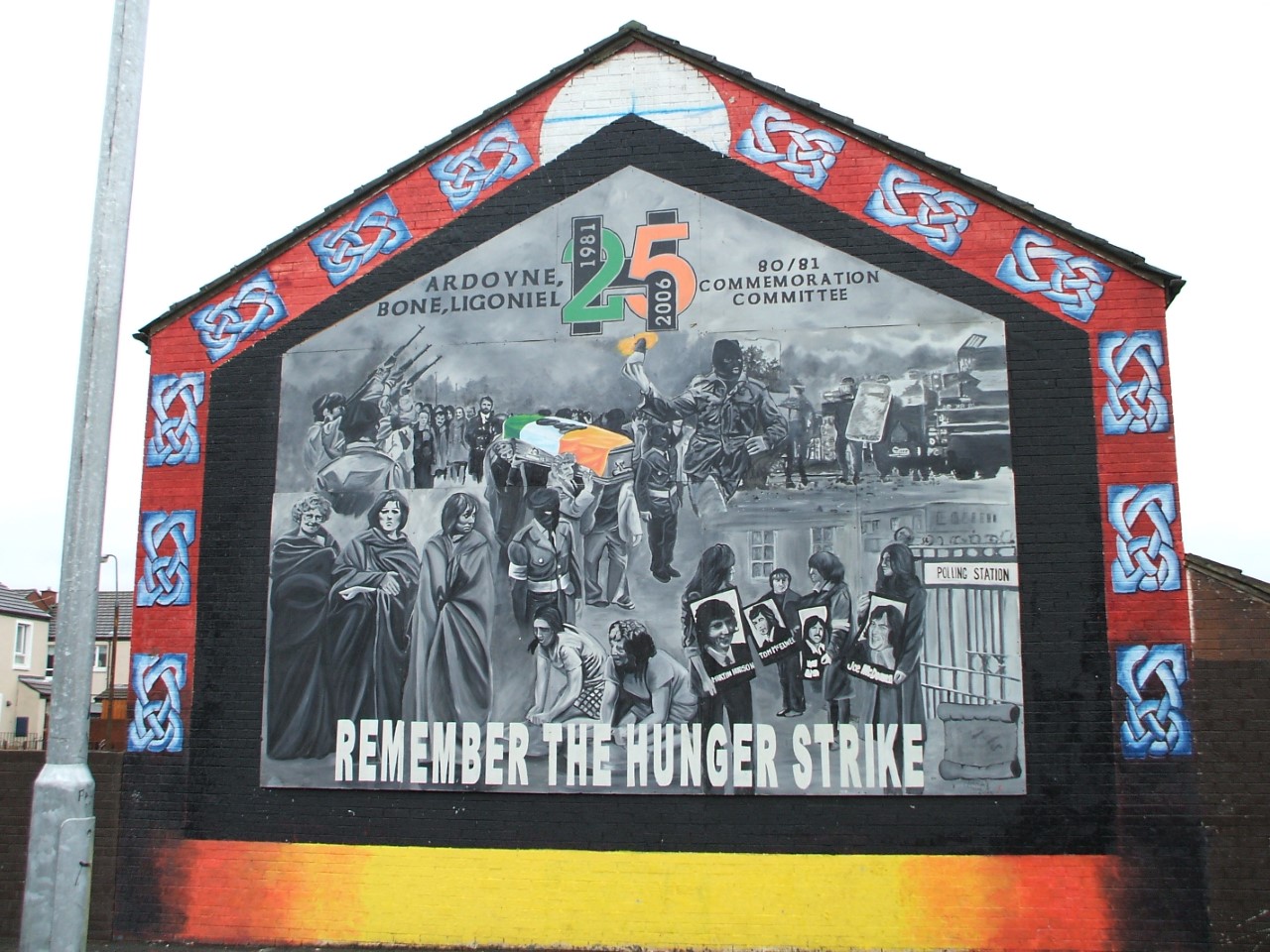
Anna Burns’ recent Booker Prize-winning novel Milkman is a tale of gender politics and political strife. It weaves together the minutiae of daily life and social interaction to create a complex narrative that portrays the height of the Northern Irish troubles in the 1970s. The situation it describes is sketched out for us by its 18-year-old protagonist – who remains unnamed – as she attempts to evade the unwanted attentions of ‘the Milkman,’ a prominent local ‘renouncer of the state’ (read: paramilitary) some 30 or so years her senior. A short way through the narrative, Burns’ protagonist recalls her deceased father – a man portrayed as a long-time sufferer of severe depression – who died from an unspecified illness some time before the events depicted in the novel take place. The father met frequently, the protagonist tells us, with a group of like-minded individuals, to discuss and record the significant political events of the day, and to talk about other historical moments of bleak significance, one named example of which is the Holocaust. Here I would like to discuss the manner in which Milkman dramatises two diametrically opposed approaches to the use of historical tragedy as a means of reckoning with contemporary disaster and atrocity. Ultimately, I suggest, the novel finds both approaches to be lacking, and instead illustrates an alternative to each through the progression of its narrative, and its stylistic choices.

The specific naming of the Nazi genocide of the Jews in the midst of a novel in which the reader becomes accustomed to almost nothing and no one being named directly was particularly striking upon first reading Burns’ work; the majority of the naming that takes place in the text occurs through euphemistic allusion and a complex web of nicknames. This mention occurs at a moment at which we learn of the father’s wholesale sense of despair, and its inclusion suggests a kind of homogenisation, or levelling of difference between the tragedy of the Holocaust and the tragedy of the Irish Troubles. The father and his friends (described collectively as ‘brooding, obsessive and overhung with cliffs, crags, ravens, crows and skeletons’ (p.86)) engage in a ‘hyper-engrossment’ with the political reality of life in Northern Ireland, compiling and maintaining minutely-detailed records of ‘everything to do with the political problems’ (p.86). Following his frenzied ‘scrapbooking,’ we are told, the father would invariably ‘sink down deep again into despondency’ at which point
…all he’d be fit for…would be his bed, the hospital, his comics, his sports pages, or those Holocaust programmes on the TV. Natural disaster programmes too, such as David Attenborough talking about insects eating other insects and ferocious wildlife pouncing upon gentle wildlife (p.87)
Here, the Holocaust and animal death are consumed alongside comics and sports pages, almost as a kind of light entertainment. This regimen of viewing and reading, notes the protagonist, ‘didn’t cheer him up’ (p.86). Rather, this habit serves to induce ‘some sense of ‘See! Look at that. What’s the point? There’s no point,’‘ therein offering the protagonist’s father a comforting, ‘solacing’ affirmation of his view that ‘there couldn’t be triumphs and overcomings because overcomings were fancies and triumphs were daydreams, effort and renewed effort a vain waste of time’ (p.86). Clearly, it is suggested, the convergence of the father’s fragile mental state and general sense of despair at the surrounding situation entail a bleak levelling of difference between – and, in some sense, a striking desensitisation to – tragedies. The Holocaust, cannibalistic insects, the Troubles, the sports pages; these things appear equally woven into the homogenous background of the father’s life. For this man, who is portrayed as absorbing quantities of information with little critical differentiation, it appears that the world is a wholly hopeless place.
Burns offers us an equally striking counterpoint to the father’s worldview in the form of the protagonist’s mother, a woman who ‘didn’t get depressions’ and who ‘didn’t tolerate them’ (p.85). According to the ‘onwards-and-upwards talk’ of the novel’s principal matriarchal figure, ‘legitimate people’ do not ‘succumb’ to their despair (p.86). The protagonist outlines the difference in her parents’ perspectives as follows:
So with da and his type, unlike ma and her type, it wasn’t a case of ‘I must be cheerful because of the Holocaust’ or ‘I’ve a boil on my nose but yer man down the street’s missing a nose so I must be cheerful he’s missing a nose whereas I’m not missing a nose and he must be cheerful because of the Holocaust.’ With da it was never ‘Must get down on knees and give thanks that others in the world are suffering far worse than me’ (p. 87-88)
The contrast here is stark. The mother explicitly invests in a ‘hierarchy of suffering,’ here illustrated by the use of the Holocaust as a kind of yardstick of maximum despair, which illustrates (in rather extreme, albeit practically-focused, day-to-day terms) an individualised version of the kind of ‘zero-sum game’ of memorialisation that Michael Rothberg seeks to disavow in his work, Multidirectional Memory. According to the mother, ‘There are some people…with much more reason for psychologicals, with more cause for suffering than those who help themselves to suffering – but you don’t see them giving in to darkness, giving in to repinement’ (pp.85-86). With respect to the specific example of the Holocaust, between the two parent-characters Burns dramatizes an extreme view of the uniqueness of the event on the one hand (the mother’s ‘hierarchy of suffering’) and a bleak and heavily exaggerated interpretation of work like Rothberg’s on the other – the father’s world view appears to recall scholarly anxieties around the levelling of difference between the Holocaust and other events in the context of multidirectional, or transnational/transcultural memory. In each case, the event is instrumentalised, and employed as a tool, of sorts, with which to interpret the specific political situation depicted in the novel.
The protagonist initially appears to have some sympathy for her father’s position; she notes of her mother’s view that, ‘[if] life worked like that then all of us – except the person agreed upon to have the most misfortune in the world – would be happy, yet most people I knew weren’t happy’ (p.88). Nonetheless, I would contend that the novel at large is deeply sceptical of both of these extreme positions, and offers a more nuanced view on the possible role of history in contemporary contexts. On the one hand, it appears to slough off the weight of the father’s heavy and hopeless despair through its repeated examples of individual and collective community action, large and small, as a means of improving daily life, or at the least, restoring equilibrium. To give but three examples, Burns tells us how, in defiance of a draconian curfew imposed by the army, mothers and children of the depicted area take to the streets at the restricted time – standing around talking, hanging out washing, playing in the roads, going to the shops – in such volume that the authorities have little choice but to abandon the new rule; likewise, after a newly-formed local feminist discussion group draws the ire of the local paramilitaries by inviting to their meetings a speaker from ‘over the water,’ a large force of unconnected local women band together to directly challenge the wrath of the local men through a desire to keep the peace; finally, the mother’s friend ‘the real milkman’ (as opposed to the titular paramilitary stalker) offers an example of a character who is deeply concerned for the welfare of the community and acts accordingly, often in defiance of the local paramilitary group. These examples suggest the importance of action (yet they remain finely balanced with examples of actions that are regarded as foolhardy and dangerous), and thereby disavow the homogenising hopelessness expressed by the protagonist’s father.
On the other hand, the novel’s form suggests a disavowal of the mother’s ‘hierarchy of suffering.’ It has been noted that ‘[reviewers] have seen [Milkman’s] erasure of names as an ascent to ‘universalism’, a portrayal of any ‘totalitarian’ society at any time, anywhere’ (Toal, 2018); this ‘ascent to universalism’ is a vital tool in Burns’ ‘condemnation of tribalism and inner-community surveillance and control…[and] attention to the still underplayed dynamics of gender inequality during the Troubles, in particular women’s vulnerability to a predatory violence at once psychological and physical’ (Toal, 2018). Tribalism, inner-community surveillance, and gendered violence are features that might well apply to any number of historical atrocities, and Burns investigates the mechanics of such things in detail in Milkman. While crafting a near-fantastical narrative world in their strangeness, the ‘surreally generic set of signposts’ that tends to replace proper nouns in the text also lend themselves to a disturbing, psychologically real account of day-to-day life under the pressure of an extreme situation – in its surreality and often-extreme coding it reminded me, at times, of the portrayal of Nazi bureaucracy in Jiří Weil’s Mendelssohn is on the Roof, or even the enciphered narrative of the island of W in Georges Perec’s W: Or, the Memory of Childhood (Toal, 2018).
Ultimately, Milkman fully accords with neither parent’s perspective on the Holocaust, and by extension, their views on the narrative’s present tense. Many of its characters avoid the trap of blanket despair in the face of both history and their contemporary moment, while its language does seem to suggest the value of investigating shared features that may be common to other historical events, not least the ever-present inner-community surveillance that blights the text. In each of the protagonist’s parents, Burns presents us with a vastly different example of how not to make use of history as a means of interpreting the present.
References
Burns, A. Milkman. London: Faber and Faber, 2018.
Rothberg, M. Multidirectional Memory: Remembering the Holocaust in the Age of Decolonization. Stanford: Stanford University Press, 2009.
Toal, C. “Milkman by Anna Burns: putting Ardoyne on the literary map.” Irish Times, last modified October 16, 2018. https://www.irishtimes.com/culture/books/milkman-by-anna-burns-putting-ardoyne-on-the-literary-map-1.3664420.
 The British and Irish Association for Holocaust Studies